
You are here
News Feeds
Gravitational waves may have created dark matter in the early universe
TOI-201 Planets Are Wobbling Out of Our Line of Sight
It turns out that even after studying our solar system in depth and discovering more than 6,100 exoplanets across more than 4,500 exoplanetary systems, not all solar systems are created equal. The longstanding notion is that planets orbit almost entirely in the same orbital path, also called an orbital plane. But what if an exoplanetary system was found to have exoplanets that not only orbit in different planes, but also exhibits changing behavior regarding when they pass in front of their star?
JWST Hunts for an 'Earth-Moon' Twin in a Habitable Zone, But the Star Has Other Plans
The Moon has played a huge role in the development of Earth. It stabilizes the planet, tempered dramatic climate swings, and possibly even provided the tidal heating that might have led to the first life forms. So it’s natural we would want to find a similar Earth/Luna system somewhere else in the cosmos. But astronomers have been searching for one for years at this point to no avail. And a new paper from Emily Pass and her colleagues at MIT, Harvard, and the University of Chicago describes using the James Webb Space Telescope to track some of the most promising exomoon candidates - only to be foiled by the star they were orbiting.
Colibre: A New Cosmic Simulation With Cinematic Flair
The new Colibre cosmological simulation includes more critical detail than previous simulations. It also includes updated models of things like AGN feedback and star formation. The simulations also include a sonic component, giving the results a cinematic and information-rich flair.
Gravity's strength measured more reliably than ever before
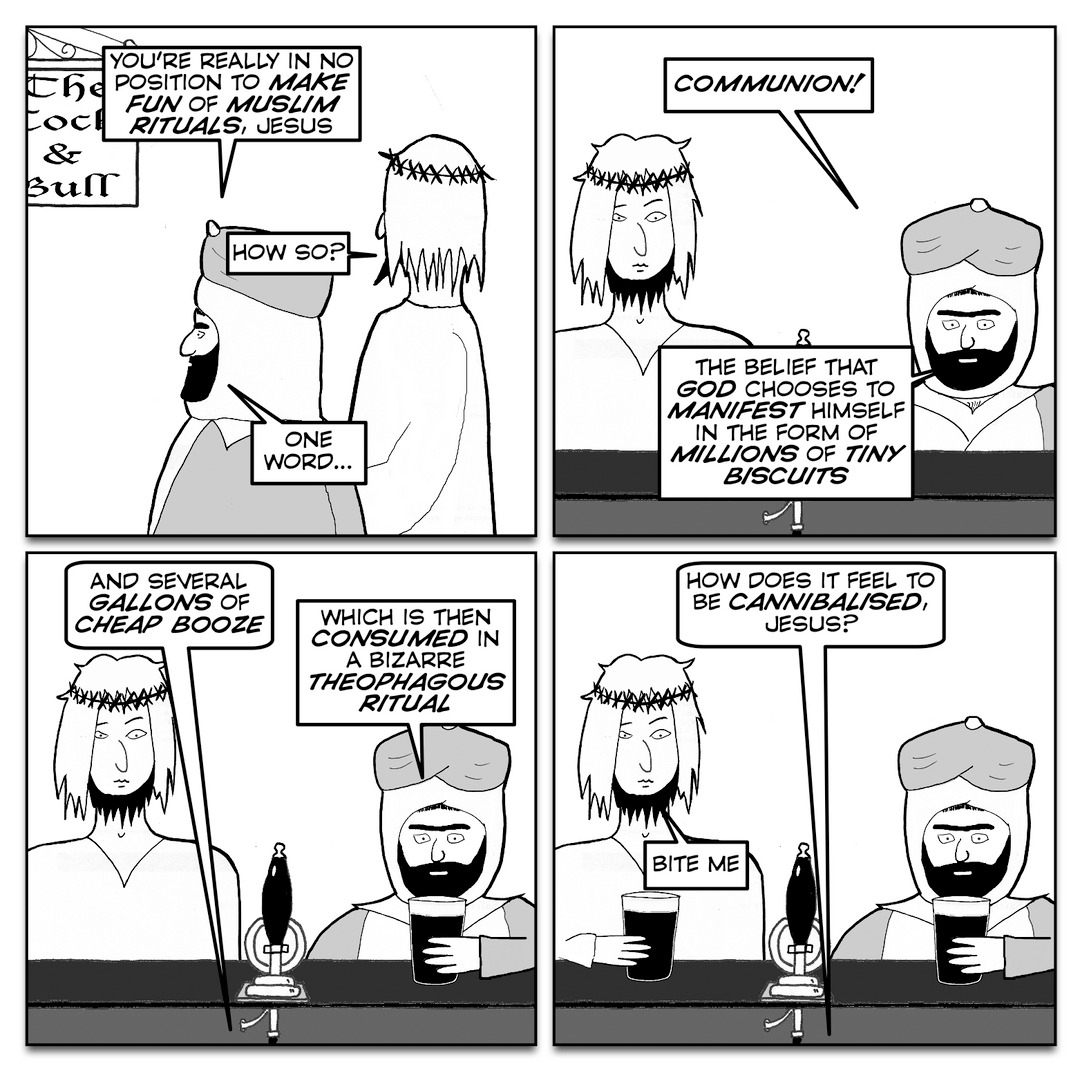
Jesus ‘n’ Mo ‘n’ crackers
This week’s Jesus and Mo strip, called “bite2”, is new but came out a bit late on Wednesday. In response to last week’s criticism of Islam, Mo now gets the chance to make fun of Christian ritual. He does a good job, but Jesus gets the last word.
Desmond Morris (1928–2026): A Keen Observer of the Human Condition
Zoologist by career, TV celebrity in the 1960s, renowned surrealist painter, and bestselling author of more than 70 books, Desmond Morris left a legacy that enlightened our species, answered taboo questions, and made audiences around the world look at behavior with renewed eyes. This is a tribute to one of the greatest observers of human behavior.
He never shied away from controversy. His first popular book, published in 1967, proclaimed on its cover what at the time was seen as offensive: that we humans are “naked apes.” The logic was compelling: if one were to place close to 400 primate species side by side, a quick visual inspection would reveal that the most notorious difference is the general lack of body hair in humans. Not intelligence, not language, not technology. That was the beginning of his effort to spoon-feed society a lesson in evolutionary humility: there is nothing insulting in seeing humans as animals; every species is extraordinary in its own way.
Going back to that book, in his 1979 autobiography Animal Days, Morris recounts the 30 days he took to write the whole manuscript for The Naked Ape on a typewriter, without editing—an astonishing result by any measure. The book spread fast not only because of its provocativeness, but because the world got to experience what descriptive, entertaining, and compelling writing can do when science merges with audience-centered prose. With over 20 million copies sold, it still stands among the 100 bestselling books in history.
Desmond’s curiosity was unstoppable, and it can be traced back to his unusual rise in academic science through the study of animal behavior. His Ph.D. began with small fish, sticklebacks. While his mentor Niko Tinbergen—the man who showed him there was a path for studying animals without putting them in cages through ethology—was adamant about the importance of specializing in a single species, Desmond rebelled against that idea. That was his character. He then expanded, in his postdoctoral studies, to birds, particularly the small finch. By this time his basement at the university had become overcrowded with multiple species, and there was even an aviary on the department’s roof. No fewer than 84 species passed through his lab during this period at Oxford. He was able to dedicate three full years to the ten-spined stickleback, while exploring variation in other species, fulfilling his tendency to be a “spreader”—to broaden his interests too much.
Out of academia, Morris became curator of the largest collection of mammals at the renowned London Zoo, sharpening his observations across more than 300 species. His insatiable curiosity pushed him to want to know everything there was to know about every mammal. He later focused on our closest relatives, non-human primates, such as Congo—the chimpanzee he taught to paint and whose works ended up in the hands of world-class painters like Picasso and Miró. Again, non-human primates were only a pitstop before the next stage, an obvious one to him: humans.
Once The Naked Ape skyrocketed, Morris moved to Malta, where he enjoyed the pleasure of spending his earnings and living a comfortable life. There he realized something that we may better understand from the flip side: “The city is not a concrete jungle, it is a human zoo.” Under that premise, he published what could be seen as a follow-up to The Naked Ape, called Human Zoo (1969), where he revisits controversial topics of status, sex, and power. From this work, his commandments of dominance are priceless. He lists the behaviors that, in primate species, are associated with gaining and defending power and status, like “make changes even if no change is needed to demonstrate that you are in control” or “a leader should display his position in their demeanour.” All his work cultivated a unique view of the human animal through the lens of ethology, or through Desmond’s eyes.
Then, motivated by his book editor, Morris began the odyssey that he never finished. It started with a simple premise: a full description of the repertoire of human behavior. After a few months of work, his editor asked about his progress, and he said he was covering the eyebrows. To the editor’s surprise, he had started not from the feet but from the top of the head. That was a sign that his dedication to cataloging gestures was going to take him a lifetime, much like the Oxford English Dictionary (OED).
Not coincidentally, Morris moved to North Oxford, to the house of James Murray, one of the main lexicographic contributors to the OED, as if foreshadowing his own intentions. His book originally titled Manwatching (1977), later adapted to the zeitgeist of our times as Peoplewatching (2003), is still, to this day, the most exhaustive and profound description of human behavior. I believe it offers the highest rate of insight per sentence among all the books I’ve read, and I have called it the bible of human behavior. Ten years later Morris produced another version of that project, this time focused on areas of the body, covering each one through biology, anatomy, culture, and behavior, called Bodywatching (1985). For the serious human observer, these two are indispensable guides.
But Morris knew that the journey was longer than a book. The human repertoire of behaviors cannot be compressed into a trade book. He kept collecting behaviors, labeling them one by one. He had to coin names for many of them, because code-to-elbow or nose-to-forehead behaviors are not commonly described in ordinary language. His approach aimed to solve the natural ambiguity of behavior, so he used descriptive labels to avoid subjective interpretations. His encyclopedia of human actions, titled The Human Ethogram, reached at least two thousand entries by the time he decided to let it go. Now those archives sit at the University of Porto, at the Museu de História Natural e da Ciência, where at some point they may be compiled into one of those posthumous manuscripts worthy of Desmond’s legacy.
Morris’s success transcended writing, probably inspired by the admiration he held for Julian Huxley, a trailblazing biologist who broke scientific etiquette by appearing in mass media. Desmond became a celebrity-like figure with his weekly TV show Zootime. Each week he introduced audiences to different species from the London Zoo, where he worked. The anecdotes are hilarious, and his descriptions of behavior glued audiences to topics they otherwise might have ignored. He developed a charismatic presence that evolved further in his documentaries.
Over his life Morris ended up writing three autobiographies, each time adding new elements, culminating in his more than 600-page 2006 memoir, Watching. This book is as funny as a comedy, and it has the depth and texture of stories that let you enjoy and learn in equal parts. In it, Desmond shares an observational palate so rich that he successfully predicts winners of sumo fights, accidentally receives a papal blessing from Paul VI, and is mistaken for British intelligence in Moscow.
Since 2017, I have had the great good fortune to be in regular contact with Desmond Morris. We exchanged ideas, discussed a few gesture interpretations, like the elbow clapping, and he revealed that his favorite animal was the chequered elephant shrew. He kindly wrote a letter of recommendation for my Ph.D., gave me a few signed books, and invited me to dinner with his family in Ireland. I conducted one of the last interviews with him.
Desmond Morris with the author, Alan Crawley.Over these years I asked Morris many questions. Among them was: “If you have to give a single recommendation to those interested in studying nonverbal behavior, what would it be?” Here is Desmond Morris’s insightful response (personal communication, 03/03/2021):
With body language studies, it is my impression that there is often too much abstract theorizing and semantic debate, when we should be getting out in the street conducting field studies. The question I would ask any student of human behavior is “How many hours of field observation have you done?”, not “How many theoretical papers have you written?” How many riots, bar-fights, pop concerts, boxing matches, art auctions, festivals, law courts, beach parties, military parades, religious gatherings and sporting events, have you attended as an objective, body language observer?Desmond had in mind Tinbergen’s warning about his tendency to spread too thin across multiple problems and numerous species, a signature of his identity. That tension lived in the two sides of his personality: scientific researcher and popularizer. Those identities wrestled within him, and both appear relentlessly in his work and demeanor. For example, in Oxford Morris bought the neighboring house to accommodate his collection of more than 20,000 books. Intrigued by how many of them he had actually read, I asked. His answer was revealing:
I can’t remember the last time I read a book cover to cover.That line reveals the tradeoff between scope and depth. Morris consumed texts across domains, ages, and styles, allowing him to create unique compilations of facts organized under a single ethological framework, something that could only have been achieved by an unsatisfied curious mind that pursued one question and then moved on to the next. Such an approach may increase the likelihood of stating inaccurate claims, and some people use Desmond’s mistakes as a convenient excuse to discard the rest of his ideas. That is a dishonest and unfair approach. He was a prolific well of novel ideas: where others saw laughter, he saw an evolved mechanism of tension; where Freud saw sexual fixation, Morris described behavioral relics that increase in frequency under discomfort.
Awards and prizes were not his motivation. He was never interested in being knighted as a Sir. Someone of his accomplishments would have been a strong candidate for such recognition. I once asked him about this, to which he replied in his unique humorous manner:
I have made enough rude comments about the authorities and about politicians to ensure that my name is safe from that nonsense. And The Naked Ape won’t have helped.Morris was well aware of the consequences brought on by the depiction he made of the human animal. Those depictions may have reached their widest audience through his TV documentaries, like The Human Animal, a fantastic visual portrayal of human behavior across more than 40 cultures.
Desmond enjoyed his competing interests—writing and painting—which occupied his mind deeply throughout the day. In his words:
There are two Desmond Morrises, and they are quite different people. I can easily pass from one to the other, but I cannot be both at the same time. When I'm Desmond Morris the painter, I am quite different.... There is rarely any clash between the two aspects. The one helps the other. I obey the two sides of my brain alternately.Morris’s legacy is gigantic. Beyond more than 12 books on human behavior, he produced books on the behavior of dogs, cats, horses, primates, bison, leopards, and owls. Yet his impact on surrealism was far more than a hobby. Not only were books like The Lives of Surrealists (2018) influential, but, more importantly, in 1950 his paintings were exhibited in galleries alongside Joan Miró. He was an accomplished surrealist painter and filmmaker. If you have read Dawkins’ most famous book, The Selfish Gene, you may have encountered one of his paintings, since Richard himself chose one for the cover.
Until his last days he kept painting and writing. In perspective, he was an outlier who reached the highest level in two incredibly different professions through sheer excellence. And that excellence was cultivated over time, until the end.
For the past five years, he shared in his emails that he woke up with the desire to write and paint—a man in his late 90s who continued relentlessly to enjoy his daily work. Someone who, at the age of 95, published three books in a single year. This year he was also doing two gallery exhibitions of his paintings. That was Desmond: an unstoppable force of passion and curiosity.
Thanks, Desmond. We will continue watching for you.
See the Moon Occult Regulus for The Americas Saturday Night
Much of visual astronomy requires nothing more than clear skies, keen eyes, and patience. If you’re out skywatching Saturday evening and live in North or South America, watch for the waxing gibbous Moon pairing with Regulus at dusk. For a privileged region, the Moon will actually blot out or occult the star, in one of the best-placed lunar occultations of a bright star for 2026.
Astronomers may have found a strange new kind of cosmic explosion
Savannah: Day 6
It was a lazy day today, with one visit to an architectural/history site and then one big and delicious meal. After we had a leisurely breakfast and did our ablutions, it was nearly 11 a.m. We then walked the ten blocks to the Owens-Thomas House and Slave Quarters:
The Owens–Thomas House & Slave Quarters (originally known as the Richardson House) is a historic home in Savannah, Georgia, that is operated as a historic house museum by Telfair Museums. It is located at 124 Abercorn Street, on the northeast corner of Oglethorpe Square. The Owens–Thomas House was designated a National Historic Landmark in 1976, as one of the nation’s finest examples of English Regency architecture.
Renovations in the 1990s uncovered and restored one of the oldest and best preserved urban slave quarters in the American South.
. . . The house is notable for its early cast iron side veranda with elaborate acanthus scroll supports on which the Marquis de Lafayette addressed the citizens of Savannah on his visit in 1825.
The house was built between 1816 and 1819, designed by the architect William Jay of Bath and financed and occupied by Richard Richardson. It was then purchased by attorney and politician George Welshman Owens, who was briefly mayor of Savannah and later a U.S. Representative.
The Owens family lived in the house for a while, but after some decades turned it into a boarding house, which is when Lafayette stayed there on his final visit to America on the 50th anniversary of the American Revolution—in which Lafayette played a huge role.
In 1951 the family turned the house over to the Telfair Academy of Arts and Sciences , which still owns it (I visited the other two parts of the Museum on my first day here).
The sign below gives pretty much the same information above.

The front of the house (I forgot to photograph the famous balcony). When Lafayette, an abolitionist, visited Savannah in 1825, the town kept all the slaves inside, along with the free blacks, so they wouldn’t be incited by Lafayette’s antislavery sentiments.

The back garden of the house, designed to be completely symmetrical. In the rear are the slave quarters. This is only part of them: the small house held 12 people, and there were a bit more than 20 enslaved people working for the white residents.

This sign was in the slave quarters, explaining why the guides and many of the signs used the terms “enslaved people” instead of “slaves.”

Inside the quarters, which slept at least twelve people, though many of the enslaved, like the cook and those who took care of the chlldren, slept inside the big house.

The dining room. Food was cooked in the basement, and since there was no dumbwaiter it was carried on trays up two floors from the basement and put in the butler’s pantry before being served.

The butler’s pantry was a small room, with four empty bottles of wine sitting on the sideboard. As the tour moved on, I picked up one of the bottles and saw what’s below: a bottle of Barton and Guestier bordeaux—from 1870! I’d never held a wine bottle that old before. And this chateau is still going strong; it was founded in 1725.

The structural material of the house was tabby, an equal mixture of sand, burnt oyster shells, water, and ash. It was an early form of concrete, and was quite durable. As you see, the tabby was covered with wood paneling.

This room was presumed to be the library/study, though now they’re unsure what all the rooms were used for.

This is presumed to be the oldest son’s bedroom.

And a mirror, at the bottom of which you can see a selfie of Professor Ceiling Cat (Emeritus):

The (presumed) master bedroom, now a word that’s out of favor for obvious reasons (I can’t remember what it’s supposed to be called now).

After the tour we walked home and then got in the car to drive to a restaurant I’d scoped out as a likely prospect: great food, not overly expensive and, most important, Southern. Yes, we went to Erica Davis Lowcountry. It turned out to be all I hoped for, though if you drove by this place you wouldn’t think to go in. But you’d be making a mistake if you didn’t.

We split two appetizers. First, oysters Rockefeller made with local oysters. Wikipedia describes the dish this way:
Oysters Rockefeller is a dish consisting of oysters on the half-shell that have been topped with a rich sauce of butter, parsley and other green herbs, bread crumbs, and then baked or broiled.
There were also collard greens, cream. and Parmesan cheese. It was scrumptious—the first time I’ve had this dish. With all that garnish you could still taste the oysters, and I love oysters. You’d think the dish would be too busy with all the ingredients, but the flavors mingled perfectly.

Another Southern classic: fried green tomatoes, these with feta cheese and balsamic vinegar reduction.

The menu was so full of good stuff (see the link above) that I asked the waiter what she recommended. Without question she mentioned the shrimp, which are local, fresh, and delicious. So I got a half pound of boiled shrimp. They came with clarified butter, shrimp sauce, and two sides (I chose cheese grits and deep-fried okra). And oy, were those shrimp good! I ate the shells, of course, as all good shrimp lovers do.

Tim had the Wassaw redfish, described as “pan-seared redfish filet, garlic beurre blanc, heirloom tomato, stone ground grits, fresh green beans.” He pronounced it excellent.

Betsy had two crab cakes along with green beans and cole slaw. As expected, the cakes were almost all lump crabmeat, with just a small amount of filling to hold them together. With a little bit of the sauce on the crab, it was a Platonic version of this dish.

And my Southern dessert: the third helping of banana pudding I’ve had on this trip—this time served in a Mason jar. This was the fanciest version of all I’ve had. As you can see, it’s topped with whipped cream dusted with vanilla wafer crumbs, with a whole wafer on the side. (Banana pudding sans vanilla wafers is unthinkable.) Then there’s a layer of banana pudding, then a layer of cake, and then a bottom layer of pudding with chunks of banana. This was the best version I had on this trip, and probably the best version I’d ever had. (I’ve eaten it many times, often with BBQ or a meat-and-three plate in the South.)
The meal was terrific, not very expensive, and prepared with great care. I’d recommend this place very highly to anyone who visits Savannah.

Symptoms of early dementia reversed by bespoke treatment plans
QBox theory may offer glimpse of reality deeper than quantum realm
Is stem cell therapy about to transform medicine and reverse ageing?
The MAHA Amnesia Project
The same disinformation agents who are trying to erase the history of the pandemic, are also trying to erase the history of MAHA.
The post The MAHA Amnesia Project first appeared on Science-Based Medicine.Interstellar Comet 3I/ATLAS Left a Trail of Methane in its Wake
A new analysis of data obtained by JWST on 3I/ATLAS as it was on its way out of the Solar System (in December 2025) showed that its interior is rich in methane ice.
New Research Reveals That Interstellar Comet 3I/ATLAS Formed in a System Far Colder Than Our Own
The interplanetary comet 3I/ATLAS is remarkably rich in a specific type of water that contains deuterium, meaning it came from somewhere colder and with lower levels of radiation than our early Solar System.
This Bathtub Ring of Minerals is More Evidence for an Ancient Warm, Wet Mars
NASA's MSL Curiosity rover found a bathtub ring-like deposit of zinc, manganese, and iron in Gale Crater. These metals precipitate out of water in the right conditions, and there's not really any other way they could've become concentrated here. Adding to the excitement, these deposits also form in lakes on Earth, where the concentrated metals are food for some types of bacteria.
Largest-ever octopus was great white shark of invertebrate predators
Do you need to worry about Mythos, Anthropic's computer-hacking AI?
The Most Energetic Neutrino Ever Detected Could Be Primordial
Neutrinos are very difficult to detect. And when they are detected, pinpointing their sources is likewise difficult. New research shows that the most energetic neutrino ever detected must have had an extraordinarly energetic source. It could even be primordial.
Pages
