
You are here
News Feeds
RFK Turns Food Pyramid On Its Head
Last week I wrote about the new vaccine schedule under RFK, which reveals his process. He doesn’t appear to have one. Our HHS secretary is shooting from the hip, ignoring expert advice, and trusting only his own conspiracy-addled instinct. He quickly followed with his take on the food pyramid, echoing unscientific nonsense he has been spouting for years. This also reflects another […]
The post RFK Turns Food Pyramid On Its Head first appeared on Science-Based Medicine.Jesus ‘n’ Mo ‘n’ equivocation
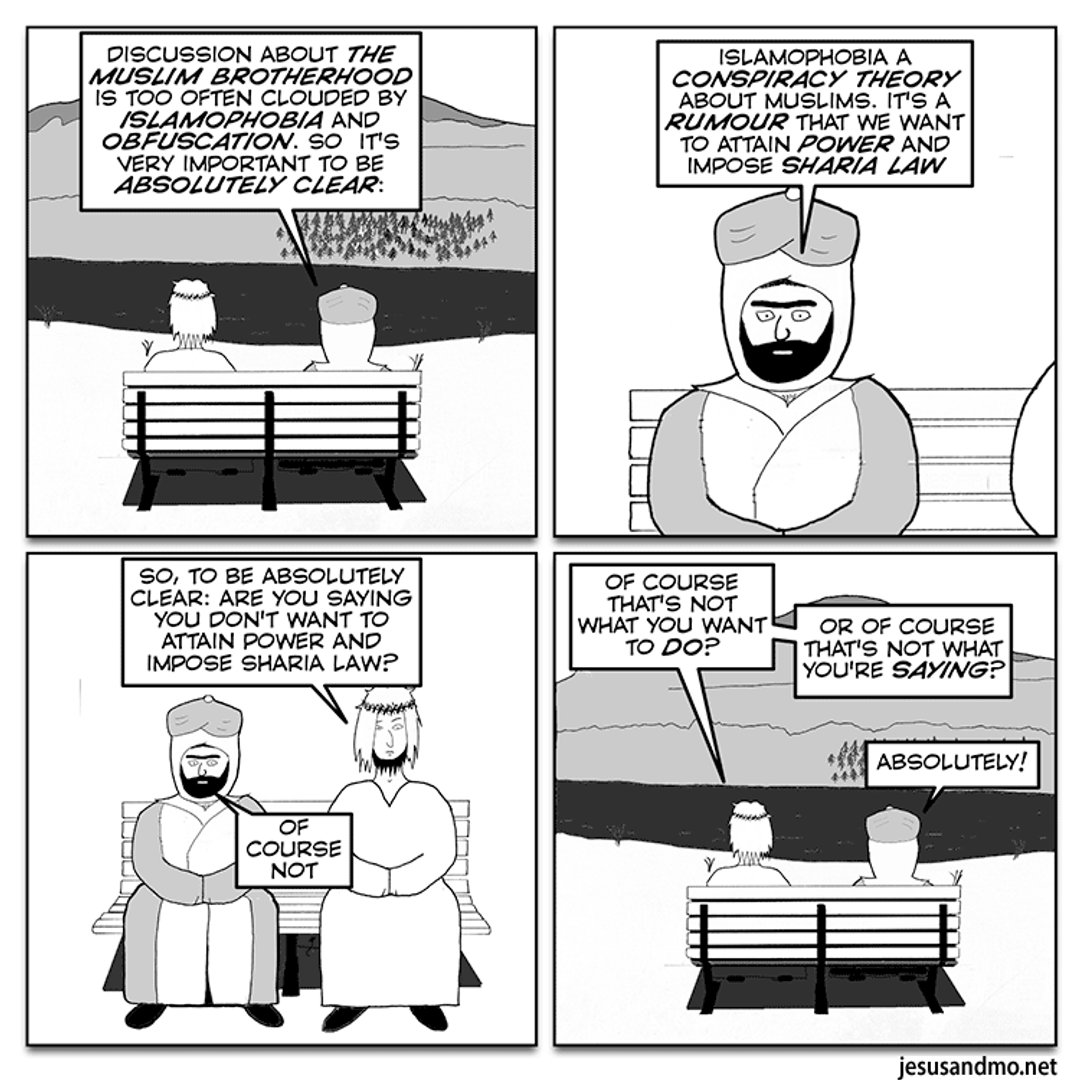
Today’s Jesus and Mo strip, called “absolutely,” came with a terse comment from the artist: “Thanks for clearing that up, Mo.”
Peering Below Callisto’s Icy Crust with ALMA
What exists beneath the surface of Jupiter’s icy moon, Callisto? This is what a recent study accepted by The Planetary Science Journal hopes to address as a team of researchers investigated the subsurface composition of Callisto, which is Jupiter’s outermost Galilean satellite. This study has the potential to help scientists better understand the interior composition of Callisto, which is hypothesized to possess a subsurface liquid water ocean, and develop new techniques for exploring planetary subsurface environments.
Readers’ wildlife photos
In the last readers’ wildlife photo feature I have, James Blilie has appeared with some black and white photos. His captions are indented, and you can enlarge his photos by clicking on them.
Here are another set of landscape photos that I have converted to black and white for posting to a black and white Facebook group. I am having a lot of fun having another “go” at older images in B&W. Over the last 15 years or so, my software skills for editing photos have improved dramatically. Since I “came from” the perspective of shooting Kodachrome slides (everything was fully captured when I pressed the shutter button), I at first resisted the idea of using photo-editing software after I switched to digital. That was a mistake. Editing images is critical (like editing most other works).
These are from all over and many are scanned 35mm slides or negatives.
Three images for Jasper National Park and Mount Robson Provincial Park in Canada, September 1981. All scanned B&W negatives.
Beaver Lake on the Jacques Lake trail in Jasper National Park:

Summit Lake with figure, on the Jacques Lake trail in Jasper National Park:

Mount Robson from Berg Lake at dawn. One of the great mountain views of the world. I lugged the Rolleiflex and a tripod up to Berg Lake. To be young and strong again!:

Next a photo from September 1982, also scanned B&W negative: Taking a break from long canoeing days in the Boundary Waters Canoe Area Wilderness in far northern Minnesota:

Next, a few from my days of mountaineering in my youth, all scans from film originals:
An image I call The Thinker, taken at a camp at around 8200 feet elevation (2500m) on the south side of Mount Stuart in Washington state en route to the summit. 1984,
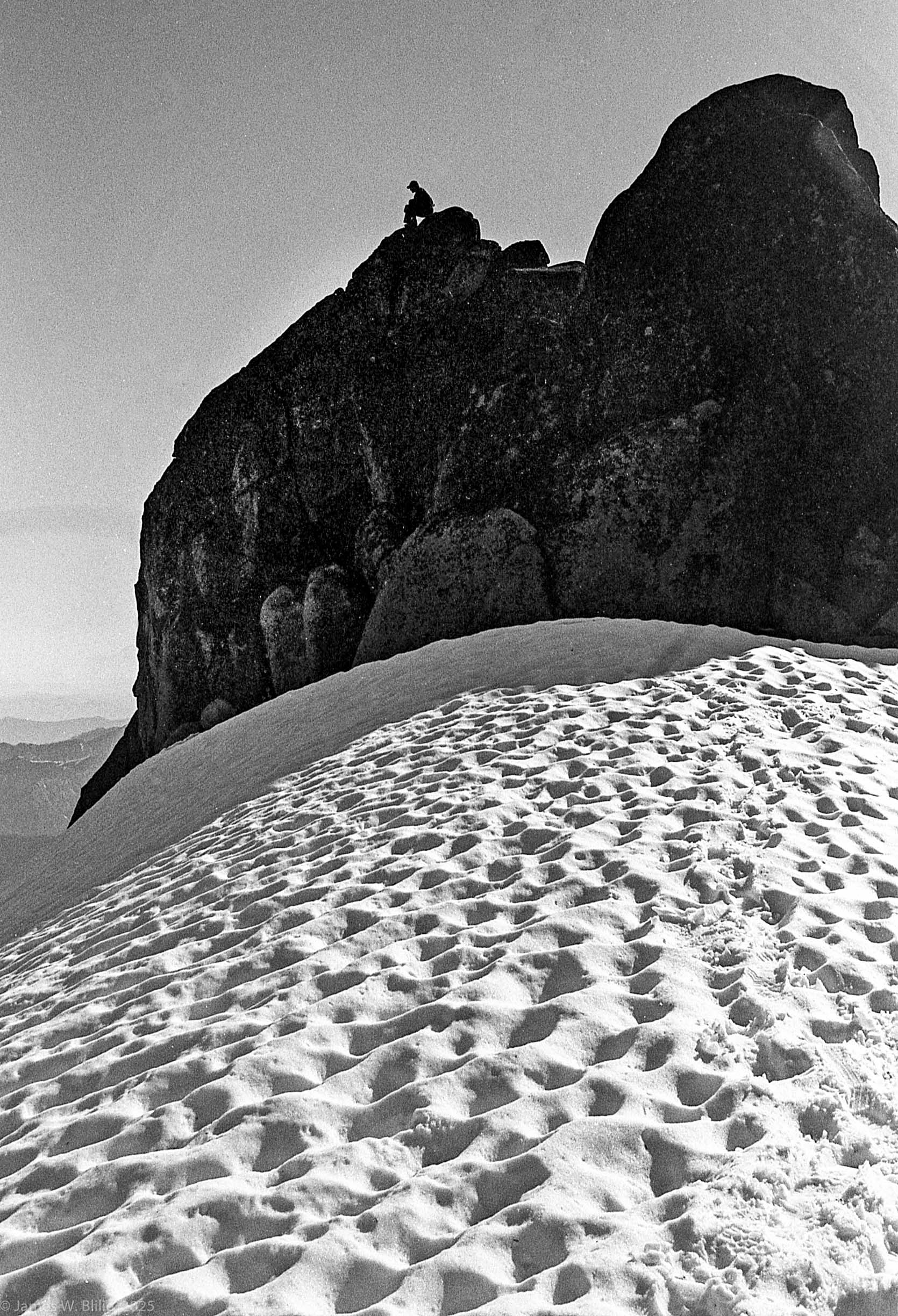
Climbers on the north ridge of Mount Adams, Washington state, with Mount Rainier in the background. 1987. I have climbed Mount Adams, now visible outside my office window, three times, always by the more remote, less-frequented North Ridge:

Climbers on the Easton Glacier on Mount Baker, Washington state, 1989:

Next, a photo taken in Kathmandu, Nepal, 1991, scanned Kodachrome 64:

A photo taken while backcountry skiing in Gairbaldi Provincial Park, north of Vancouver, BC, 1988:

A photo of skating tracks on the frozen pond behind our former home in Minnesota, 2013:

A photo from the Mission San Juan Capistrano, California, February 2023:

Finally, a photo taken in Seattle, in the vicinity of the Ballard Locks, March 2023:

Equipment:
Pentax K-1000, ME Super, and LX cameras and various Pentax M-series and A-series lenses
Rolleiflex 6cm roll film camera with Schneider 75mm f/3.5 lens that my Dad bought in Germany in 1950 and passed on to me in the 1980s
Olympus OM-D E-M5 micro-4/3 camera and various Olympus Zuiko and Leica lenses for that system
Software: Lightroom 5
Scanner: Epson V500 Perfection (current model is V600, I think. An excellent scanner.
China has applied to launch 200,000 satellites, but what are they for?
Follow SpaceX's Returning Crew-11 Mission Wednesday Night
In a historic first, an unspecified medical issue is prompting an early return from the International Space Station on Wednesday night, January 14th. And while the return will be featured live online from undocking to splashdown, if skies are clear, you might just be able to see the pair crossing the night sky tonight, shortly after undocking.
T. rex took 40 years to become fully grown
Three ways to become calmer this New Year that you haven't tried (yet)
We must completely change the way we build homes to stay below 2°C
Sooner-than-expected climate impacts could cost the world trillions
The Surprising Heat of Early Clusters
Astronomers using ALMA have detected the earliest hot galaxy cluster atmosphere ever observed, revealing a massive reservoir of superheated gas in the infant cluster SPT2349-56 just 1.4 billion years after the Big Bang. The gas is far hotter and more pressurised than current theories predicted for such a young system, forcing scientists to completely rethink how galaxy clusters evolved in the early universe. This discovery suggests that violent processes like supermassive black hole outbursts and intense starbursts heated these cluster atmospheres much earlier and more efficiently than anyone expected, fundamentally challenging our understanding of how the universe’s largest structures formed.
How Black Holes Slowly Starve Galaxies
Astronomers using the James Webb Space Telescope and ALMA have discovered one of the oldest ‘dead’ galaxies in the universe, revealing that supermassive black holes can kill galaxies through slow starvation rather than violent destruction. The galaxy, nicknamed ‘Pablo’s Galaxy’, formed most of its 200 billion solar masses of stars between 12.5 and 11.5 billion years ago before abruptly stopping, not because its black hole blew away all the gas in one catastrophic event, but because it repeatedly heated incoming material over multiple cycles, preventing fresh fuel from ever replenishing the galaxy’s star forming reserves.
When Baby Stars Throw Tantrums
NASA’s Hubble Space Telescope has captured stunning new image of HH 80/81, a pair of objects created when supersonic jets from a newborn star slam into previously expelled gas clouds, heating them to extreme levels. These jets, powered by a protostar 20 times more massive than our Sun, stretch over 32 light years through space and travel at speeds exceeding 1,000 kilometres per second, making them the fastest outflows ever recorded from a young star.
These small lifestyle tweaks can add a year to your life
Young Stellar Objects Are Prominent In A New Hubble Image
A disparate collection of young stellar objects bejewels a cosmic panorama in the star-forming region NGC 1333 in this new image from NASA’s Hubble Space Telescope. To the left, an actively forming star called a protostar casts its glow on the surrounding gas and dust, creating a reflection nebula. Two dark stripes on opposite sides […]
Siwarha's Wake Gives it Away at Betelgeuse
Betelgeuse is the star that everybody can't wait to see blow up, preferably sooner than later. That's because it's a red supergiant on the verge of becoming a supernova and there hasn't been one explode this close in recorded human history. It's been changing its brightness and showing strange surface behavior, which is why astronomers track its activity closely. Are these changes due to its aging process? Do they mean it's about to blow up? Probably not.
New Evidence That An Ancient Martian Ocean Covered Half The Planet
Mars Was Half Covered by an Ocean susannakohler33808 Mon, 01/12/2026 - 12:00 Mars Was Half Covered by an Ocean https://mediarelations.unibe.ch/media_releases/2026/media_releases_2026/mars_was_half_covered_by_an_ocean/index_eng.html
The hunt for where the last Neanderthals lived
Two Movies on One Screen: Conflicting Narratives of the Renee Good Shooting in Minnesota
Anyone following recent events in Minneapolis has likely noticed something strange. People watching the same videos, reading the same headlines, and reacting to the same street-level events often seem to be describing entirely different realities. Conversations quickly break down, not because people disagree about what should be done, but because they cannot even agree on what is happening. It’s as if people are watching two completely different movies on one screen.
The “two-movies-one-screen” concept was first coined by Scott Adams, the creator of Dilbert turned political commentator, to describe radically different interpretations of the same political events. People with access to the same set of facts come away with completely different understandings of what is happening. In some cases, each side seems genuinely unaware that the other interpretation even exists.
This is not merely disagreement, and it goes beyond ordinary bias. It is also not quite what psychologists usually mean by cognitive dissonance. Cognitive dissonance, first described by Leon Festinger in the 1950s, occurs when people experience psychological discomfort from holding conflicting beliefs or encountering information that contradicts their existing views, and then attempt to reduce that discomfort through rationalization or reinterpretation of the facts. In cases like the Renee Good shooting in Minnesota, however, something else seems to be happening. So, what is going on?
From a psychological standpoint, this resembles dissociation more than cognitive dissonance. Dissociation refers to a class of mental processes in which certain thoughts, perceptions, or experiences are kept out of conscious awareness. As clinical psychologists have long noted, dissociation functions as a defensive mechanism, shielding the individual from information that is experienced as overwhelming or intolerable. The mind does not reject the data after evaluating it. It fails to perceive it in the first place.
The following is an attempt to provide a neutral description of the events, followed by two very different interpretations.
On January 7, 2026, in Minneapolis, Minnesota, 37-year-old Renee Nicole Good was fatally shot by an Immigration and Customs Enforcement (ICE) agent during an operation targeting undocumented immigrants for deportation. Good was a U.S. citizen and mother of three from previous relationships, and present on the scene with her wife, Rebecca (Becca) Good.
Multiple videos from bystanders, body cameras, and agent phones capture the event, showing a chaotic scene lasting about three minutes.
0:00 /0:47 1×ICE Agent’s Cellphone Video (Credit: Alpha News)
Renee Good was in her SUV, which was blocking or near the path of ICE vehicles during an arrest operation. Agents approached, giving conflicting commands: some ordered her to leave, while others demanded she exit the vehicle. One agent attempted to open her door and banged on the window.
Rebecca Good, Renee’s wife, was outside the vehicle filming and confronting agents.
At one point during the interaction, Renee’s wife urged her to “drive, baby, drive” as the situation escalated. Good maneuvered the vehicle forward and started to accelerate. The vehicle made contact with an ICE agent who was positioned in front; the agent fired through the windshield, striking her in the face and killing her.
0:00 /0:39 1×Bystander Video (Credit: Nick Sortor)
According to official statements from ICE and the Department of Homeland Security (DHS), the shooting occurred after Good allegedly used her vehicle as a weapon, attempting to run over an agent who then fired in self-defense. Renee and Rebecca Good were part of “ICE Watch” groups monitoring, protesting, and interfering with ICE operations. The ICE agent who fatally shot Good was injured and hospitalized following a prior incident in June 2025, during which an undocumented immigrant with an open warrant for child sexual assault dragged him with his vehicle while attempting to flee arrest.
0:00 /4:26 1×Bystander Video 2 (Credit: @Dana916 via X.com)
Progressive voices view Good’s killing as an example of ICE overreach, law enforcement brutality, and systemic abuse of power, especially against citizens exercising First Amendment rights. They emphasize Renee was a “legal observer” and had a constitutional right to protest. They further note that Good was an unarmed American citizen on a public road who was fatally shot in the face and head by a masked federal agent. They also interpret the footage as showing Good attempting to navigate away from the scene rather than intentionally trying to harm the agent. They further warn against normalizing state killings, such as in statements made by Rep. Alexandria Ocasio-Cortez (D), who responded to Vice President JD Vance’s defense of the ICE agent by calling it a “regime willing to kill its own citizens.” This sentiment is tied to broader concerns about police/ICE militarization against undocumented immigrants, and observations such as that even if Good erred (e.g., by not complying with instructions of federal law enforcement officers), it wasn’t worth her life, and society needs a higher bar for lethal force.
Conservative commentators frame the shooting as justified self-defense against anti-ICE radicals who disrupted lawful operations. They emphasize Renee’s alleged aggression and Rebecca’s role in escalating the situation by shouting “You wanna come at us? Go get yourself lunch, big boy,” portraying the couple as part of a coordinated harassment campaign rather than passive observers or demonstrators. They also argue Good was an active participant and perpetrator obstructing enforcement of long-standing immigration law, and someone attempting to flee from the scene rather than simply a citizen attending a protest. They maintain that the shooting was tragic, nevertheless law enforcement (and citizens) can use lethal force if they reasonably believe they face imminent serious harm. Further, they make the following distinction: debating whether the officer should or should not have fired is rational, but refusing to acknowledge that being struck/pushed by a vehicle is basis for self-defense isn’t.
These conflicting media narratives matter because most people do not build their understanding of the world through direct experience. Our personal encounters are limited. The rest of our mental model is assembled from stories. Indeed, research in cognitive psychology and media studies consistently shows that humans rely heavily on narrative to organize information and assign meaning. In other words, we are not natural statisticians. As psychologists such as Jerome Bruner and Daniel Kahneman have shown, people reason intuitively through stories, examples, and emotionally salient cases, often treating mediated experience as a stand-in for reality itself. This is why propaganda is most effective when it does not look like propaganda.
Many people assume propaganda is something obvious that you notice and argue with. In reality, the most powerful propaganda works through repetition rather than persuasion. Social psychologists have documented what is known as the “illusory truth effect,” in which repeated statements are more likely to be judged as true, regardless of their accuracy. When a moral narrative is replayed often enough, it stops feeling like a claim and starts feeling like memory.
Consider the recurring portrayal of tech executives in films and television. A wealthy founder speaks in vague abstractions, dismisses ethical concerns, and pursues profit at the expense of ordinary people. The specifics vary, but the moral structure remains the same. Whether any individual depiction reflects the reality of modern technology firms is almost beside the point. After repeated exposure, viewers absorb not just a critique of corporate excess, but an intuitive framework for interpreting innovation, wealth, and motive. Repetition trains audiences to assign intent instantly and to stop questioning it.
This works because fiction bypasses our analytical defenses. Experimental research on narrative persuasion shows that people are less likely to counterargue when they are emotionally absorbed in a story. Psychologists refer to this as “transportation,” a state in which attention and emotion are captured by a narrative, making viewers more receptive to its implicit assumptions. We do not fact-check television dramas. We empathize with them. Their moral premises are absorbed quietly as background knowledge.
For most of us, the names Jeff Bezos, Elon Musk, Mark Zuckerberg, or Peter Thiel evoke an immediate moral impression. But how did that impression evolve? Have you, for example, ever heard them speak at length or know how they run their companies? Do you understand what motivates them? Do they have a good sense of humor?
There is also a structural problem with storytelling itself. Everyday reality, especially everyday crime, is usually chaotic, senseless, and narratively unsatisfying. Criminologists have long observed that much violent crime lacks coherent motives or moral meaning. Writers, understandably, select stories that feel legible, purposeful, and emotionally engaging. But those selections shape our expectations of reality and thus our perception, and make us see otherwise messy events as morally clearer than they actually are.
The result is a moral universe in which certain kinds of harm are treated as profound moral ruptures, while other kinds are treated as routine or unfortunate facts of life. Violence committed by some characters is framed as a social crisis demanding urgent moral response. Similar violence committed by others is portrayed as tragic but unremarkable, something to be managed rather than interrogated.
A clear example appears in the pilot of The Pitt. A dramatic subway assault is immediately interpreted through a moral lens before basic facts are known. The graphic depiction gives viewers the feeling that they are seeing something raw and unfiltered. At the same time, the narrative structure carefully guides inference and sympathy. In the same episode, a different shooting is treated as mundane and procedural. It carries little moral weight and prompts no larger reflection.
The show is not depicting reality. It is presenting a moral map.
This does not require a conspiracy, and it does not require malicious intent. Many writers openly acknowledge that fiction shapes social norms and expectations. Cultural theorists from Walter Lippmann to contemporary media scholars have noted that narratives function as “pictures in our heads,” guiding perception long before conscious judgment enters the picture. What is new is the growing cultural distance between those producing these narratives and the audiences consuming them, combined with a strong confidence that the moral direction of society is already settled.
When this kind of storytelling dominates, it does more than persuade. It trains perception itself. Viewers learn what to notice, what to ignore, and which conclusions should feel obvious. Over time, alternative interpretations stop feeling like interpretations at all. They begin to look irrational or delusional.
This is how “the other movie” disappears.
♦ ♦ ♦
A functioning society does not require agreement on every issue. It does require a shared reality. When large groups of people cannot even see what others are responding to, debate becomes impossible. You cannot resolve disagreements if one side experiences the other as hallucinating.
The answer is not counter-propaganda, and it is not simply more facts. Research on motivated reasoning shows that facts alone rarely change minds when perceptions themselves are structured by narrative. What is required instead is closer attention to how stories shape perception. What they highlight. What they omit. And how repetition turns fiction into intuition.
Was Renee Good heroically intervening in an unlawful abduction and a victim of reckless police violence? Or was she someone who interfered with a lawful enforcement action and nearly ran over an officer? Each interpretation feels obvious to those who hold it, and nearly invisible to those who do not. If you analyze both long enough, you might start to see the narratives and the chain of events that lead one to interpret this particular incident in a particular way after watching the exact same three minutes of video.
Skepticism, properly understood, is not just about questioning explicit claims. It is about examining why certain narratives feel natural, why others feel unthinkable, and why some movies seem to be playing on the screen while others are never seen at all.
Discussion post
I have put most of the news in the Hili dialogues, and, frankly, am afflicted with a bad case of Weltschmerz (I believe Dr. Cobb shares my ailment). So today I’m proffering space for you to talk about anything you want, and it need not be limited to the news. I expect many people will want to give their opinions on the ICE killing in Minnesota, but remember that there are huge protests, and thousands of deaths, in Iran, with the possibility of regime change. A government blackout is preventing us from hearing much about what’s happening, but video and messages have been smuggled out. That’s the news I’ll concentrate on in Hili Nooz until things are resolved one way or the other. The Iranian protestors, knowing that they could be shot, are still congregating en masse in the streets of many cities.
Finally, astronauts are coming back to Earth early because one of them has an undisclosed illness.
So talk about what you want, but please adhere to Da Roolz. For this one post I’ll relax the frequency restrictions, so you can make up to 15% of the total comments (about one comment in six). Please try to avoid one-on-one arguments, and be civil, and, if I can add one more thing, don’t keep emphasizing the same point over and over again.
Okay, that’s it. Ready, set, go. . . . and if I get fewer than 50 comments, I’ll be even more depressed.

Pages
