
You are here
News Feeds
Martian Astronomers
A review of Parallel Lives of Astronomers. Percival Lowell and Edward Emerson Barnard by William Sheehan. (Cham, Switzerland: Springer, 2024. Hardcover, 687 pages)
Of the two astronomers whose lives and accomplishments are chronicled in William Sheehan’s Parallel Lives of Astronomers, Percival Lowell was far better known than Edward Barnard. Lowell is famous for having championed the idea that the canals on Mars were built by intelligent beings. The origins of the idea that there were canals on Mars lay in the Italian astronomer Schiaparelli’s report of “canali” on the red planet in 1877. The word is best translated as “channels” but was popularly mistranslated as “canals.” Since in the latter part of the 19th century canals were being built all over the world by intelligent humans, the implication was that the “canals” on Mars were built by intelligent aliens.
A major theme of the book is that Barnard and Lowell in many ways were opposites of each other. Barnard grew up in poverty in Nashville, Tennessee. He became interested in astronomy as a nine-year old working in a photography studio. He received some academic training in astronomy and was a superb and objective observer. Unlike Lowell, his mathematical skills were comparatively weak. Lowell came from an extremely wealthy Boston family and his interest in astronomy began in college. He graduated from Harvard in 1876 with honors in mathematics. The topic of his graduation speech was the nebular hypothesis of how solar systems came together from collections of gas and dust around a sun. These contrasts (and others) between Lowell and Barnard provide an intimate view not only of the two men, but of much of the history of astronomy of the late 19th and early 20th centuries, especially regarding Mars because the two men were at opposite ends of a raging debate among astronomers and the general public on the matter of the nature of the canals.
From a skeptical point of view, the most interesting organizational concept that Sheehan uses is the distinction between top-down and bottom-up processing. He uses this to contrast the approaches used by Lowell and Barnard in their interpretations of what they saw through their telescopes and later in photographs. Lowell was a largely top-down man, starting with an idea and then searching for evidence to support it. Barnard continued to make observations until he believed he had enough data to come to a conclusion. Lowell focused his astronomical interests largely on the canal debate, while Barnard was one of the most productive observational astronomers of his day. The top-down versus bottom-up distinction allows Sheehan to use basic concepts in perception to explain the differences between the two men in their position on the reality of the canals.
Perception is a function of two very different processes that together usually lead to an accurate perceptual experience of the world. Bottom-up processing refers to the incoming sensory inputs from the various sensory systems. These, alone, are not sufficient to specify what is actually out there in the world. Top-down processing refers to the expectations, beliefs, and knowledge that we all have about the perceptual world. These are needed for the brain to interpret and make sense of the information that is brought in by bottom-up mechanisms. Almost always these two sources are in accord and the world is perceived accurately.
Between the series of fleeting images hitting the retina of the observer and the final drawing or description of what the observer saw, the constructive nature of perception has ample room to create perceptual experiences of structures that were not there in reality.However, sometimes expectations, beliefs, and knowledge can be wrong, and the incoming sensory input may be distorted or incomplete. Under these rare circumstances, people can and do actually perceive things that are not there even though they are not intoxicated or psychologically impaired. Thus flying saucers, sea monsters, Big Foot, and the like, are perceived when the sensory input is minimal, often seen in fleeting glimpses at night and in the distance. The Loch Ness Monster never swims up the Inverness River through downtown Inverness at high noon on a pleasant sunny day for vacationers to witness. Final perceptual experiences are a function of the sensory inputs as well as expectations and beliefs. Thus, perception is said to be a constructive process and one that can produce incorrect experiences. The canals of Mars fall directly into this perceptual cognitive model.
Before reading the book, I had the mistaken impression that when looking through a telescope, one saw a fairly stable image of whatever object the instrument was focused on. Nothing could be further from the truth. The image of a planet as seen through a telescope is just a tiny disc of light. To make matters worse, that image is far from stable, especially for the telescopes in use in Lowell and Barnard’s time. The book makes clear how unstable those images could be. Momentary changes in the characteristics of the air above a telescope would make the image waver, fade in and out of focus, and change in other characteristics from moment to moment.
Even when “seeing” was excellent, all one saw were successive glimpses of the target object. Then those glimpses had to be constructed by the brain into a coherent impression of what the target was. Between the series of fleeting images hitting the retina of the observer and the final drawing or description of what the observer saw, the constructive nature of perception has ample room to create perceptual experiences of structures (i.e., canals) that were not there in reality.
Sometimes expectations, beliefs, and knowledge can be wrong, and the incoming sensory input may be distorted or incomplete.Astronomers had known since the early 19th century that such non-sensory factors could influence perceptual judgments in their observations. Thus, different observers reported different times at which a planet or star crossed a line in a telescope reticule. These differences were recognized by the term “personal equation.” But the idea that perception was constructive in the sense that honest observers could perceive structures that were not present had to wait until at least the start of the 20th century before it was recognized.
Following his Harvard graduation, Lowell was expected to go into his family business of highly profitable textile mills. As an intelligent, curious young man he found that prospect stultifying. To make matters worse, he was involved in a serious scandal. He had proposed marriage to a daughter from the sniffy Boston upper crust, but then withdrew the proposal, something that just wasn’t done in that time and place. As a result, Lowell was effectively banned from that elite circle, so in response in the early 1880s he travelled to Japan and Korea and wrote several books on Asian culture and became part of the Korean government delegation to the United States (in 1883). He continued to live in Asia until 1893.
That Lowell continued his interest in astronomy before actively pursuing the mystery of Mars was demonstrated by the “astronomical references and imagery [that] are scattered throughout the Far Eastern books and if gathered together would make a long list” (p. 97). That interest turned into a lifelong obsession in 1892 when he read French astronomer Camille Flammarion’s book La Planete Mars et ses Conditions d’habitabilite, in which the author argued that the “canals” were evidence of an advanced civilization. Lowell was wealthy enough to fund the creation of the Lowell Observatory in Flagstaff, Arizona, which opened in 1894.
In his autobiographical writings, Barnard noted that he became interested in the stars while walking home from work in the dark. One star “seemed to be slowly moving eastward among the other stars.” This struck him as unusual because the other stars “seemed all to keep to their same relative positions,” (p. 121) while this one did not. This was clear evidence of an early careful observer who had, unknowingly, seen not just another star but the planet Saturn. When he was 19 years old, Barnard was given a book written by the Reverend Thomas Dick, who believed that all the planets of the solar system were inhabited. The book included simple star charts that Barnard “rushed to compare with what he could make out in the small patch of sky visible from the open window of his apartment” (p. 126). The book, a later fellow astronomer and friend wrote, “awakened a thirst for astronomical knowledge which … never ceased to be controlling” (p. 126). Around 1880 or 1881, Barnard was given a simple telescope by an older friend at the photography studio where he was still working. He later received a scholarship to Vanderbilt University, but never finished his degree. Such things were less important in the late 19th century, and in 1887 he obtained a position at the Lick Observatory outside of San Jose, California, one of the earliest mountain-top observatories so positioned to rise above atmospheric turbulence and local city lights.
During their long careers, both Lowell and Barnard observed Mars. Their different approaches—top-down versus bottom-up—permeated how they interpreted and represented the image that fell on their respective retinas. Figure 1 (from page 291 in the book) shows this difference beautifully. On top is Lowell’s version of what he saw in 1894, while Barnard’s representation from the same year is below. Overall, the images are similar in general outline. However, Lowell has added to his drawing numerous lines, which he contended were the canals, and details not present in Barnard’s. This is a classic example of constructive perception. Lowell saw similar geometric patterns on Mercury and Venus, although he apparently did not attribute them to intelligent design.
Figure 1. Lowell’s map of Mars from 1894, published in Mars (1895), Plate XXIV. A new projection by Joel Hagen, for comparison with the Barnard map below.A map of Mars compiled on the basis of Barnard’s unpublished drawings from 1894, produced by astronomer-artist Joel Hagen. The projection has been chosen to match the map of Lowell on p. 227, so as to emphasize the striking differences. (Credit: Joel Hagen)While Lowell was seeing things that didn’t exist, Barnard was busy with more fruitful astronomical activities. In 1895 he became a professor of astronomy at the University of Chicago, which gave him access to the Yerkes Observatory in Wisconsin. It was there that he spent the rest of his life and professional career. Wisconsin is not known for warm winters and the observing platform of telescope at Yerkes was not heated. Nonetheless, Barnard would observe almost compulsively, night after night, even in the bitter cold. He was famous for having extremely good eyesight, which made him an excellent observer. During his long career he was an active member of the astronomical community. He made numerous important discoveries including over 15 comets and the fifth moon of Jupiter. Barnard’s Star, whose motion relative to the sun he determined in 1916, was named after him in 2017, although it had been recorded photographically in the 1880s. It is a red dwarf that is one of the four stars closest to Earth.
Perhaps Barnard’s most important contribution is the explanation for what are known as dark nebula, sometimes called “Barnard objects.” When the Milky Way is looked at through a telescope, there are large dark areas that appear to contain no stars. Why certain areas of the galaxy didn’t contain any stars was a mystery. In fact, these areas do contain stars, but their light is blocked by huge clouds of interstellar dust. The understanding of the nature of the dark nebula provided an important insight into the evolution of stars and planets. Another major accomplishment was his photographic atlas of portions of the Milky Way. The work, which is stunningly beautiful, took years to compile and wasn’t published until 1927, four years after his death in 1923.
During his active career Barnard did not ignore the controversial issue of the canals on Mars. He photographed Mars through the great telescope at the Yerkes Observatory in 1909, when Mars was “in opposition” to the Earth—as close as it would be for many years in the future, and was an ideal time for observation and photography. These photographs showed no canals. Barnard was not as vocal in the great canal debate as some other astronomers. It was the brilliant Greek-French astronomer Eugene Antoniadi (1870–1944) who became Lowell’s most serious detractor. Sheehan includes the often acrimonious debates between Lowell and Antoniadi in the story of the contrasts between Lowell and Barnard.
Final perceptual experiences are a function of the sensory inputs as well as expectations and beliefs … perception is said to be a constructive process and one that can produce incorrect experiences.During the time that Barnard was active in astronomical research and writing, Lowell was not inactive. However, his activities and interests were heavily focused on the issue of the canals. He lectured frequently and wrote widely defending his view that the canals were real. He, too, took photographs of Mars through the telescopes at the Lowell Observatory in Flagstaff. But constructive perception works just as well with photographs as it does with images seen through a telescope.
Both Lowell and Barnard made contributions to astronomy; Barnard as a careful scientist and Lowell as a popularizer who inspired many to an interest in astronomy, including Robert Goddard and Carl Sagan. In terms of fiction, Lowell’s argument that the canals were the products of intelligent Martians led to the writings of H.G. Wells and Edgar Rice Burroughs. Sheehan’s book goes into great, but never boring, detail about the lives and work of both men. The book is beautifully illustrated. There are pictures not only of the protagonists as they, to paraphrase Shakespeare, “strut and fret their hour upon the stage” but of their drawings and photographs of Mars and important locations in their stories. It is beautifully produced with copious references and notes. Unfortunately, the publisher did not provide an index, but with the 150th anniversary of Schiaparelli’s observation in 2027, Sheehan’s book is especially resonant.
Frailty can be eased with an infusion of stem cells from young people
Human brain cells on a chip learned to play Doom in a week
Readers’ wildlife photos
Doug Hayes of Richmond, Virginia, has sent some dance photos (H. sapiens in action). Doug’s captions are indented, and you can enlarge his photos by clicking on them.
The most recent photoshoot with Starr Foster Dance. The company is currently rehearsing new choreography for their upcoming show, “Shouting Distance” which will premiere April 9th – 12th at the Firehouse Theater. Once again, my friend Starrene Foster asked the dancers to perform several leaps, some derived from the choreography that will be performed during the show.
The core company members (L to R) Sarah Carrington, Roya Baker-Vahdani, Madison Ernstes, Molly Huey, Shannon Comerford:

A basic group jump. While it looks simple, it took a couple of tries to get everyone off the ground at the same time:

Roya, Molly and Shannon strike a dramatic pose:

Shannon, Roya and Molly:

Sarah and Madison defy gravity:
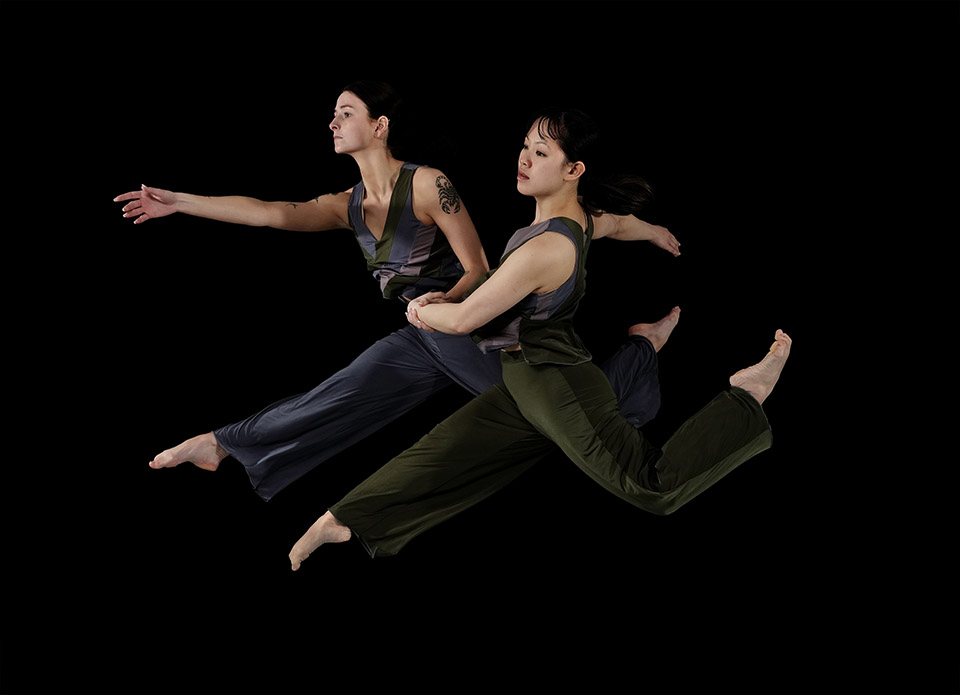
Madison makes it look effortless:

Another incredible leap by Madison:

Roya sitting on air:

An aerial split by Shannon:

Molly gives a new meaning to “high kick”:

Floating through air with the greatest of ease:

Molly does an easy leap:

Starr had an idea to photograph Shannon looking into a hallway. The door was featureless, painted dark gray and the floor where Shannon is standing was the same light gray as the hallway floor and walls. Starr asked if I could make the door look like an apartment door and make the floor hardwood. Rather than spend several hours looking for proper flooring and doors, then doing the tedious compositing in Photoshop, I turned to AI. Google’s Gemini AI has a photo editing feature called “Nano Banana” – I’m not making this up. Nano Banana is incorporated into the latest version of Adobe Photoshop, but one has to pay to use it when editing high resolution images. By logging into Gemini AI directly, Nano Banana is free to use unless you need to use some of the more advanced editing features. It only took two prompts to get the result I wanted and only about three minutes to get the final image. There is a second image featuring Shannon at the door, but the AI made two different-looking doors, and the hardwood floor was different in each. It took about three prompts to get Nano Banana to understand that the doors and floors should match, but it finally “understood” and gave me what I wanted. I have been using AI for the past few months to restore old faded and damaged photos. The results have been amazing and saved hours of tedious retouch work in Photoshop. While AI has gotten better, it still requires human input to correct some errors. In the photo of Shannon, the AI put a doorknob and deadbolt on the right side of the door. Sometimes I wonder if the computers are just screwing with us to see if we notice.

Photo information: Sony A1 II mirrorless camera body, Sony GM 24-70 zoom lens, Westcott 400 electronic flash units, Westcott wireless flash controller. Photos edited with Adobe Photoshop and Google’s Gemini AI. The electronic flash units have a “freeze” mode which fires the flash in sync with the camera which is in burst mode – about 15 frames per second or the equivalent of a 1/10,000 of a second shutter speed. ISO 1250.
A lost moon may have created Titan and Saturn’s rings
Ocean geoengineering trial finds no evidence of harm to marine life
How worried should you be about an asteroid smashing into Earth?
New engine uses the freezing cold of space to generate power at night
Our verdict on Juice by Tim Winton: Australian climate novel is a hit
'If a drug had the same benefits as the arts, we’d take it every day'
Read an extract from Art Cure by Daisy Fancourt
We all harbour 9 secrets and they are eating us up inside
Could a niche 80s technology be the key to better quantum computers?
Why Does Dr. Vinay Prasad Refuse to Answer Questions About His Job Performance at the FDA?
Although he took softball questions from MAHA sycophant Bari Weiss, Dr. Vinay Prasad, a public servant, refuses to leave his safe space to answer tough, but fair questions from credible reporters like Lizzy Lawrence.
The post Why Does Dr. Vinay Prasad Refuse to Answer Questions About His Job Performance at the FDA? first appeared on Science-Based Medicine.Green hydrogen has a hidden problem and scientists may have fixed it
A Method for Extracting Oxygen from Extraterrestrial Soils Just Passed a Major Test
NASA’s Carbothermal Reduction Demonstration (CaRD) project completed an important step toward using local resources to support human exploration on the Moon.
Stem cell patch reverses brain damage in fetuses with spina bifida
America’s Alien Problem: Why We Ignore Common Sense in Favor of Belief
In the span of just weeks, two major U.S. releases captured the nation’s attention: Bugonia, Yorgos Lanthimos’s darkly playful alien tale, and The Age of Disclosure, a documentary staged like science fiction, where whistleblowers insist that nonhuman craft exist and the government is concealing the truth about alien contact. Their timing is not accidental. Both arrived on the heels of the first public congressional UFO hearings in over fifty years, in the middle of a nationwide spike in reported sightings. The All-domain Anomaly Resolution Office (AARO) documented 757 new UAP (Unidentified Anomalous Phenomena) incidents between May 2023 and June 2024—more than in many previous years combined—and some analysts now describe 2025 as the most active reporting year in history. We are not just witnessing reports of the unexplained; we are witnessing the psychic temperature of a country—its anxieties, conspiratorial hunger, and collective imagination—made visible.
At the end of Bugonia, when the alien empress finally speaks—exactly as the conspiracy theorist had foretold—she delivers her verdict to her crew, all of them dressed in strange, animal-like furred spacesuits: “We believe it is over. They have had their time. And in their time they have imperiled the life they share, and so we have decided their time will end.” The aliens then waddle away in eerie unison, and the empress punctures the protective Earth bubble. What follows is an instant apocalypse: humanity wiped out in a scene that resembles the visual language of the Rapture—a sudden and absolute religious experience.
Poster for Bugonia (2025), directed by Yorgos Lanthimos. Image courtesy of Focus Features/CJ ENMBut The Age of Disclosure, Dan Farah’s latest sci-fi-styled documentary production, framed as a serious exposé of government UFO secrecy, ultimately reveals nothing new. It offers no evidence, only a procession of interchangeable older men linked to government or aerospace who repeat secondhand stories about witnesses who said they back-engineered crashed spaceships, recovered “biologics” (the new fancy term for aliens), and looming threats. At the watch party I attended, a few of us sat nonplussed at the end because, although the film insists danger is near, we wondered: danger from what, exactly?
Why are aliens capturing our cultural imagination now?Most alien or UFO reports1 involve sightings of lights, orbs, or spheres that move oddly or swiftly and vanish silently—a pattern that has remained consistent over time. Some observers also report cigar-shaped objects or triangular craft. Many of these phenomena are reported worldwide. In 2025, the National UFO Reporting Center had already logged 2,174 UFO/UAP reports by midyear, a sharp increase from 1,492 reports during the same period in 2024. This rise may reflect the establishment of the AARO and renewed government attention, which have made reporting easier and less stigmatized, not to mention nudging people to look up more and notice what was previously missed (Starlink satellites are often reported as UAPs). Increased public awareness through media coverage, documentaries, and congressional hearings also encourages people to report sightings they might previously have ignored. This explanation, of course, presumes the alien sightings are real. Are they?
An alternative interpretation—commonly referred to as the Psychosocial UFO Hypothesis—traces back to Swiss psychologist Carl Jung, whose 1958 work Flying Saucers: A Modern Myth of Things Seen in the Sky, proposed that UFOs reflect psychic and cultural realities, not extraterrestrial ones.2 Jung suggested that flying saucers emerge in the collective imagination during eras of social disorientation, technological upheaval, or existential threat, functioning as modern myths that carry the weight of collective anxiety and longing. Rather than evidence of literal beings from another world, UFOs become symbols of fear, hope, salvation, or invasion—a projection of what the psyche cannot resolve. From this view, alien encounters are psychologically real even if not physically tangible: They reveal something true about the human mind and the cultural moment, not necessarily the cosmos.
It is unsurprising that UFO sightings are on the rise today. Scholars have observed that UFO reports tend to increase during periods of societal crisis—such as existential uncertainty, geopolitical tension, or rapid technological change—reflecting collective anxieties rather than objective phenomena.3 In times of social distress and distrust, people are more likely to assign meaning or threat to ordinary or ambiguous events. Some psychological-cognitive theories suggest that ambiguous stimuli—lights in the sky, radar blips, or unexplained objects or events—are interpreted through cultural narratives and heightened pattern seeking.4 This is sometimes called the “low information zone,” in which blurry photographs and grainy videos stimulate the mind to fill in the missing spaces or connect the dots into meaningful patterns of an extraterrestrial nature.
We live in a time of deep distrust in politics, corporations, and the media, which makes people question what they are told. Heightened fears from draconian COVID policies (“they closed the schools, restaurants, and parks so the pandemic must be really bad!”), hypermediated climate collapse (“if we don’t do something in twelve years all is lost”), threats of rising fascism (“Trump, MAGA!”), threats of an AI takeover (“the singularity is near!”), and rising nihilistic political violence (“burn it all down and start over!”) have created a pervasive state of anxiety. This fear, combined with distrust of formerly trusted institutions, fuels conspiracy thinking, including beliefs about aliens. With few reliable frameworks to navigate uncertainty, many turn outward for explanations or as distractions from personal responsibility.
In Bugonia, Lanthimos suggests that conspiracy beliefs often emerge as a response to real pain and injustice. The film’s central conspiracist grew up with an addicted, neglectful mother and later lost her to a medical experiment. His belief in aliens and corporate malevolence is not baseless; it is rooted in trauma, exploitation such as pharmaceutical misconduct and corporate neglect, and social alienation. In this way, the film does not simply mock conspiracists as “crazy,” but explores the social and psychological conditions that give rise to such beliefs.
To these we can add two more conditions contributing to Americans’ increasing belief in UFOs: the decline of religious faith and a reduced reliance on instinct and common sense.
As traditional faith wanes, many turn to belief systems grounded not in evidence or instinct but in ideology and narrative—UFO conspiracies being a prime example. Belief is migrating from shared moral and religious frameworks to culturally mediated myths that promise meaning and belonging. In this sense, aliens function as a modern sacred avatar, a substitute for God, mystery, and existential structure.
This mindset—that what you see may not be true, or what you don’t see is probably true—has fundamentally contributed to the widespread and enduring belief in a U.S. government cover-up of UFOs.The complexity of contemporary society has been linked to a reduced dependence on intuitive judgment and common sense, making individuals more susceptible to being drawn into ideology and conspiracy theories.5 This effect has been amplified over the last two decades by our deep immersion in the online world, coupled with persistent global political instabilities. These factors have ushered in an era of “alternative facts” (on the right) and “postmodernism” (on the left) for many Americans, where the core assumption is that there is more than one truth or no truth at all.
This mindset—that what you see may not be true, or what you don’t see is probably true—has fundamentally contributed to the widespread and enduring belief in a U.S. government cover-up of UFOs. Thus, even though most individuals have never personally seen or experienced a UFO firsthand, they are readily pulled into the conspiratorial narrative and accept it primarily because of the powerful surrounding cultural and ideological framework. It’s ideology over instinct.
Common Sense and InstinctEvolutionarily, humans developed heuristics to make rapid decisions in uncertain environments—recognizing patterns, detecting threats, and navigating social hierarchies. These shared mental shortcuts form a basis of common knowledge, allowing groups to act cohesively, from identifying safe foods and interpreting emotional cues to cooperating in collective tasks. This intuitive knowledge also extends to social cognition: Humans can rapidly infer intentions, predict behavior, and synchronize actions with others, often without conscious reasoning. In this sense, common knowledge is not arbitrary but adaptive, providing a shared framework that increases survival, cooperation, and cultural stability. As Steven Pinker argues, common knowledge is foundational to human society because it enables social coordination and complementary decision making.6 Much of this understanding operates beneath awareness, signaled through involuntary behaviors like laughter, tears, blushing, eye contact, and blunt speech—embodied expressions of the intuitive knowledge that binds us.
Paradoxically, people often engage in elaborate efforts to obscure, ignore, or deliberately avoid acknowledging common sense and, tragically, their own instincts. The tendency to avoid recognizing widely shared knowledge is well-documented in psychology and sociology. This behavior, known as information avoidance, allows individuals to shield their happiness, preserve existing beliefs, or maintain social standing. Research also shows that information avoidance can serve as a coping mechanism in situations of uncertainty or threat, helping people reduce cognitive dissonance and emotional discomfort.7
People sometimes engage in information avoidance not merely to protect their beliefs or personal happiness, but to align with a group ideology and secure a vital sense of belonging. According to Social Identity Theory,8 individuals derive meaning, status, and self-esteem from the groups they belong to; consequently, they may reject information that threatens the group’s worldview. Specifically, people may set aside their personal instincts or empirical skepticism to be part of a community—be it political, spiritual, ideological, or conspiratorial—that claims to possess special, hidden, or insider knowledge. Aligning with a group that asserts access to deeper truths, secret insights, or a more “awakened” understanding often feels more meaningful and elevating to one’s identity than simply accepting one’s ordinary, concrete life.9
In addition, people often bypass common sense by relying on cognitively unfalsifiable ideas—using claims for aliens such as “trans-dimensional,” “telepathic,” or “unperceivable by ordinary minds,” which place the phenomenon in a realm where no evidence could ever contradict it. This creates epistemic shielding, where the claim becomes immune to challenge: Any lack of proof is simply reframed as expected, since the phenomenon supposedly exists beyond ordinary perception or logic.10 This often involves setting aside common-sense reasoning—such as the implausibility of coordinated alien visits, the immense logistical challenges of secrecy, or the extreme hazards of space travel. By suspending these rational doubts, individuals can fully engage with the group, strengthening both cohesion and commitment to shared beliefs like UFOs.
Believing the government hides alien knowledge signals social intelligence and alignment with the modern order of suspicion, whereas trusting official explanations can appear naïve or even irrational—suggesting that disbelief in conspiracy has become more deviant than belief itself.System Justification offers another cogent explanation for why people override instinct, even without empathy-driven motives. This psychological process leads individuals to defend and reinforce the prevailing system or worldview, even when it may run counter to their own interests.11 In the context of UFO belief, the dominant “system” is no longer governmental authority but rather the conspiratorial worldview itself. Institutional distrust has become the cultural status quo, so accepting the narrative of a cover-up functions as a way of justifying and maintaining that system.12 Believing the government hides alien knowledge signals social intelligence and alignment with the modern order of suspicion, whereas trusting official explanations can appear naïve or even irrational—suggesting that disbelief in conspiracy has become more deviant than belief itself.
A further reason that common sense is bypassed in UFO narratives stems from a psychological profile that makes the alien stories uniquely meaningful to the participants. The key players in The Age of Disclosure documentary, reflecting the wider UFO conspiracy community, are largely older White men, often from the Baby Boomer generation, including many former Cold War intelligence and military personnel. They were trained for decades to perceive patterns, secrets, and threats everywhere, interpreting anomalies like radar returns, classified flights, and black-project aircraft. This environment rewarded suspicion, dramatic interpretation, and assuming hidden motives—a mindset that doesn’t simply switch off upon retirement. Once retired, many lose their high status and sense of purpose; they miss being “in the know” and having a mission. UFOs restore all of that, allowing them to be relevant again by “exposing secrecy,” “protecting humanity,” and “warning people about what’s coming.” This powerful way of restoring identity and meaning creates a significant blind spot for rational facts or instinct, cementing a narrative where they matter again.
A more common-sense approach—one uninfluenced by ideology—would align closely with how neuroscientists are beginning to frame the perception of unidentified objects. A trio of researchers, for example, recently posed this question: How can we “explain why healthy, intelligent, honest, and psychologically normal people might easily misperceive lights in the sky as threatening or extraordinary objects, especially in the context of WEIRD (western, educated, industrial, rich, and democratic) societies”?13 These researchers draw on predictive-coding theories of perception, which suggests that the brain constantly generates top-down predictions based on prior experience. When sensory input is ambiguous or weak, such as distant lights in the sky or other celestial stimuli, perception becomes highly subject to existing beliefs and expectations. Frohlich, Christov-Moore, and Reggente argue that in Western contexts, where skepticism and distrust of institutions are amplified, psychologically normal people are more likely to interpret ordinary phenomena as potentially extraordinary, thereby reinforcing their mistaken beliefs and fostering the acceptance of conspiratorial explanations.14
Illustration by Marco Lawrence for SKEPTICDecline of Traditional FaithAnother factor reinforcing the heightened interest and belief in UFOs is the dramatic decline of traditional faith systems in the U.S. and globally, especially in Europe.15 We are living through a moment of profound spiritual and cultural upheaval, marked by widespread secularization. Data from the Pew Research Center’s Religious Landscape Studies (2007–2024) clearly illustrate this shift in the United States: The share of Americans identifying as Christian has dropped significantly from 78 percent in 2007 to 62 percent in 2023–2024. Much of this shift is driven by the growth of the religiously unaffiliated—those identifying as atheist, agnostic, or “nothing in particular”—the “nones.” Furthermore, a stark generational divide exists, as only approximately 46 percent of younger Americans (ages 18–24) identify as Christian, contrasted with about 80 percent of older generations. Related measures of religious practice have also declined, including the share of Americans who believe in God “with absolute certainty,” pray daily, or attend regular services.
These trends are not isolated to the U.S., reflecting global secularization that affects major world religions, including Christianity, Islam, Judaism, Buddhism, and Hinduism. A 2023 analysis of the World Values Survey data found that age and income are among the strongest predictors for decreasing religiosity, confirming that modern economic and demographic shifts correlate strongly with this decline.16 The consequence of the decline in traditional religious structures (churches, organized faith, and institutional religion) is the creation of a spiritual and cultural void. This vacuum can then be filled by alternative spiritualities, existential searches, or other belief systems that offer meaning, structure, and a sense of the transcendent—including UFOs, alien-mythologies, “otherworldly” beliefs, and nature mysticism.
As younger generations grow up without strong religious roots, their search for meaning and a comprehensive moral framework often shifts toward political, psychiatric, or identity-based frameworks rather than centuries-old orthodox religions. While these new frames of belief are influenced by contemporary cultural anxieties, they tend to be less stabilizing and reassuring than traditional faith and wisdom. Studies of the culture wars indicate that, instead of offering equanimous guidance, these ideologies frequently contribute to an “us versus them” positionality, demanding allegiance to a specific side rather than fostering broad acceptance or spiritual integration.17, 18, 19
A Desire for FaithWhen social anxieties intersect with waning religious practices, a spiritual void emerges, which faith, in its deepest sense, functions to fill. Paul Tillich described faith as the recognition of what is ultimately important in life, providing meaning and courage in the face of despair.20 Faith counters the secular demand to find fulfillment solely in the material present by offering a framework of ultimate value that extends beyond the empirical, fostering trust that reality holds order, purpose, and goodness beyond human comprehension. While it does not remove suffering, faith situates pain within a larger narrative of redemption or spiritual growth, offering hope, belonging, and the resources to endure the “unlivable self.” In this light, participation in alien beliefs can, in part, be interpreted as a search for a similarly powerful spiritual experience.
For Carl Jung, the emergence and widespread cultural interest in alien experiences and UFOs were a form of spiritual projection. He posited that this phenomenon arose from a collective longing for something transpersonal—a desire for meaning and connection beyond the material world—driven largely by the decline of traditional spiritual practice and the sociopolitical existential crisis in the West. Jung argued that, regardless of their physical reality, what UFOs primarily represent to people is the archetype of salvation or integration, serving as a potent symbol of hope that something external might save humanity from its own crises.
This powerful psychological need quickly spilled into the social sphere: By the early 1950s, the world saw the beginning of UFO religious communities, almost all of which were tied to the emerging New Age Movement.21 This established a distinct, if unconventional, religious community that has since expanded into a diverse landscape of cults, spiritual groups, and online movements. These modern mythologies offer their adherents not only an answer to the cosmic riddle but also a sense of belonging, a moral framework, and a promise of ultimate transformation—functions historically reserved for organized religion.
We are not just witnessing reports of the unexplained; we are witnessing the psychic temperature of a country—its anxieties, conspiratorial hunger, and collective imagination—made visible.The world of UFOs deeply echoes religious communities, particularly in how the phenomenon inherently divides people into believers and nonbelievers, subsequently demanding an alignment with a collective ideology or community for those who accept the narrative. In particular, abduction narratives strongly resemble spiritual transformation stories, carrying powerful mythic, symbolic, and spiritual overtones that speak to a profound human need. These experiences often involve narratives of a calling, being chosen, initiation, and transformation, placing the individual in touch with a greater, transcendent, and mysterious unknowable power.22 In this way, both alien abduction and traditional spiritual experiences—such as deep prayer, apparitions, mystical visions, or spiritual possession—can be viewed as powerful modern myths. They serve as psychic containers for deeper psychological realities, suggesting they both function as potent cultural frameworks for expressing profound feelings of internal conflict, such as disconnection, trauma, or identity crisis, and a fundamental longing for transcendence or an escape from the confines of a prescribed self.
If participation in UFO belief systems satisfies a spiritual longing, what’s the harm? Perhaps none. However, when such belief requires individuals to suppress instinct, embodied perception, and common sense, the stakes shift. We risk creating tension with the fundamental architecture of evolutionary biology and psychology. To override these deeply ingrained perceptual systems in favor of a socially constructed narrative demands a significant cognitive sacrifice—one that erodes the innate trust in our instincts that has historically kept us alive. Over time, this override may dull the very intuition evolution shaped to help us discern reality from story.
We cannot expect young Americans to find faith in religious institutions, as many are still working to repair the trust of congregants they have long disenchanted. Yet faith—faith in something, anything—is essential to begin filling the emptiness left by a lack of meaning. Without faith in a larger cosmic order—be it a sense of karma, a belief in something greater, or a feeling of being loved or held by a transcendent whole—our younger generations are far more likely to attach to an ideology introduced to them on social media, which often leaves them unattached to an embodied instinctual reality.
Into this void step alien narratives.
Europa and Other Jovian Moons May Have Formed With Their Own Supply of Life's Building Blocks
Complex Organic Molecules (COMs) are important building blocks for life. They can form in space and be delivered to planets. But new research shows some of them can form in circumplanetary disks where moons form, boosting the prospects for life in Europa's ocean.
When we interbred with Neanderthals, they were usually the fathers
Pages
