
You are here
News Feeds
Astronomers Produce the Largest Image Ever Taken of the Heart of the Milky Way
Astronomers have captured the central region of our Milky Way in a striking new image, unveiling a complex network of filaments of cosmic gas in unprecedented detail. Obtained with the Atacama Large Millimeter/submillimeter Array (ALMA), this rich dataset—the largest ALMA image to date—will allow astronomers to probe the lives of stars in the most extreme region of our galaxy, next to the supermassive black hole at its center.
From Sisterhood to Mean Girls: Evolutionary Insights Into Friendship and Fiendship
“Gretchen, I’m sorry I laughed at you that time you got diarrhea at Barnes & Noble. And I’m sorry for telling everyone about it. And I’m sorry for repeating it now.”
—Karen Smith in Mean Girls 1
Popular culture, including literature and film, often extols the value of friendship and the important emotional role it plays in the lives of women and girls. From The Divine Secrets of the Ya-Ya Sisterhood, Memoirs of a Geisha, and Anne of Green Gables to films such as Steel Magnolias, Thelma and Louise, and Bend It Like Beckham we see portrayals of female friendship that highlight social and emotional support as it occurs across the lifespan. Such tales are often centered on self-discovery, and the value of generous and loyal friends. And yet, popular culture has also given us products that focus on the dark side of female relationships in films such as Mean Girls (the theatrical release poster had the tag line “Watch Your Back”), the television show Gossip Girl, and numerous songs from artists like Taylor Swift with Better Than Revenge and Katseye with Mean Girls. These works emphasize the competition that can occur between women, even those who appear to be friends, over sexual partners and social status in one’s peer group. The ubiquitous nature of social media today has also raised concerns about this type of aggression between females. While there are substantial benefits to friendship,2, 3 there can also be significant costs.4 Our friends can be our most trusted allies but they can also betray us in the name of competition. Before delving into the depths of female friendship and fiendship, it is important to understand evolutionary forces that shaped same-sex friendships in general as well as how natural selection may have differentially influenced male versus female same-sex friendships.
In general, across our evolutionary past, same-sex friends would have played a crucial role in our survival and fitness. For example, potential benefits of friends would have included protection against rivals or other threats to survival, enhancing one’s status and access to mates or resources, transmission and development of culturally important skills, social support in raising children as well as navigating other relationships, and emotional support to help manage stress and social challenges.5 The number and quality of these same-sex relationships are associated with better mental well-being and physical health for both men and women.6 However, since men’s and women’s same-sex friendships evolved in different contexts to solve somewhat different adaptive problems, there are significant differences in their same-sex relationships.7, 8 Friendships between men evolved in a side-by-side group context. Historically, this would have been men forming alliances with one another for purposes of hunting, protection, and warfare. As such, they tend to center around a shared activity (e.g., sports in modern society). In addition, these friendships tend to be hierarchical in nature and often involve direct competition (including physical contests of strength, skill, or both). In contrast, women’s same-sex friendships evolved in a face-to-face, one-on-one context in which women formed alliances with one another for purposes of alloparenting (that is, the care of offspring by individuals who are not their biological parents, from feeding and grooming to protection and socialization), emotional support, and sharing of resources and social information. Historically, upon marriage, women typically left their own kin behind and relocated to their husband’s community.9 Therefore, in the absence of others who would be invested in their well-being, these social alliances between women would have played an important role in their own survival as well as that of their offspring (and therefore of the group they had joined). Today, friendships between women are more intimate than friendships between men and tend to center around mutual disclosure, trust, and empathy. Even in contexts where there is an activity involved (the popular “Stitch-n-Bitch” groups, for example), the shared activity typically tends to come second to the emotional bonding between the women. Compared to their male counterparts, competition between female friends tends to be more indirect and involves reputation-damaging gossip, social exclusion, and subtle undermining of each other’s interests.
In addition to differences in friendship interaction style, the structure of male and female same-sex friendships also influences how men and women react to interlopers who may threaten these friendships.10 Male same-sex friendships evolved in a context that historically included banding together to defend their group against threats from other groups. Consistent with this, men (compared to women) report greater feelings of friendship jealousy when primed with a threat of intergroup conflict. Furthermore, since a larger coalition of same-sex friends would mean greater benefits accrued from those relationships, men report greater friendship jealousy (compared to women) over the prospect of losing acquaintances. Women, on the other hand, tend to engage in one-on-one interactions with their same-sex friends, and report experiencing greater loss and friendship jealousy over the prospect of losing a best friend (compared to men). This loss is compounded by the fact that, compared to men, women invest more time and energy to develop their close, intimate relationships, thus making it harder to replace their close friends. The greater self-disclosure between female close friends also makes the dissolution of such close friendships potentially more damaging to one’s reputation if the ex-friend spreads rumors about them or shares their secrets. These features motivate women to protect their friendships.
The shift from friendship to fiendship comes into play when jealousy is triggered by the friend themselves versus an interloper. As indicated above, women tend to use indirect competition strategies. Specifically, while men are more likely to engage in direct physical aggression with their competitors, women are more likely to engage in relational aggression,11 which involves attempts to harm others by damaging their social ties.12 Often done covertly, this social sabotage involves behaviors such as excluding the so-called friend (e.g., giving them the silent treatment or intentionally leaving them out of some interaction), gossiping or spreading rumors about them (e.g., sharing their secrets), and attempting to turn others against them through public embarrassment. Relational aggression in female same-sex friendships seems to peak in adolescence.13 Since this aggression occurs between friends, not just rivals, it is often perceived as a personal betrayal. Relational aggression can also be subtle, though, making it hard for the so-called friend to detect. It could include backhanded compliments or manipulating the “friend” and setting them up for failure. One example would be setting them up for failure or public embarrassment by encouraging them to wear an unflattering outfit or approach a potential romantic interest knowing they’ll be turned down. Since intimacy and emotional closeness is prioritized in female same-sex friendships, being betrayed or excluded by someone one considers to be a close friend can be especially hurtful. Research suggests that this type of betrayal in adolescence is often associated with negative academic and psychosocial outcomes, including feelings of depression, anxiety, poor self-image, suicidal ideation, and social withdrawal as they find it hard to trust others.14, 15 Prospective longitudinal studies have found that girls’ peer victimization experiences of relational aggression between ages 7 and 10 were associated with an increased risk of self-harm behaviors in late adolescence.16 The observed self-harm behaviors included cutting themselves as well as swallowing pills, with roughly 27 percent of adolescents reporting they engaged in those behaviors with suicidal intent. In addition, other longitudinal studies suggest that girls who experience peer victimization in middle childhood are more likely to develop eating disorders by early adolescence.17
While it is clear that women engage in aggression, albeit commonly in a different form than men, it’s important to understand the motivation behind it as well as the forms it takes. In general, greater female aversion to risk of physical injury promotes the pursuit of low risk and indirect strategies of same-sex competition. What are the drivers behind such competition between women and girls? They are largely intrasexual competition for social status and mates. For the majority of human history, women have lacked direct access to resources, relying on male provisioning and protection for themselves and for their children. As a result, same-sex peers are primary rivals for acquiring and retaining partners willing and able to invest and protect. We see echoes of this in the behavior of modern women, who dislike and work actively against rivals who threaten their romantic prospects, often directing their animosity toward physically attractive and sexually unrestricted peers. Cross-cultural research has demonstrated that men have a preference for physically attractive youthful women as sexual partners18 and studies examining female behavior with regard to online dating profiles to trends in cosmetic aesthetics suggest that women compete with other women over their attractiveness to men, aiming to look more youthful and attractive than their competitors.19, 20, 21 It is worth pointing out that beautification can be seen as a tactic in competing for male attention22 but also a vehicle for pursuing social status in social and workplace spaces.23 High status can also influence access to resources and valuable allies. High status individuals are in demand as friends. It is also worth noting that high status girls bully lower status ones, though they do so using less overt strategies than boys, sometimes taking on an authority or maternal role for the group, and enforcing equality among the rest at the risk of social exclusion.24 A number of studies suggest that high social status in adolescent girls, especially when indexed by peer perceptions, is linked to dating success, sexual activity, and the use of indirect aggression. It is somewhat less clear whether the status leads to increased aggression (due to lower costs) or that the covert aggression leads to increased popularity. However, some evidence suggests that physical attractiveness results in greater social status, which can be defended through indirect aggression—by keeping attractive rivals from one’s own social circle.25
A wide range of studies have examined aspects of intrasexual competition in women and how they play out in terms of friendship. Across several studies, April Bleske-Rechek and colleagues found that women are less willing to be friends with a woman who is sexually promiscuous; women perceive sexual promiscuity as undesirable in a same-sex friend, they deceive their friends about their own engagement in mate poaching, and they are more likely to be upset by imagined scenarios of a same-sex friend acting sexually available toward their partner, as well as attractiveness enhancement by friends.26 The researchers also found that attractiveness plays a role in the perceptions of rivalry within friendship dyads with pairs both agreeing on who was the more attractive woman (outside judges agreed as well), and the less attractive women seeing more rivalry in the friendship than their more attractive friend.27 Interestingly, at least one study has also shown that these competitive tactics are sensitive to costs in that women are more likely to engage in clothing-based enhancement when with an acquaintance than with a close friend, but even then only when there was a desired male present. This again suggests that intrasexual competition mechanisms are sensitive to possible friend relationship costs and are more likely to be activated when a rival is seen as a legitimate threat (such as being more attractive).28 Despite being in possible conflict over mates or status, women rely on their cooperative friendships and there is a cost to jeopardizing them.
The underlying reason is that women rely on same-sex friends for help, information, and other forms of social support. As previously described, ancestral mating and residence patterns often created an environment where women needed to build close social relationships with other biologically unrelated women. As a result, women may not only be averse to open competition but also have strong friendship preferences that encourage them to avoid other women who are highly competitive or highly status driven in favor of those who show indications of being kind, committed allies in order to develop valuable cooperative supportive friendships. Our ancestral adaptations for forming friendship ties likely shaped preferences designed to acquire same-sex friends able to help women accomplish evolutionarily recurrent tasks such as competing for status among peers, access to social information and resources, as well as caring for offspring. Recent studies of friend preferences suggest that women (particularly in comparison to men) highly value female friends who provide emotional support, intimacy, and social information.29 And even though women may report that their friends compete with them for attention from desirable men, they also report substantial emotional support as well as mating advice and companionship in mating contexts (bars, clubs, etc.).30
However, success may be best achieved by pursuing both cooperative and competitive goals at the same time. Researchers such as the late Anne Campbell and more recently Tania Reynolds have highlighted how women can pursue both by cloaking their intrasexual competition in prosocial gossip or other relatively low risk tactics that can do reputational damage to a rival while preserving own reputation and avoiding damage to status in their peer group. As discussed previously, the indirect aggression favored by women and girls focuses on social manipulation. In some cases, the victim would never know who the primary aggressor was if the tactics concentrated on social ostracization, stigmatization, and gossip. Rumors can be easily spread without the original source being singled out, protecting their reputation while damaging their target (through accusations of sexual promiscuity, disloyalty, and so on), and shielding them from retaliation. Women utilize their friends to gather and disseminate social information, including gossip about rivals, particularly when those rivals are perceived as a legitimate threat to their status or romantic opportunities. Experimental studies suggest that more attractive rivals wearing more provocative clothing increase women’s tendency to spread reputation damaging information, even when women report liking the target of their damaging gossip, and more so for highly competitive women.31 Preliminary results seem to confirm what many women may have experienced, namely that reputation damaging social information does cause harm to the target, in terms of how men and women may view and interact with them. Further, not all women are as likely to inflict such reputational harms, highlighting why less competitive women and those high in loyalty are seen as more valuable friends.
Cartoon by Oliver Ottitsch for SKEPTICThis also highlights the possible costs of being seen as someone who engages in overtly malicious gossip. If women prefer friends who are kind and loyal, those who are seen as malicious gossips are less likely to be preferred as friends and may also be seen negatively by desirable romantic partners. The problem then is how to engage in damaging gossip without being seen as malicious. How can sharing such information perhaps be seen in a prosocial light? There are at least two different strategies that may achieve this, perhaps involving a degree of self-deception or lack of awareness of one’s own motivations. The first is to disclose one’s own victimization, which may not be perceived as gossip but rather as sharing a painful experience and request for emotional support. There is evidence that women are more sensitive than men to friendship violations that suggest the friend is not a loyal and kind friend as well as being more likely to disclose such treatment to others. In addition, research has found that first person disclosures of mistreatment were more trusted than third party reports, and female perpetrators of that mistreatment did suffer reputational damage as a result of the victim sharing that narrative.32 These covert victimization narratives can effectively damage the same-sex peers that are targeted for their perceived misdeeds in terms of desirability as a friend and social status. In addition, a number of women articulate that they are sharing this information out of concern—not malevolent intent—for the target of their gossip. Researchers have also explored such concern-based gossip, demonstrating that women endorse more concern versus harm-based motivations for engaging in gossip and that concerned gossipers were viewed more positively by social and romantic partners than were malicious gossipers. Interestingly, concerned gossip harmed perceptions of the target as much as did malicious gossip, indicating that negative commentary on an individual that is framed with concern harms the targets reputation and insulates gossipers from reputation damage (due to lower perceptions of maliciousness).33 The tendency to engage in these forms of gossip may explain the fact that many women report being targeted by gossip while relatively few report spreading negative rumors. There is a degree of self-deception about one’s motivations that makes these effective tactics for covert female intrasexual competition.
The popular neologism for this type of close friend is “frenemy.” The term “frenemy” has become popularized in the last twenty years or so and is defined as a “person with whom we outwardly show characteristics of friendship because of certain benefits that come with the façade.”34 Studies suggest that people maintain such “frenemyships” because there are relational benefits such as shared social networks, status, and information sharing that may outweigh the cost of terminating the relationship—though there may be high levels of covert competition and social manipulation.35 It is clear that same-sex friendships can be some of our most valued and rewarding relationships, ones that are lifelong and help us navigate the challenges of life. Yet, they can also be damaging, with frenemies causing harm in the pursuit of their own goals. As a result, choosing same-sex friends wisely is an essential skill as is the ability to engage in covert competition. In other words … keep your friends close but your frenemies closer.
“It is better to have an enemy who honestly says they hate you than a friend who’s putting you down secretly.”—UnknownThe Big Feed: My dinner at Next with Robert Lang
I am not usually fond of restaurants that serve many small “nouvelle” courses that are lovely and exquisitely curated, as they don’t usually get me full—my prime requirement for a good restaurant. But last night we went to one of these multicourse places and had one of the best meals of my life—and it left me sated. This is the story of that meal.
AT 5:30 I met up with my friend, the engineer and origami master Robert Lang, visiting Chicago to teach a two-day class in origami at a meeting. And, as I mentioned yesterday, he invited me to a well-known Chicago restaurant for a slap-up dinner, which lasted a full three hours. It turns out that his niece manages the place, and so we were able to obtain hard-to-get reservations. From Robert:
As I may have mentioned before, my niece Kate is the general manager at Next Restaurant, and she’ll get us in. (You may recall I tried this with you several years ago during a Chicago trip, but the airlines conspired to ruin my arrival. This time, I’m flying in the day before, so there’s more buffer.) Next is in the family of restaurants owned by the famous chef Grant Achatz, the most famous of which is Alinea. Here’s a Wikipedia photo of Achatz at Alinea, preparing a dish tableside: star5112, CC BY-SA 2.0, via Wikimedia CommonsThere’s a University of Chicago connection with Achatz, and I well remember his diagnosis of, ironically, mouth cancer. I did not expect him to survive, but he did:
On July 23, 2007, Achatz announced that he had been diagnosed with stage 4 squamous cell carcinoma of the mouth, which spread to his lymph nodes. Initially, Achatz was told that radical surgery was necessary, which would remove part of his mandibular anatomy, including part of his tongue and large swaths of neck tissue. Later, University of Chicago physicians prescribed an alternative course of chemotherapy and radiation treatments. This led to full remission, albeit with some side effects including a transitory loss of his sense of taste, which eventually returned. On December 18, 2007, Achatz announced that he was cancer-free. He credited the aggressive protocol of chemotherapy and radiation administered at the University of Chicago Medical Center for driving his cancer into full remission. The treatment regimen, administered under the direction of Drs. Everett E. Vokes, Blair and Haraf at University of Chicago, did not require radical invasive surgery on Achatz’s tongue.
Yay! It’s been nearly twenty years now and he remains cancer-free. Achatz cooks at Alinea, but owns some of Next and, I presume, visits and gives feedback.
Every four months or so, the appropriately named Next changes its themes—themes that are quite eclectic. You can see the history of the changing themes since 2011 at its Wikipedia page, as well as reading about the difficulty of getting reservations. We were lucky to get in, but Robert began the request several months ago, and of course has a genetic connection to the restaurant.
The theme until the end of April is Japan.
From Next’s website:

Robert sent me this photo the menu, so I knew we were in for a treat: There’s a more complete menu below. as we got a few extra dishes:

Below is Achatz from a FB video. To prepare for the meal, as he says, much of the Next team went to Japan and spent their time eating at a variety of humble and fancy restaurants. They then, said his niece, came back and spent a few months developing a menu that was inspired by what they tasted. I think the slurring of Achatz’s speech is due to his treatments for mouth cancer.
There is only one menu, and you can get it with or without a wine pairing (this one includes sake) or with non-alcoholic beverages. We got it with booze, of course, and the wines and sakes chosen matched the dishes remarkably well. They were fancy, tasty, and pricey wines. This place is a class act with some good palates working behind the scenes.
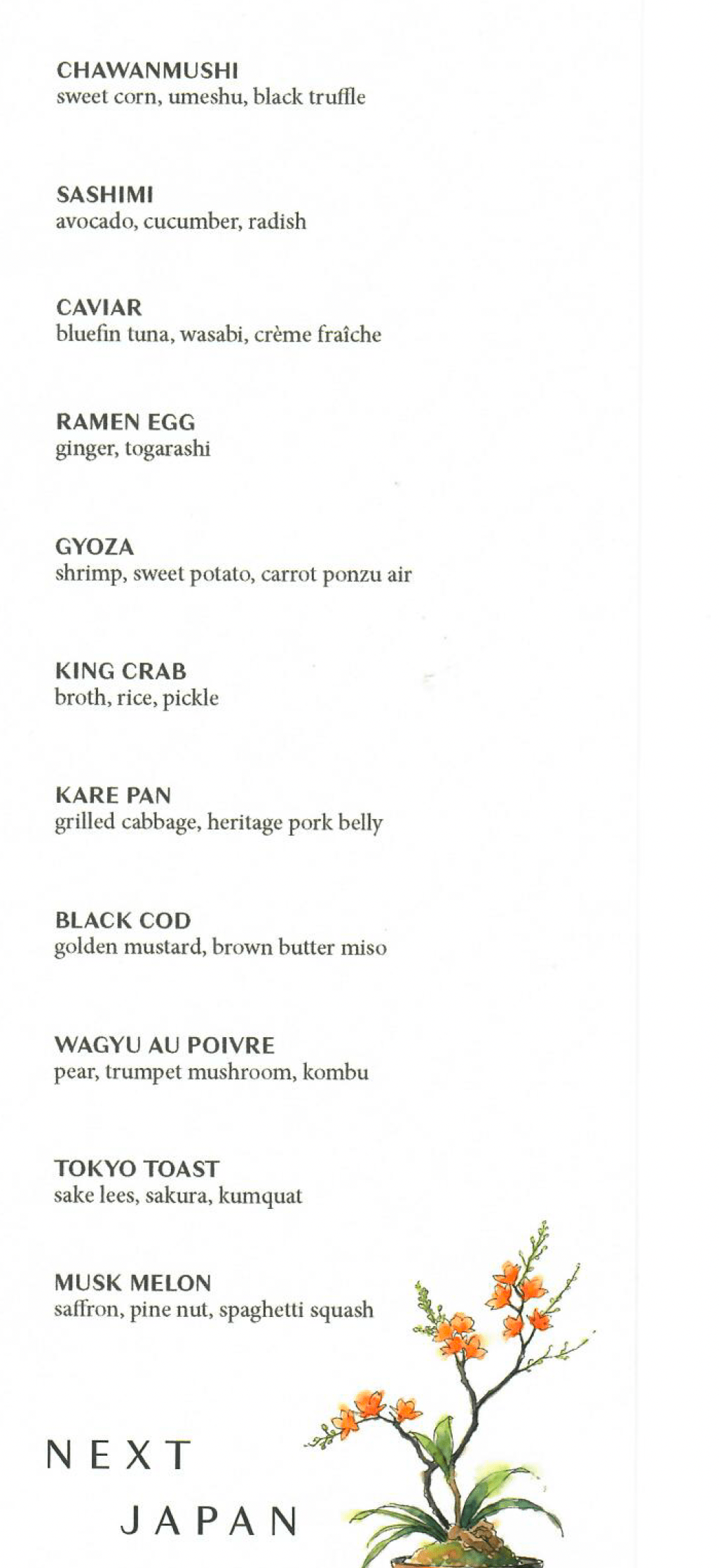
This is our menu; we were comped a few dishes because of Robert’s relationship to his niece, and so we wound up with eleven dishes, six wines, and two sakes (I love sake, and these were good ones, not obtainable, I was told, in local stores):
The food menu (this is what we were actually served including the gratis dishes; they apparently made up a custom menu post facto for us as a souvenir):
The wine-and-sake menu (while waiting for me, Robert was given a glass of champagne):

And now for the dishes (all photos by me except Robert’s, which are labeled “RJL”).
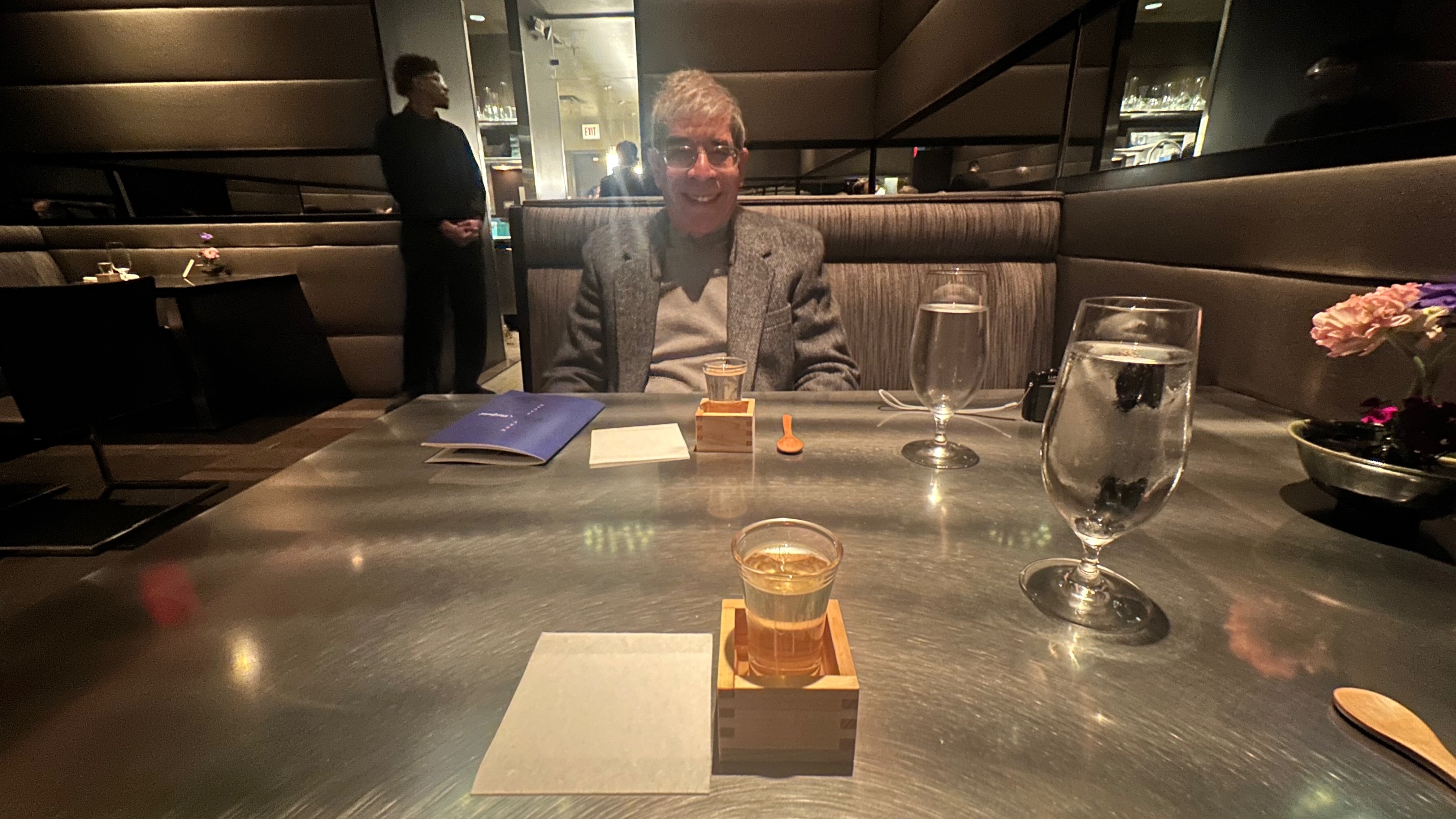
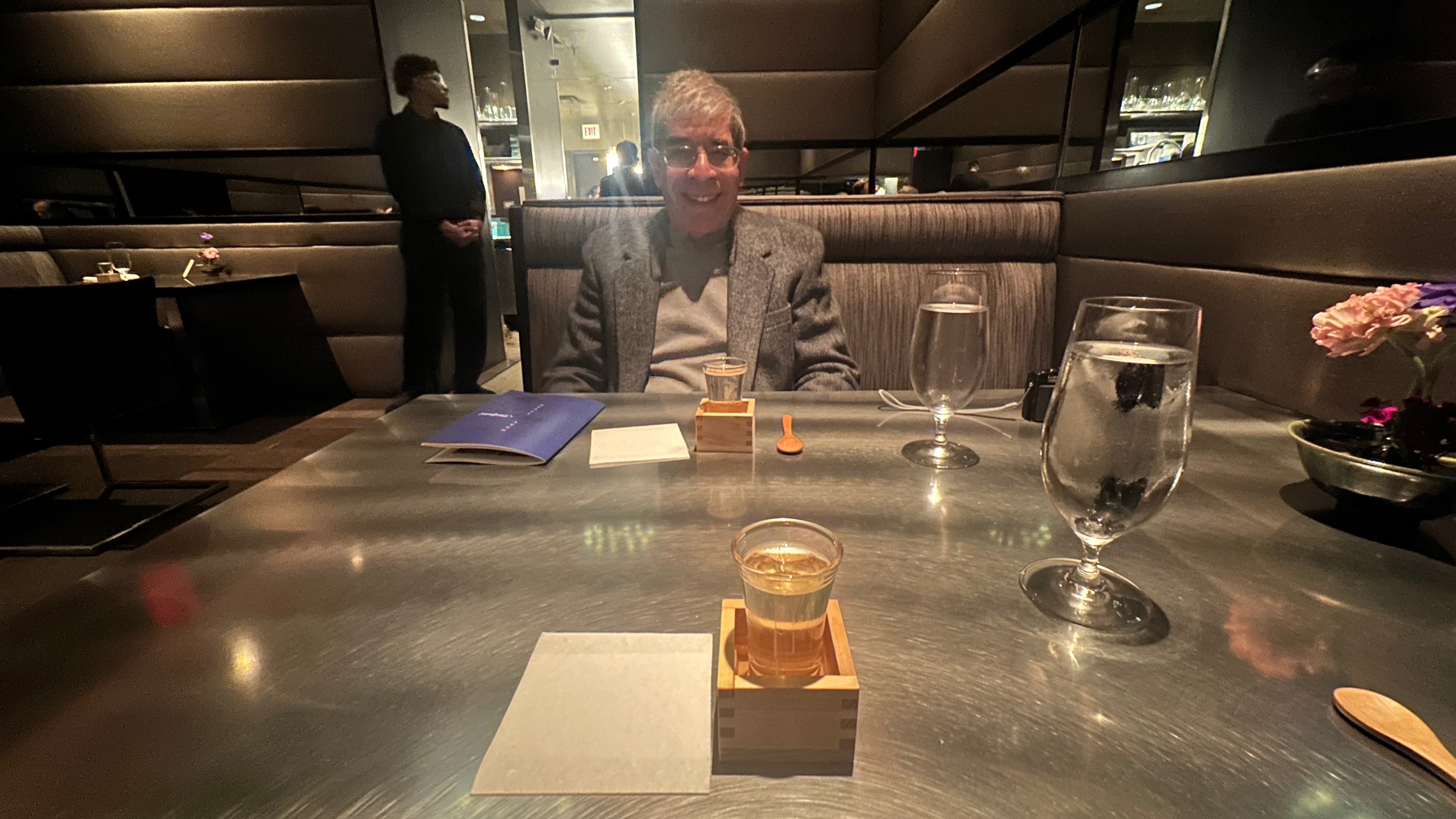
First, a glass of bottle-fermented sparkling sake, a real treat. It was served poured to overflowing in a glass inside a cedar box. After you take a few sips from the glass, you pour the rest of the glass into the cedar box and drink it from there, a traditional practice that gives the liquid a slight woody flavor:

The sake, one of several made by Masumi. It looks to cost about $60 a bottle retail: they did not stint on the wines but that was not near the most expensive libation we were served:

Me, excited before dinner; photo by RJL:
First course: chawanmushi (a savory egg custard), made with sweet corn, umeshu (a Japanese plum liqueur), and black truffle. Like nearly all the dishes, I had never tasted anything like it before. It was fantastic. Note the dried cornhusk garnishing the plate. It’s eaten with the wooden spoon:

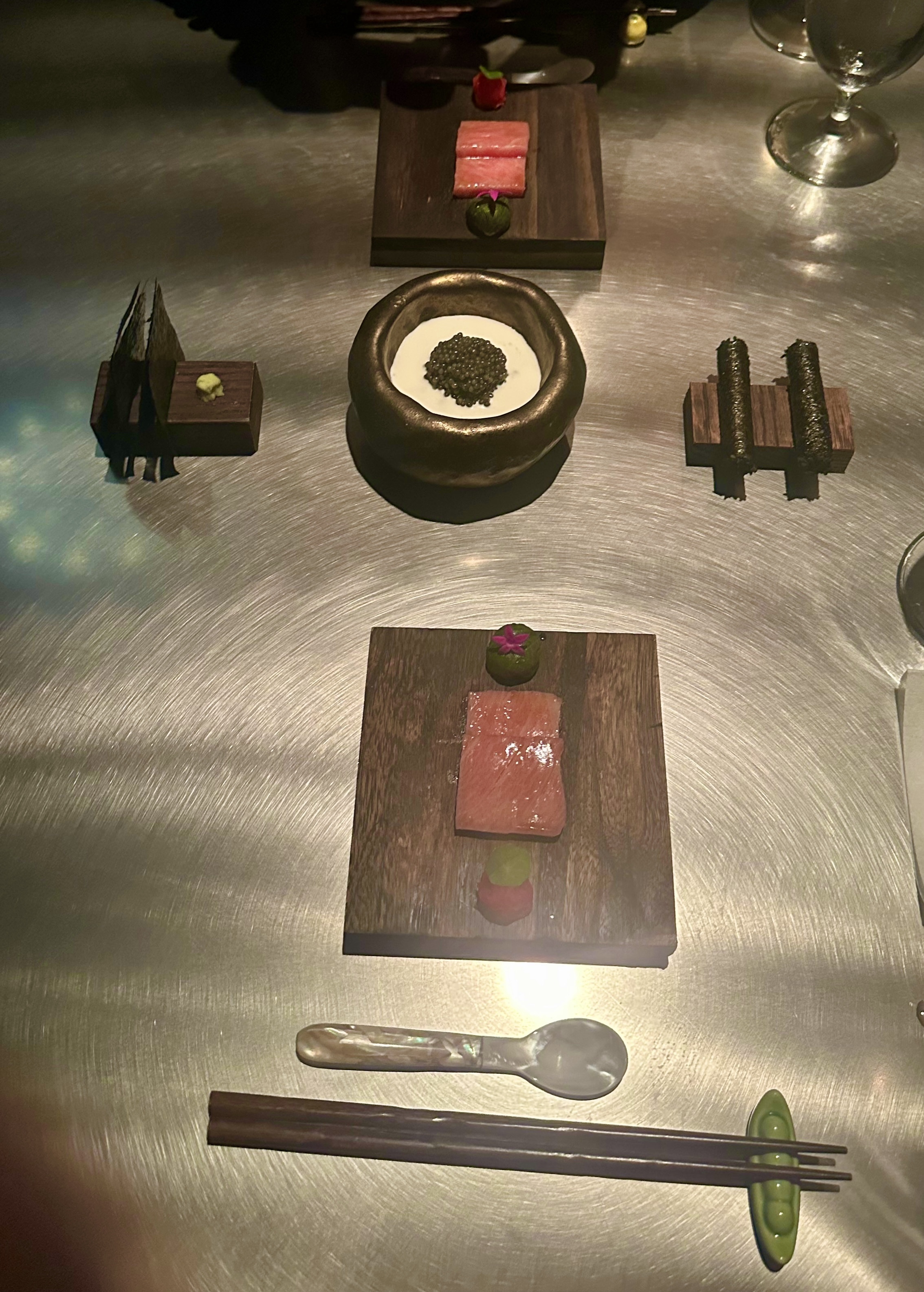
The next dish arrived at the table as a gift: osetra caviar (the second best in the world after beluga) served with bluefin tuna, wasabi, and crème fraîche. It came with four sheets of seaweed (to the right next to the wasabi), and two already-formed seaweed rolls (left) with unidentifiable goodies inside. You are supposed to roll the caviar, crème, wasabi, and salmon into a sheet of seaweed and eat it as if it were a luxurious Japanese burrito.

The only caviar I’d ever had before was pressed caviar made from irregular eggs, and sevruga caviar (the third rarest). It was hard for me to resist leaving the caviar out of the burrito and just eating it plain with the mother of pearl spoon (the traditional utensil), so I did eat some plain (fantastic) and also put some into two “burritos” (also fantastic). The two rolls to the left were eaten separately. Note the two “fruits”, actually pickled vegetables) at the top and bottom of the plate. I believe they are a pickled radish and a pickled cucumber, both decorated with nasturtium blossoms. Those, too, were amazing, full of complex flavors. The “pickle” was like the most delicious pickle you could imagine, and of course you can’t buy them as they’re made in house.
Photo by RJL. Note the lovely setting with chopsticks (and fancy chopstick rests) and spoons:
The wine: Vermintino, an Italian white wine made by Laura Ascero, light, crisp, slightly saline, and dry, a perfect accompaniment to the creamy burritos with caviar. These people know their wines:

Two cute little “ramen eggs” in a spoon with ginger and togarashi (the red spice on top), made to resemble the flavor of Japanese ramen (there’s no ramen in there, and I can’t remember what is). Two cute and savory bites.

A fancy dish: gyoza (a dumpling filled with shrimp and sweet potato), accompanied by a froth made from carrot ponzu. You can see the dumpling at 10 o’clock next to a savory crunchy thing. AI describes “ponzu” as “a tangy, citrus-based Japanese sauce made from soy sauce, vinegar, and citrus juice (like yuzu or sudachi), often with added mirin, dashi, and bonito flakes for a complex salty, sour, and umami flavor.” Again, it was like nothing I’d ever tasted.

The wine: a Grüner Veltliner (Austrian white), the “Ried Rosenberg” blend made from the Weingut Ott. A dry version of the wine, it again was great with the dish:

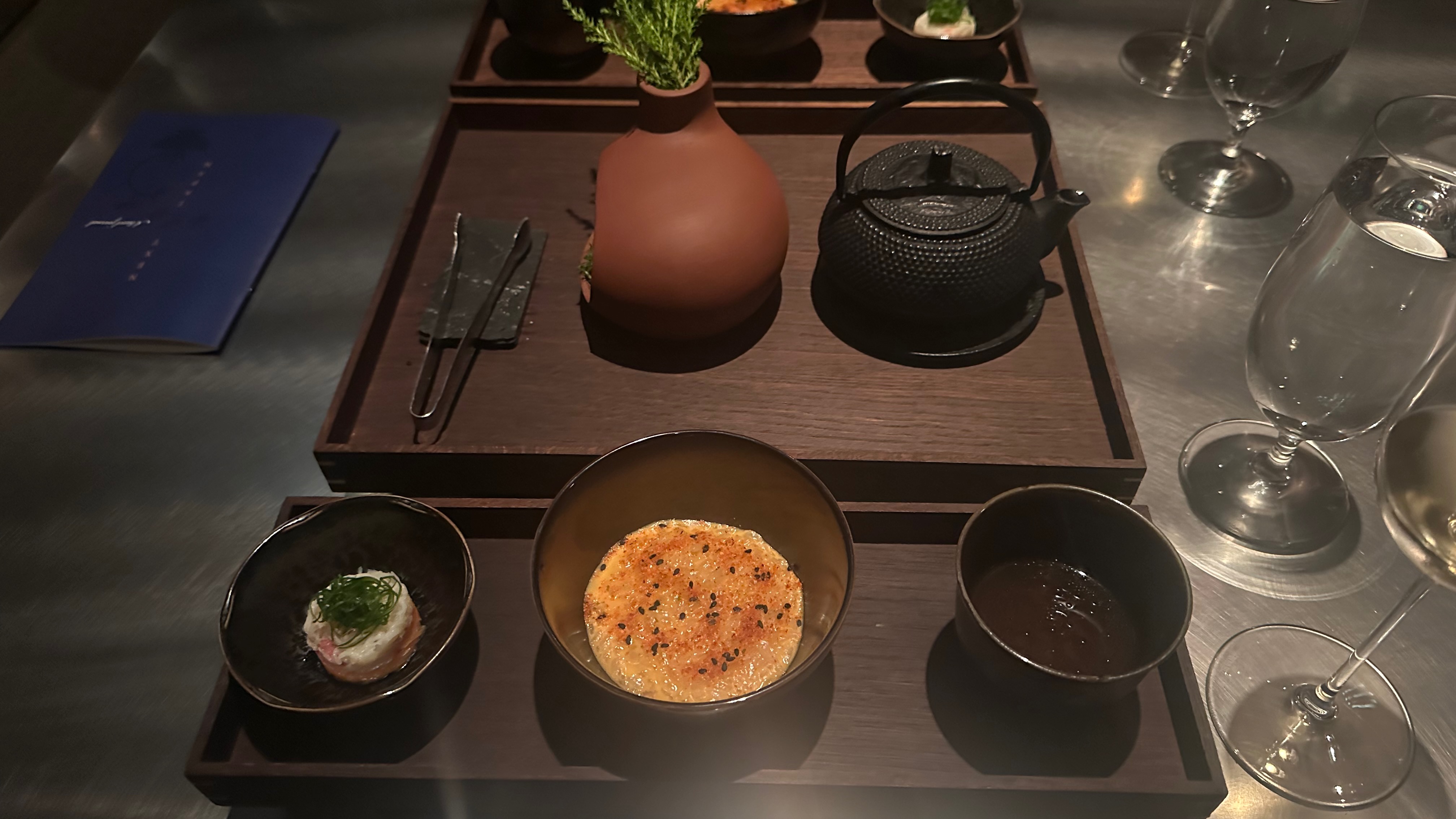
We continued with a fancy dish comprising three items: king crab to the left, a fancy rice in the middle, and a broth (I can’t remember what kind) to the right, with the broth poured from the traditional Japanese metal teapot. Above on the tray is also a pot with sprigs of fresh rosemary, with coals below them to create a herb-scented smoke while you had this dish. You could eat a bit of the incredibly sweet king crab with some rice, and then wash it down with the broth.
With that dish we move to Burgundy for the white wine, A Premier Cru Chablis, the “Fourchaume” blend by De Oliveira Lecestre, a crisp and fruity but dry wine. Another good pairing.

The seventh dish was kare pan (Japanese curry bread), filled with grilled cabbage and heritage pork belly. This was very complex, and look at the decorations! I didn’t photograph the inside but yes, it was excellent. There was no dish in the whole meal that I found less than inventive and tasty.

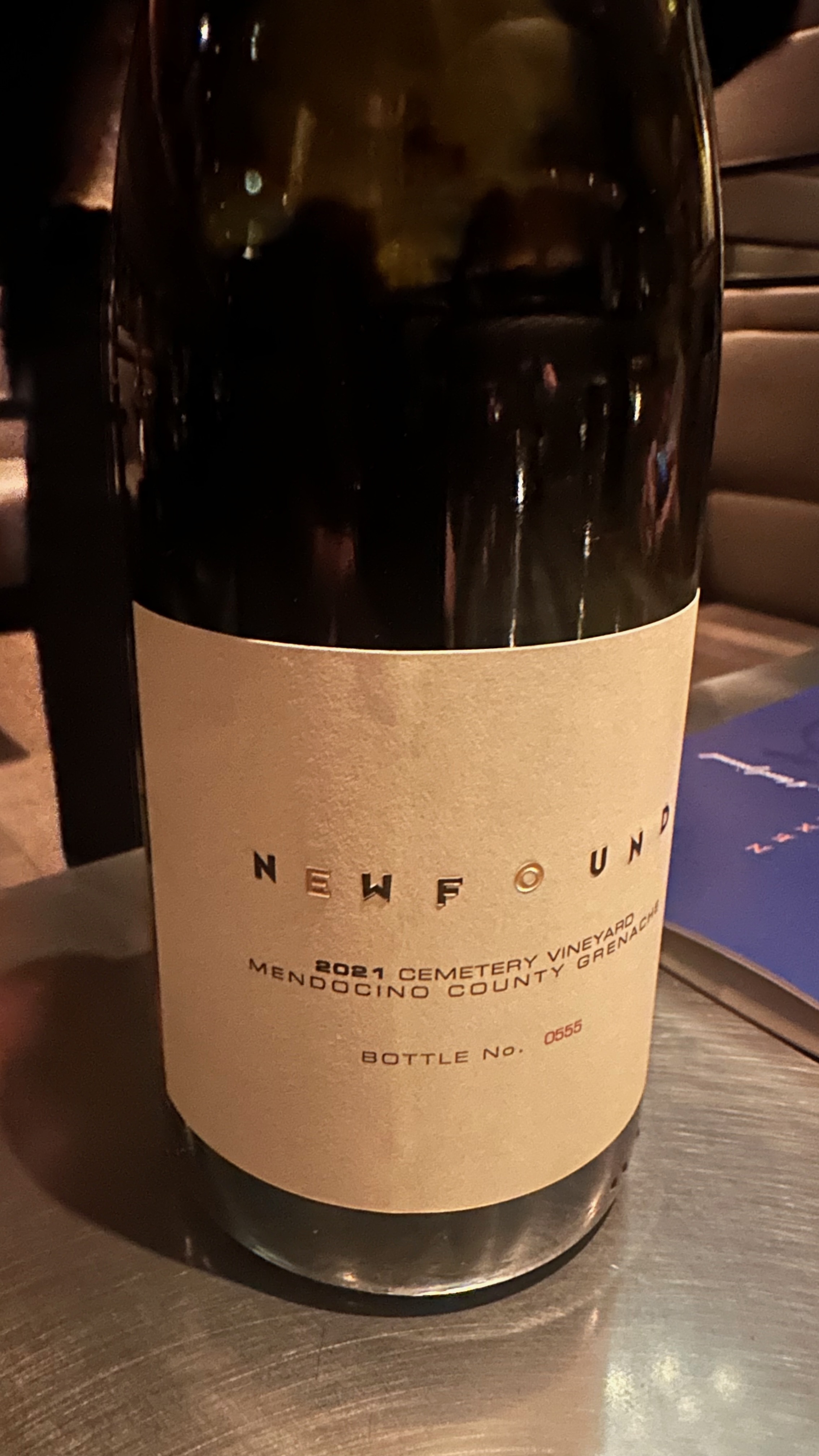
And with the kare pan we moved to the red wines, this one a 2021 Grenache from Cemetery Vineyard from Newfoundland Winery in Mendocino, California. It was a light red wine to go with the pork, and very tasty (photo by RJL).
I couldn’t remember why they called it “Cemetery Vineyard” (they told us), but AI had the answer:
The “Cemetery Vineyard” (specifically the noted Rockpile Ridge site) is named for a distinct outcropping of rocks at the base of the vineyard that looks like giant, old-fashioned headstones. This specific block has been referred to by this name for over 140 years, long before the wine was commercialized
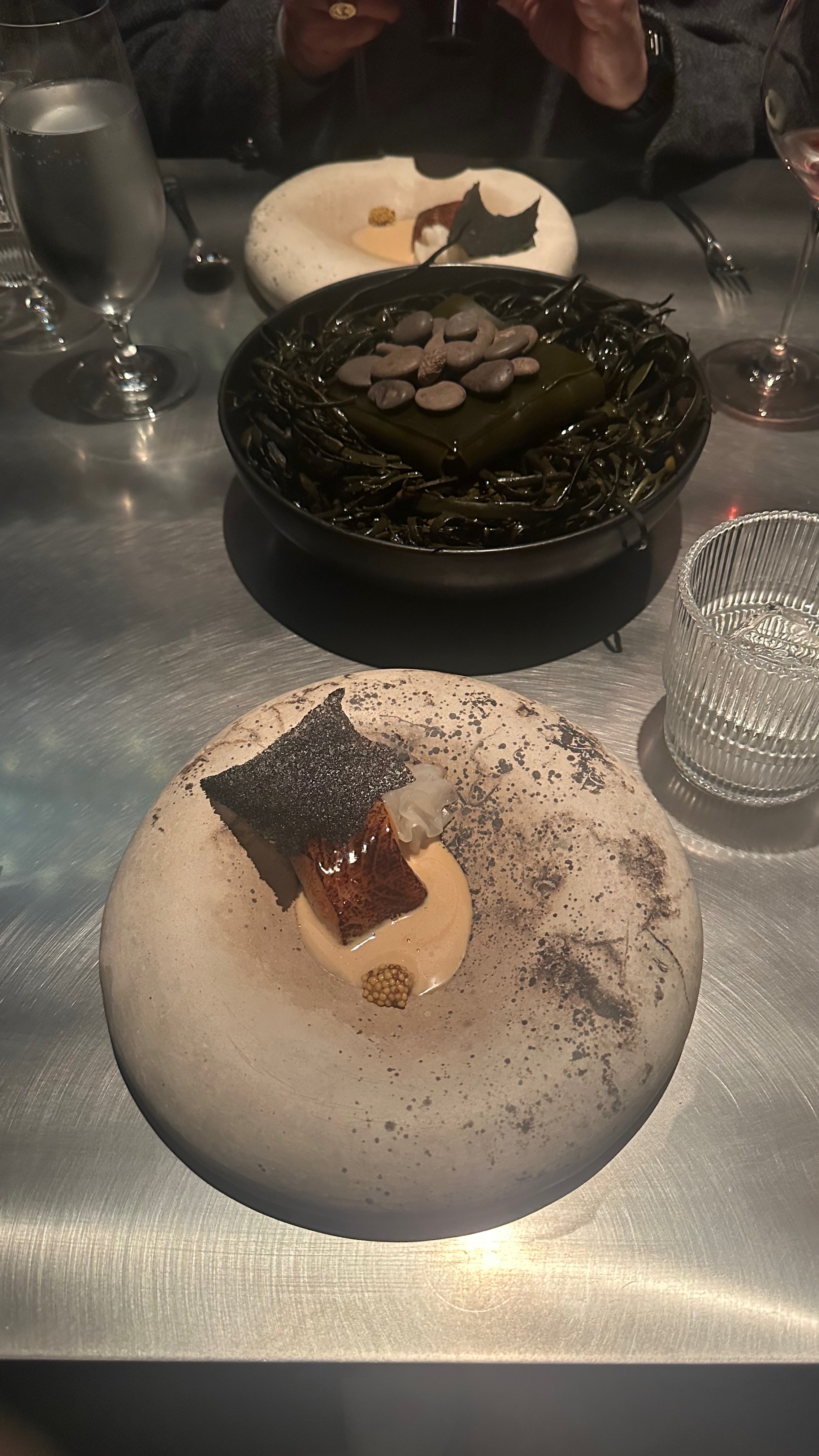
And then some fish: a luscious piece of grilled cod with a brown butter and miso sauce, accompanied by seaweed and golden mustard seed. I’m not much of a fish-eater but I loved this:

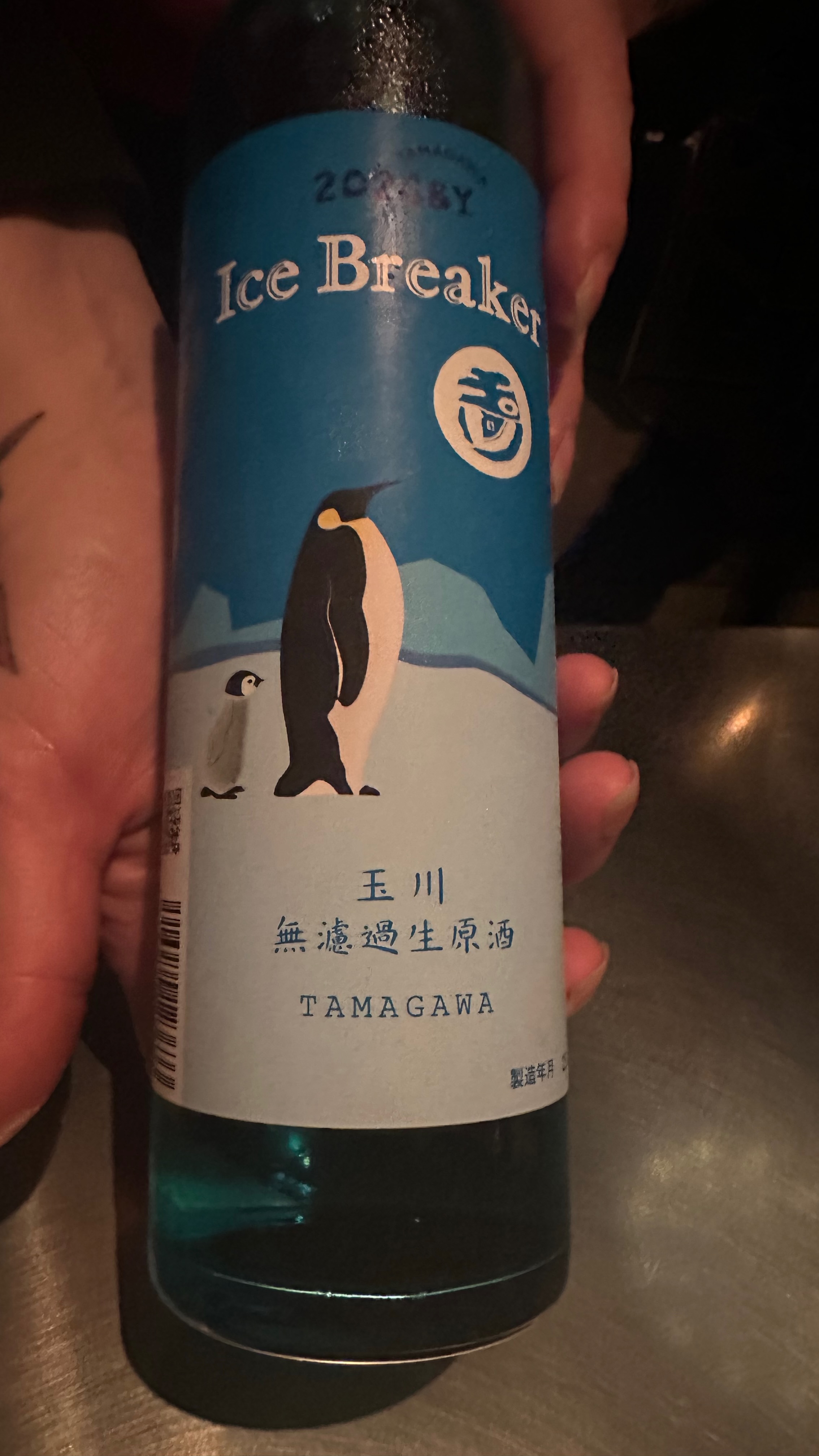
And for that dish of course we needed sake, and were poured a whiskey tumbler (with ice) of 2024 Tamagawa “Ice Breaker” sake. We were told it was unfiltered, and it was a stronger, slightly sweet, and luscious rice wine. And there was a penguin on the label! The website says this:
Tamagawa’s Ice Breaker is a cask-strength, fresh-pressed junmai ginjo that is undiluted, unpasteurized and unfiltered. This is a seasonal release always listed with the brewery year (BY).
Pairing Notes: The Ice Breaker sake is designed to be drunk over ice as a refresher in the humid Japanese rainy season. Try it with edamame, mackerel, skipjack tuna and eggplant with zesty grated daikon.
I believe the white stuff with the cod above is grated daikon (white radish), but I’m not sure.
When the cod was served, they also put a mysterious bowl of seaweed containing very hot rocks atop a seaweed packet. We asked what it was, and were told was part of the next course being steamed by the rocks while we ate the fish. See below. (Photo by RJL).
Where’s the beef? It was next in a “wagyu au poivre”, and yes, it was real wagyu beef from Japan, the first I’ve had. It was of course rare, and then the seaweed packet was opened to reveal the cooked accompaniments: pear and trumpet mushrooms, along with kombu (edible kelp). Photo by RJL:
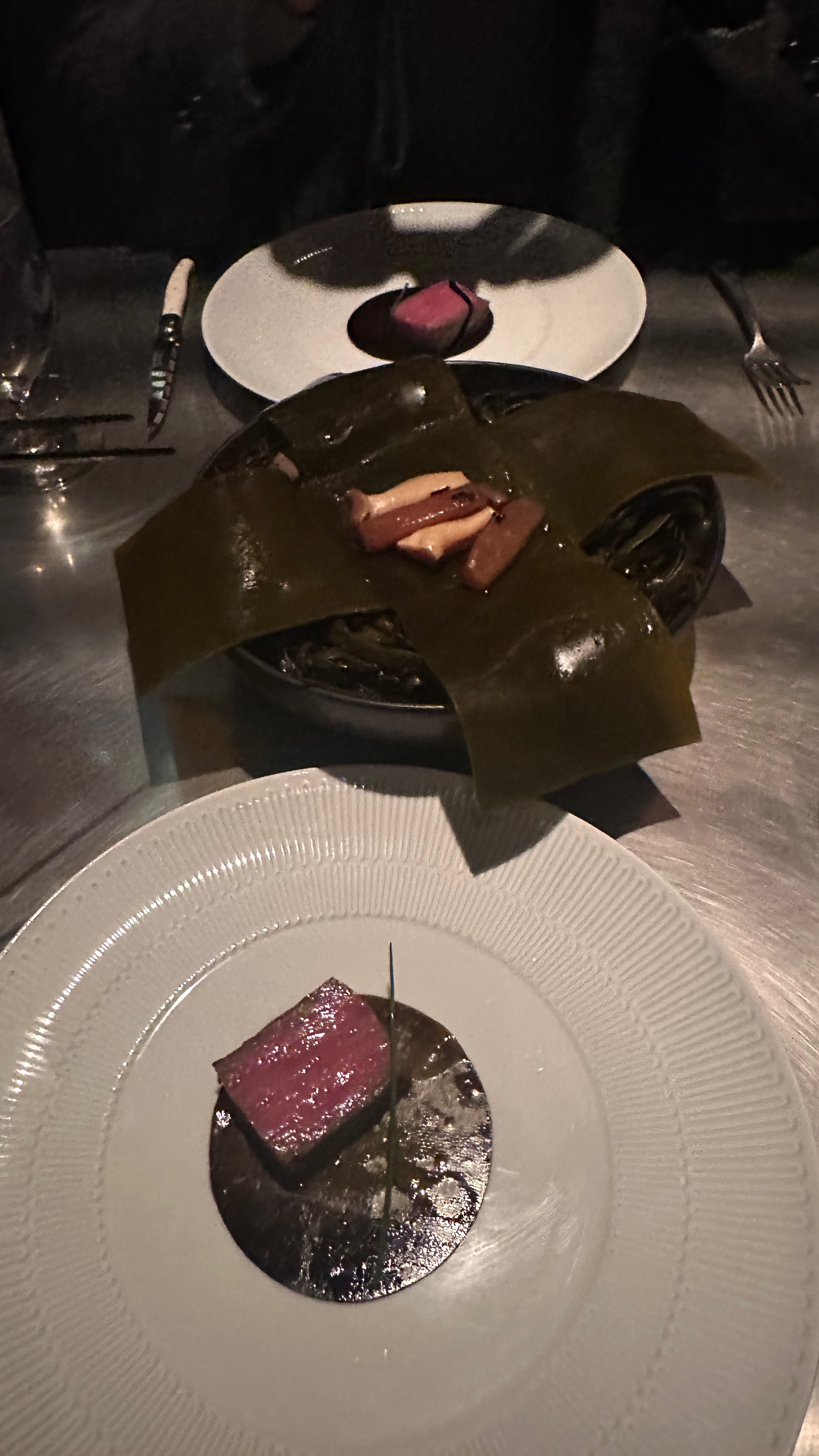

Yummers! The beef was so tender and tasty that although the slice was not large, I ate it in very small bites so I could prolong the flavor. It was great with the meaty trumpet mushroom and the fruitiness of the pear:

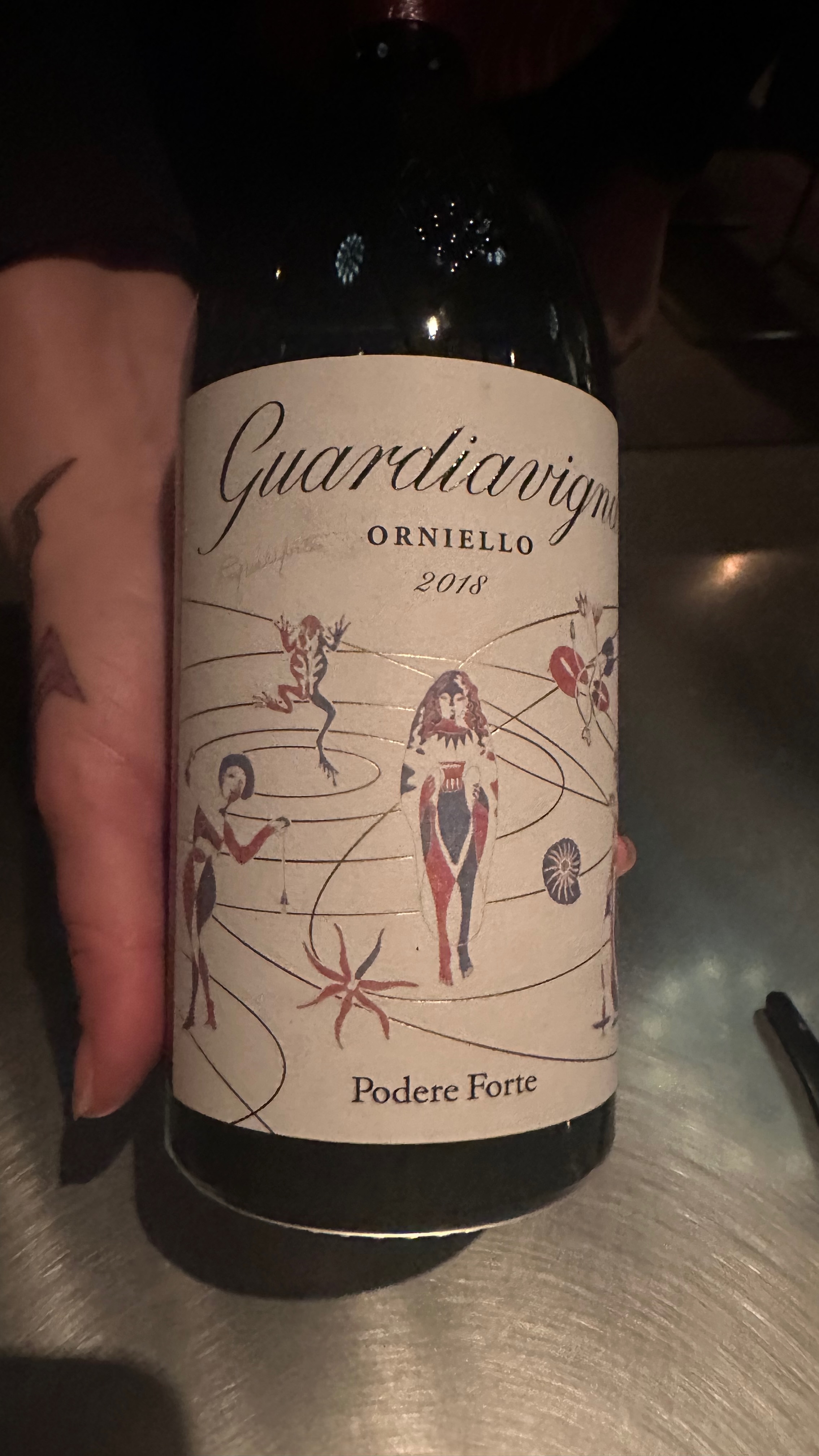
Of course with that you need a gutsier red wine, which came as a Cabernet Franc (often found in Bordeaux) from Podere Forte, an Italian winemaker. The designation was “Guardiavigna Orienello” with some age: 8 years. It’s a biodynamic wine, tasting much like a Bordeaux; the website describes it this way:
Guardiavigna is a version of perfectly and slowly ripened Cabernet Franc. An intense, deep and vast bouquet. Full bodied, with a very refined tannic structure. A very elegant and endless wine.
It goes for $150-$180 per bottle.
Photo by RJL:
With two courses left, we had dined for about 2½ hours, eating leisurely and catching up. Robert’s house is nearly rebuilt after the Altadena fire and should be done by June. His studio will take a bit longer.
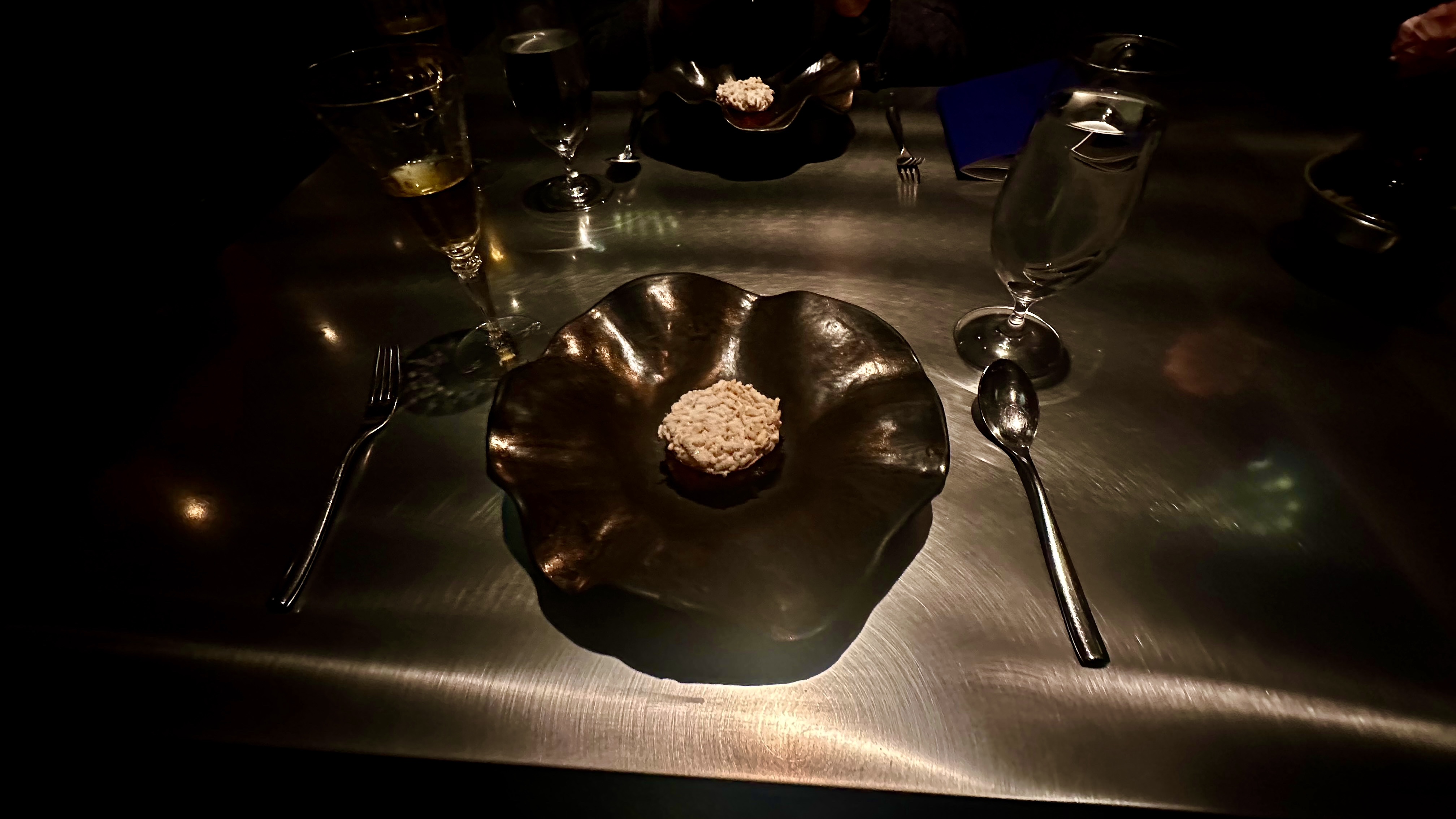
We were then treated to “Tokyo toast”, with sake lees (I guess the rice at the bottom of the fermenting tank), sakura (cherry blossom), and kumquat. You see that the dishes are inspired by the flavors the team encountered in Japan, but the dish itself is sui generis. It was a very elegant version of a Rice Krispy treat:

And the eleventh and last course: musk melon with saffron, pine nuts, and spaghetti squash. An inspired combination; you have to have a good palate to even think of putting these things together. They melded well. Again, the presentation was carefully thought out, with matching fancy plates, trays, and appropriate cutlery:

Sauternes, my favorite sweet wine, goes with very few things. I eat it either on its own or with a ripe peach or mango. It does not go with chocolate (Thomas Keller hasn’t learned that lesson.) But it did go with the musk melon, which is not too sweet, and the spaghetti squash, barely sweet. And so we were served a 2019 Château Fontebride 2019. That wine also counted as dessert. If you haven’t tried a Sauternes, which gets better and more golden as it ages, you might spring for one. (I brought Robert a half bottle of another Sauternes as a gift; it wasn’t clear whether it would make it back to California since Robert is staying with his brother in Chicago.)

And so we wound up at 8:30, having started at 5:30. I was replete, filled with great food and fancy wine, amazed at what we had eaten, impressed by the thought and care that went into the food and service, and, of course, slightly buzzed. Next is an amazing restaurant and I’d gladly go again—if I was willing to spring for the meal (I have no idea what it cost) and could get a reservation (the website says there are 10,000 people on the Next waiting list!).
When you have a long, sumptuous, and fancy meal like this, you leave the restaurant with a bracing sense of well being. (A Parisian chef once told me that you know a meal is good if the birds sing more sweetly when you leave.) I had that feeling, and of course it was helped along by the slight buzz from wine and sake.
Many thanks to Robert for inviting me, to his niece Kate, the manager, for greeting us and stopping by to chat during the meal (and of course running things), and the staff who organized, cooked and served.
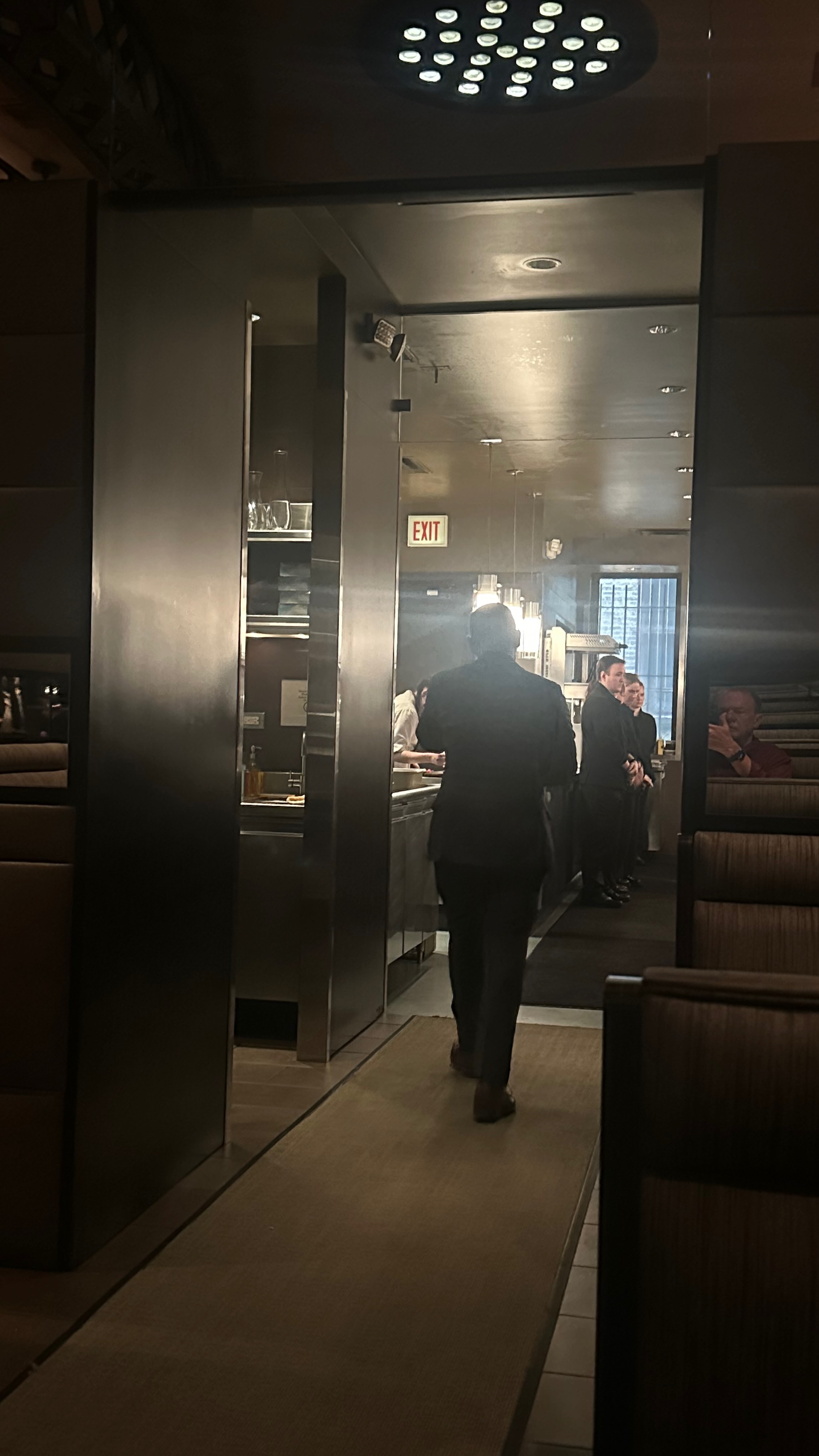
Oh, two dark pictures of the place, the first of the kitchen by Robert and the second of the main room by me. It’s not a large restaurant. Note the Japanese lanterns.

I know that I’m going to get criticized for putting this up, excoriated for eating fancy food and “privilege.” To those who would say that, take a hike. This was a rare treat, and all I can say is that there have been Japanese emperors who haven’t eaten this well.
A perfectly balanced atom just broke one of nuclear physics’ biggest rules
NASA DART mission reveals asteroids throw “cosmic snowballs” at each other
Astronauts Use Bacteria and Fungi to Harvest Metals in Space
If humankind is to explore deep space, one small passenger should not be left behind: microbes. In fact, it would be impossible to leave them behind, since they live on and in our bodies, surfaces and food. Learning how they react to space conditions is critical, but they could also be invaluable fellows in our endeavor to explore space.
AI discovers the hidden signal of liquid-like ion flow in solid-state batteries
Bill Maher’s latest New Rule: “Trump Estrangement Syndrome”
Bill Maher’s latest news-and-comedy shtick on “Real Time” deals once again with the flak he got for having dinner with President Trump. Remember? Despite Maher constantly criticizing the President’s policies durin gthe dinner, he also reported that he found Trump affable and friendly.
That was enough for liberals to come down on Maher like a ton of bricks, despite the fact that he simply gave his reaction. Trump’s policies were reprehensible, Maher averred, but he was a good host. In today’s world that will do you in. Larry David, for instance, wrote a satire of Maher’s reaction in a NYT op-ed called “Larry David imagines a private dinner with Hitler” (archived here), and I imagine that pissed off Maher.
Apparently Trump posted about his dinner with Maher on Truth Social (on Valentine’s Day), and Trump’s post was full of lies (surprise!). Here Maher corrects the record, and gets a few shots back at Trump for lying, while calling out people with true “Trump Derangement Syndrome.” (“Get a life: stop making him your whole personality”.) But he adds that Trump bears some responsibility for promoting TDS because his racism, misogyny, anti-democratic acts, and corruption “make people crazy.” Maher further also ticks off a few good things that Trump did, including asserting that “penises don’t belong in women’s prisons,” which will simply anger “progressives” more. Maher argues that he may be “the last person from the Lunatic Left that is still an honest broker when it comes to Trump.”
Maher winds up addressing Trump directly, calling him out for his many detestable acts—after he’s given the President plaudits for some things. Yes, Maher seems defensive here, but he’s honest and I still like the guy. I don’t have much truck with people who say that Trump never did anything good, and, in fact, it’s impossible for that to happen.
Bill’s guests were Rep. Adam Schiff (D-CA), journalist Don Lemon, and author Annabelle Gurwitch/
The story of our Big Dinner will appear tomorrow
As I mentioned yesterday, Robert Lang invited me to dinner last night at a famous Chicago restaurant called Next, whose metier is mulitcourse menus with a theme. And they completely change the theme every four months, so they’re always working on and testing the dishes to come (see the history of the themes at the Wikipedia link given in the first sentence). The theme of our meal was “Japan,” inspired by the restaurant chef, manager, and some staff having taken a trip to Japan to absorb the food and culture. They they returned to the U.S. and worked for a few months to develop dishes that were not explicitly Japanese, but inspired by the food they tried in Japan.
While preparing the account of our meal for a post, I realized that it is going to take some time, what with 12 dishes and 8 wines (including 2 sakes), as well photos of the menu and the restaurant. I will say now that it was one of the best meals I’ve had in America—even better than the vaunted French Laundry in California, where years ago I paid a lot for a disappointing meal.
We managed to get into this restaurant, which has a huge waiting list, because Robert’s niece is the general manager; and because of that we got a few gratis dishes.
The meal was terrific, with a largesse of small, lovely, and wonderful dishes and thoughtful and appropriate pairings with wines and sakes. The meal did not fail where many of small-dish places do: making you leave when you haven’t had enough to eat. This was not the case at Next: I left dazzled, sated, and a bit buzzed.
I will ask your indulgence because it will take me a few hours to crop the photos, insert them in a post in the proper order, and try to describe the dishes from a memory clouded by sake. The post will be up tomorrow morning.
To wet your whistle, here’s a photo taken by Robert, showing the introductory tipple, a glass of sake poured to overflowing inside a cedar box. This is traditional: you sip the full glass until it can be poured into the box, and then drink the rest from the box, which lightly flavors the sake with cedar. This was also a rare form of sake for me: a sparkling one.
All will be revealed tomorrow. Right now I am recovering.
Caturday felid trifecta: What not to do to your cat; Jock(s) the Chartwell cat(s); missing cat in England found in Paris, more than 8 years later; and lagniappe
We have three cat items and lagniappe today.
This first video was made by Meowtopia, the same people who made the informative video on cat psychology that I posted recently. Here we have 18 minutes of advice about what not to do to your cats: nine human behaviors that adversely affect cats based on their evolved natures.
The list: failure to greet the cats when you come home; using a laser pointer or other toy that a cat cannot catch (this is a no-no as it violates the predatory sequence that ends with a kill), petting in the wrong places, invasion of a cat’s territory, punishment of trangressing cats by squirting, yelling, or striking them (this conditions them to fear you; the solution is to prioritize a better option), afflicting them with loud noises (their hearing is absurdly sensitive), failure to understand their communications and to respond to it (feral cats don’t meow), picking them up and thrusting them into the hands of a stranger), and, finally, assailing their sensitive vomerine scent-detection system with strange smells like heavy perfumes or air freshener and, worst of all, scented cat litter.
This is a very good and educational effort, not simply a cute cat video. Even if you have a cat, do watch it.
*********************
Winston Churchill was a huge fan of cats, as you can see from this National Trust post below about the lineage of orange (“marmalade”) cats that still roam the grounds of Churchill’s old home, now given to the country. As Wikipedia says in its article about Winston Churchill’s pets (my bolding):
Churchill had many cats in his life, both at Chartwell and in government service. At Chartwell, these included a tabby, Mickey, and a “marmalade colored” cat named Tango. Tango was there in the 1930s and 1940s and appears in anecdotes about those years. But Churchill’s most famous wartime cat was Nelson who was initially a mouser at the Admiralty when Churchill was First Lord. Churchill named him Nelson after the great admiral after seeing the cat chase a large dog away. He then took the cat with him to 10 Downing Street when he became prime minister, where it also chased Chamberlain‘s cat, the Munich Mouser.
In later life, he was given a cat by Jock Colville for his 88th birthday. This was a ginger cat with white markings that he called Jock too. This cat became a favourite in his final years. When he died and Chartwell was donated to the National Trust, the family asked that a marmalade cat with white bib and socks called Jock should always be maintained there. This tradition has continued and Jock VII became the current holder of this position in 2020.
Chartwell was Churchill’s country home in Kent to which he retreated again and again, even when he moved 10 Downing Street as Prime Minister. Click to read about the two living Jocks:
. . . Generations of ginger cats have lived at Chartwell over the years. Since the National Trust opened the house to the public in 1966, the family of Sir Winston Churchill requested that there always be ‘a marmalade cat named Jock, with a white bib and four white socks, in comfortable residence at Chartwell’.
Here are the last two Jocks that are still alive, though Jock VI retired and, nearly blind, lives with a staff member (see short video below).
Jock VII
In May 2020 Chartwell welcomed Jock VII, a six-month-old rescue kitten, to take up this unique role.
Along with his white bib and white paws, Jock VII has a very mischievous character. His favourite pastimes are investigating what the gardeners are up to and playing down in the long grasses of the orchard. He also likes lots of cuddles on the sofa after an eventful day.
Keep an eye out for him as you tour the property.
Rescued
Jock VII, previously known as Sunshine, was rescued by the RSPCA before being adopted by one of the team at Chartwell.
He was rescued along with 30 other cats from squalid conditions. The kittens were very weak and undernourished but were young enough to be brought back to health quickly. Jock was the most confident of the whole group and was already playful and full of fun.
Jock VI
Jock VII’s predecessor, Jock VI, came to Chartwell in 2014. Sadly, he became almost completely blind and was finding life at Chartwell difficult. After his six years of service, he retired and is now enjoying a much quieter and more peaceful life with a member of staff in a garden of his own.
Here’s Jock VI with his staff; she seems quite loving:
*********************
Finally, from an author called Sean, we have a Medium story about his cat Moon Unit (you may remember that this was the name of Frank Zappa’s daughter, born in 1967).
Click on the link below to go to the story of a latter-day Moon Unit, a cat who went missing from London and turned up in France, toothless but otherwise okay, 8½ years later!
An excerpt:
A few years passed and we had a new year’s party. The next morning we discovered we had one cat missing. Moon Unit had somehow got out during the party and disappeared. We went out looking, printed out posters, told the local cat rescue places, but no luck. People told us about lots of little black and white cats they’d seen, but none of them had MU’s distinctive white nose or big whiskers. So no luck. And we were very sad.
But about a month ago, out of the blue, I got an email from the Kennel Club saying that a cat with a matching microchip had been found. IN PARIS. Now if that isn’t boggling enough, that party was EIGHT AND A HALF YEARS AGO. We exchanged photos with the French rescue place, and it was definitely Moon Unit. Distinctive nose and whiskers as I said. And she has that fur that is dark on top but white underneath.
She had been found wandering around outside a train station in a French suburb, and taken to a cat rescue place, who checked her chip and got in touch. Well, the chip contact details were a bit out of date (did I mention EIGHT YEARS missing?), but the French people were very stubborn and eventually the KC used newfangled email to get in touch with me.
So this weekend we went over to Paris. In the past few weeks, Moon Unit had been checked at the vet, and given rabies shots and worming tablets, and a Pet Passport organised for her. Two lovely ladies came over to our hotel with her on Saturday (we gave them some chocolates and flowers), and we took her to Calais by train (telling her story to the people around us), and our friends met us at the station and drove us onto the car ferry, and back to London. (There aren’t many foot passenger services that take pets).
.. . .Back in London we closed all the doors and let Moon Unit out into the hallway. She had a look around, and seemed perfectly fine. I spent the rest of the evening in the hallway with her, and she’s been following me around all day. She’s not been doing that “OMG new place I must HIDE” thing that cats often do — in fact she’s curled up next to me on the sofa as I write this. (Remember she only got back yesterday).
So there we have it. A tale of European cooperation and perseverance and international mystery. How did Moon Unit get to PARIS? How has she survived for over EIGHT YEARS? How did she lose all her teeth? Has no vet checked her chip in all that time? Answers we will never get, until she writes her mewmoirs.
. . . And the moral of the story — always get your pets microchipped and keep the contact details up to date, even if they are indoor pets. Moon Unit was an indoor cat while she was with us. Hope you enjoyed reading this.
Here’s a photo labeled “Moon Unit back in the day,” presumably taken by Sean.

********************
Lagniappe: Here’s a two-minute cat version of Indiana Jones: “Indiana Jonesy” in “Raiders of the lost treat.” You will remember some of the scenes. No cats were injured in the making of this film.
h/t: Matthew Cobb,
Gentle Reminder: Daylight Saving Time Starts Tomorrow
As a gentle reminder that you will have an hour of sleep robbed from you tonight, enjoy this episode on Daylight Saving Time Myths from the archives!
Learn about your ad choices: dovetail.prx.org/ad-choicesHow an intern helped build the AI that shook the world
The moment that kicked off the AI revolution
Antarctica has a strange gravity hole and scientists finally know why
Physicists finally see strange magnetic vortices predicted 50 years ago
VLT Image Captures a "Cosmic Hawk" Spanning its Wings.
Today’s Picture of the Week, taken with ESO’s Very Large Telescope (VLT), seems to have captured a cosmic hawk as it spans its wings.
NASA changed an asteroid's orbit around the sun for the first time
Chemistry clues could detect aliens unlike any life on Earth
Inflammation might cause Alzheimer's – here's how to reduce it
Possible brief slowdown in posting
I need a life—even if that is a life outside of writing for this website. That’s by way of informing you that posting here may be a bit light for about a week. I have a writing assignment, which is to answer Michael Shermer’s response to my own post on this site taking issue with his claim (also in his new book Truth) that we have a form of free will. (My response will appear at Skeptic.) I can do no other than answer a form of compatibilism that gives us free will simply by redefining the folk notion of free will in an un-refutable way so that that we do have free will even if all our behaviors and thoughts derive from and are compatible with the laws of physics. But I digress.
My second task is to go shopping for much-needed Chinese groceries (I ran out of everything during the cold spell), but, most important, to meet my friend origami master and engineer Robert Lang, who’s invited me for splendid dinner at Next. Next is a sister restaurant of Alinea—surely one of America’s most famous restaurants. Next is equally highly rated. Both Next and Alinea are run by the same chef, Grant Achatz (see a Facebook interview with him here). Robert’s in town for an origami convention, and the trip to Next is prompted by his rare appearance in Chicago and the felicitous fact that Robert’s niece happens to be the general manager of Next. I think that’s how we got reservations given that the site says, “On any given night, there can be 10,000+ guests on our waitlist.”
Next is so named because it changes menus to a new theme every few months. This most recent theme is Japan, and I have the menu, which has nine courses that look fabulous (Earlier, Robert provided some origami for the menu.) I’ll save the food experience for a post (with photos) tomorrow or Sunday. There will also be a wine pairing with the many courses, and I’m sure that a great and bibulous time will be had by all.
Stay tuned. As always, I’ll do my best, both at table and at this site. Oh, and don’t forget to set your clocks forward on Saturday night.
Pages
