
You are here
News Feeds
Smart underwear detects lactose intolerance by tracking your farts
The Paranal solar ESPRESSO Telescope, a New Tool for Finding Exoplanets
The Paranal solar ESPRESSO Telescope (PoET), installed at the European Southern Observatory's (ESO's) Paranal site in Chile, has made its first observations. The telescope will work with ESO's ESPRESSO instrument to study the sun in detail. Described as a solar telescope for planet hunters, PoET aims to understand how the variation in the light from stars like the sun can mask the presence of planets orbiting them, helping us in our search for worlds outside the solar system.
Conspiracy Inc.: The New Media Disorder
One of the most dramatic aspects of grand dreams of the human spirit is how quickly they come crashing down to gritty, grimy earth. This is nowhere more true than with the internet. What began as a promise of global connection and unlimited access to knowledge has become a hornet’s nest of hatred, distortion, and lies. Conspiracy theories, which blend all of those elements into novel shapes and patterns, are thriving in ways that would put to shame the architects of the most poisonous false narratives in history.
For the first time, conspiracy is not just a political or geopolitical tool, as it has been for centuries, but a booming industry. Conspiracy theories are now the blood sport of the 21st century; social media platforms that profit off them are the contemporary colosseum where the masses go to watch individuals, nations, religions, and ideas get ripped to shreds. It’s officially sanctioned barbarism. And the crowds love it.
Influencers like Candace Owens, Tucker Carlson, Alex Jones, Dave Smith, and Ian Carroll are gladiators of falsehood, deepening their fame and fortune with every next lie. But these are only the most high-profile examples. On streaming platforms, messaging apps, and social media sites, thousands more aspirants work daily—by the minute—to spin and re-spin false narratives. Some, like anti-Jewish blood libels, are as old as time. Others, including the idea that the moon landing was staged, that the Kennedy assassination was a conspiracy, and that commercial jets emit “chemtrails,” have persisted for decades. Still more, including the idea that vaccines are an instrument of social control, have come to the fore in recent years.
What separates our modern era of conspiracy theorizing from the long tradition behind it is the scale of the rewards and incentives. Recently, the leader of one of the internet’s most prominent and successful new media companies told me that, by his estimate, Candace Owens earns around $50 million annually from YouTube ads alone—not counting speaking engagements, merchandise, and other brand sponsorships. Whether or not this precise number is accurate, it’s clear that the correlation between financial gain and what we might call a largesse with the truth is tight.
In this bewildering flurry, it’s difficult to zoom out. Yet we have to ask: How did we get here? Where is this all going? And can we find a way back—or a way forward?
Only a few years ago, many people embraced the idea that the internet had ushered in a new dawn for information and communications. The media marveled that Twitter could be used by journalists as a tool to produce real-time reporting from far-flung corners of the world. Wikipedia offered a bottomless trove of free information on everything from big, broad concepts to the marginalia of unsung knowledge.
Facebook made “friends” out of strangers; Google made urban labyrinths now navigable and dynamic. E-commerce opened up entire new vistas of opportunity. Micro-loans, made possible by digital technology, would lift developing nations of endemic poverty. The vast, inscrutable world of the pre-digital era had magically become legible. We could discern truth from falsehood, fact from distorted fiction. The panacea was just on the horizon, burnishing the sky with hope.
Looking back, it now seems as if that bright glow was a conflagration—the deep tradition of Enlightenment thought in flames. While the fire has burned for years, a clearly defined break, a rupture in the epistemological chain, came in 2016, when the unthinkable took place in American politics: Donald Trump won the presidential election. There were many reasons for this, tied to the social and cultural dynamics of a country whose demographics and economics had been in flux for over two decades. But for the gatekeepers of American culture, the election represented such an upheaval, a kind of Copernican turn that upended everything they thought they knew about American society and politics.
As in so many instances in history, the response by the ruling elite was not to adapt their worldview to the newly born reality, but to mold reality to their existing worldview. Weeks after the election, Hillary Clinton declared a “fake news epidemic.” The thesis was painfully clear: The U.S. was under attack by its geopolitical adversaries, who were weaponizing social media platforms to sway electoral outcomes. Over the following years, this thesis would be unpacked over and over: The Trump campaign had worked with the Kremlin to stage a mass-scale campaign to distort public views, swinging the election in Trump’s favor.
How this could have been ascertained little more than days after the election was never explained. Nor was any evidence ever presented that activities on Facebook—the platform that was identified by the media as the primary vector for this attack—had succeeded in moving the needle. One of the few studies on this topic found that election-related false narratives on social media resulted in a shift of only a few hundreths of a percent.
But none of these very legitimate questions were raised. In fact, the narrative was deepened. The idea, deployed by the Clinton campaign in conjunction with the high-powered political PR firm FusionGPS, was that we had entered an era where information was so compromised that government intervention was urgently needed. In one of his final acts as president, Barack Obama pushed through an administrative determination that designated elections—and, by virtue of this, the information surrounding them—as critical infrastructure. Information now came under the purview of government action and control.
In retrospect, the epistemic bait-and-switch is breathtaking: In order to protect truth, Illing and others argued, journalism had to abandon its most fundamental tenets.The media seemed to openly disavow the idea of neutrality and objectivity. Vox journalist Sean Illing made one of many such declarations. Illing wrote in 2020, just months before the November election, that,
The American media ecosystem has become saturated with misinformation and noise because the press remains committed to a set of norms that are ill-adapted to the digital age … the obsession with “objectivity” in particular has led to an obsession with “balance” or “fairness” that makes it easy for bad-faith actors to get away with pushing falsehoods.In retrospect, the epistemic bait-and-switch is breathtaking: In order to protect truth, Illing and others argued, journalism had to abandon its most fundamental tenets. In this politically driven determination, they rejected not only neutrality—an idea debated for decades on the premise that journalists, as human beings, can never fully detach from their own perspective—but also objectivity—the idea that truth exists independently of the observer.
In a vacuum, this idea would have made for good copy, but little more. In reality, it was married to a social justice movement that operationalized it. Just a few weeks before the Vox piece, journalist Wesley Lowery published a wave-making op-ed in The New York Times that married the political rejection of objectivity and neutrality with the then emerging Black social justice movement. In his piece, “A Reckoning Over Objectivity, Led by Black Journalists,” Lowery opined that, “Black journalists are speaking out because one of the nation’s major political parties and the current presidential administration are providing refuge to white supremacist rhetoric and policies, and our industry’s gatekeepers are preoccupied with seeming balanced, even ordering up glossy profiles of complicit actors.”
One of the “glossy profiles of complicity actors” Lowery had in mind was an op-ed by Senator Tom Cotton (R) in The New York Times. The piece, which had been solicited by the paper’s opinion editor, called for National Guard troops to be called in to restore order in American cities rocked by Black Lives Matter protests that frequently devolved into riots.
Had Cotton issued this call on Fox News or the Washington Examiner, no one would have thought twice. But the fact that he was able to make this argument in the flagship news outlet of the center left was an outrage that demanded not just action—the op-ed prompted a mass walkout by NYT newsroom staff—but a public rethinking of the entire enterprise of journalism itself. The theory of new journalism built on a rejection of neutrality and objectivity would not be quietly embraced by journalists at legacy outlets, but trumpeted in the pages of news outlets across the country. It would become a cause célèbre of journalism in itself.
Lowery’s racially motivated rejection of objectivity was not new to The New York Times. The previous year, Nikole Hannah-Jones had published her 1619 Project, which argued in an entire edition of The New York Times Magazinededicated to the theme that Americans had been born not in liberty, but in slavery. That Hannah-Jones and The 1619 Project had been repudiated by virtually the entire field of American history, including historians at elite American universities, mattered little or not at all. The reason was exactly the one promulgated by Lowery and Illing: The subjective truths of the Black Lives Matter movement and the quest for racial equity powering not only outweighed the imperatives of truth-seeking, but negated them entirely.
By now, readers of this piece will have detected the core philosophical framework undergirding this shift. For decades, post-modernism had taught that there is no such thing as objective truth, but only social constructs built by those in power. In this case, the power was “white supremacy.” This served the movement remarkably well. With a wave of the collective hand, it could dismiss hard data about police shootings of Black Americans relative to the general population as racially biased and stigmatize those dared to raise questions around the data as full-blown racists.
Over subsequent years, the same template would be applied to whatever political cause was championed by the left at any given moment. The most prominent of these waves was the gender movement, which used this machinery to overwrite the science of biology with the social science of gender ideology. Those, like J.K. Rowling, who chose to debate the merits of these ideas were labeled anti-trans bigots, or, in Rowling’s case, Trans Exclusionary Radical Feminists, or TERFS.
With COVID, the argument shifted in the direction of near total enforcement of the science establishment orthodoxy on the issue. If you explored the idea that the virus may have originated from a lab that worked to enhance the virality of coronaviruses like SARS-CoV-2, you were branded a conspiracy theorist. If you questioned the efficacy of non-respirator masks, which the head of America’s pandemic response, Anthony Fauci, had only weeks before publicly claimed were not effective in stopping transmission, you were called not only anti-science, but a disease vector. Government, newly empowered by post-2016 election information policing powers, stepped in to censor inconvenient facts on social media.
The legacy media and its political allies had built a powerful trebuchet to beat political enemies into submission.In the introduction to my book about The New York Times, I warned that although the bien pensant had managed to successfully pull off the great epistemological feat of the 21st century—using narrative machinery to reconstruct public truth—this feat would not go unnoticed. The legacy media and its political allies had built a powerful trebuchet to beat political enemies into submission. As with any war, however, the enemy defeated by a powerful new weapon inevitably learns to build and wield that weapon itself. The warfare that results becomes far more destructive.
Over the past five years, we have witnessed exactly this effect take hold of the American public consciousness. In the wake of the greatest clampdown on information, there has been a counter-weaponization of it. Accounts banned or “throttled” by Big Tech censors returned to platforms with a literal vengeance. Users that had been punished for questioning the efficacy of COVID vaccines would now build conspiratorial narratives about inoculation as an instrument of evil. People who were labeled racist for asking if BLM’s central claims withstood real scrutiny would turn to open race-baiting as a form of retribution.
It was at this exact moment that the world was plunged into geopolitical chaos. In February 2022, Russia invaded Ukraine. A year later, Hamas stormed into Israel, slaughtering 1,200 civilians, raping women, and dragging 200 hostages, including women, children, and even infants, into Gaza. In both cases, the major combatants—Russians under a leader trained by the KGB, the master-agency of propaganda, and the Muslim Brotherhood-inspired Islamists for whom psychological manipulation constitutes the essence of their war against the West—reached naturally, almost reflexively, for the dark arts.
On social media platforms, they found legions of willing soldiers. In the pre-digital era, propaganda required either building media infrastructure—creating newspapers, standing up broadcast channels—or infiltrating existing ones by recruiting or bribing journalists as assets. Both endeavors are expensive, time consuming, and carry significant risk. Today, every one of those factors has been inverted. The creation of bot networks is, for a state actor, a relatively trivial affair. Paying off top-tier influencers through shell companies or using advertising deals with inflated pricing is virtually impossible to detect.
The vast sums at stake make this kind of activity irresistible. In 2024, news reports identified influencer Lauren Chen and her husband, Liam Donovan, as two figures mentioned in an unsealed indictment against figures tied to Russian state media outlet Russia Today (RT). The indictment alleged that individuals working for RT paid Tenet Media, the company owned by Chen and Donovan, to distribute content produced by other influencers. Ultimately, neither Chen nor Donovan were charged.
For the first time, however, we were given a glimmer of insight into the amounts at stake. The company belonging to Chen, a mid-level influencer, was paid $10 million. For top-tier influencers, the numbers likely scale disproportionately higher.
Conspiracy theory is the most optimized format … it removes the most expensive, time-consuming constraint aspect of journalism—original reporting of corroborated facts.All this has created the conditions for a perfect storm of propaganda. The demand is bottomless. All that is required is a ceaseless flow of content to feed the flywheel of social media engagement. In this maelstrom, conspiracy theory is the most optimized format. On the supply side, it removes the most expensive, time-consuming constraint aspect of journalism—original reporting of corroborated facts. Instead, the latest, zaniest, and most dangerous ideas that come to mind are instantly turned into “investigations” with dark portent. The material exists prepackaged: antisemitic tropes, tales of flying saucers and alien abductions, and alternative histories that discard established fact as their starting point. The only barriers are technical, and even then they are strikingly low—two or three cameras, a microphone, and a small production team.
On the other side of the market, the demand is bottomless. In the 1990s, when talk radio was on the rise, the content had to be heard in real time and could only be accessed on stations, and in regions, where it was available. Today, all podcasting—the modern equivalent of talk radio—is accessible at any time to every person on the planet. Hyper-specific niches open into mass audiences whose scale dwarfs that of pre-internet broadcast media. The economics scale at breakneck speed.
But there is another factor at work. In his book, How to Win an Information War, disinformation scholar Peter Pomerantsev makes a powerful point expressed in the title of the book’s first chapter: “Propaganda is the Remedy for Loneliness.” This notion traces back to French sociologist and philosopher Jacques Ellul, who wrote that modern man
feels the most violent need to be reintegrated into a community, to have a setting, to experience ideological and affective communication … That loneliness in which he can share nothing, talk to nobody, and expect nothing from anybody, leads to severe personality disturbances.If loneliness had been a driving factor in the 1960s when Ellul was writing, today it’s more than even an “epidemic,” as it’s sometimes described. It is the very premise of digital life. The all-encompassing solution to it, the rectangular black holes into which we pour our loneliness, is both remedy and cause of the disease. The atomization of living life with heads bowed, eyes locked on the device of our hands, is total. The common culture defined by books and magazines is gone. And with it, the shared vocabulary of generally agreed upon fact—the moon landing was a triumph, safely administered vaccines keep populations healthy, biological reality exists, and a complex dynamic of politics and markets, not a shady cabal of uber-rich Jews, determines the course of nations—has been dispatched.
The one great hope lies in the very thing that the confluence of forces on the left and right have sought to dispense with: Objective reality exists.Audiences, instead, walk through the doorways of conspiracy theory, where they can join a club of initiates given access to something hidden from the broader world. As Ellul put it:
For it, propaganda, encompassing human relations, is an incomparable remedy. It corresponds to the need to share, to be a member of a community, to lose oneself in a group, to embrace a collective ideology that will end loneliness. It also corresponds to deep and constant needs, more developed today, perhaps, than ever before: the need to believe and obey, to create and hear fables, to communicate in the language of myths.This is the age of propaganda. The one great hope lies in the very thing that the confluence of forces on the left and right have sought to dispense with: Objective reality exists. It can be studied, measured, and theories about it can be tested. More than anything, in the final analysis, reality always asserts itself. Getting there is about acknowledging this basic fact—and agreeing that no single party or school of thought has a monopoly on the truth. Instead, we collaborate to build models that aim not to advance interests but get close to “the real thing,” whatever it might be.
The dialectic of theorizing, testing, and improving is painstaking. It’s not sexy, and it’s certainly not lucrative. But if there is any path forward, it is this one. It’s time for us to take it.
Rich Beato criticizes the NYT’s list of greatest living songwriters
The NYT published a list of the 30 Greatest Living Songwriters that you can find here (archived here), and while many of the choices are no-brainers (Bob Dylan, Paul Simon, Brian and Eddie Holland of Motown’s Holland/Dozier/Holland, Carole King, Smokey Robinson), but I immediately saw people whose songs I knew a bit about and don’t belong. Those include Taylor Swift (she doesn’t write most of her songs alone, but with a group, and I don’t think they’re “great” songs anyway), Bad Bunny, and Fiona Apple. And where the hell is Joni Mitchell, for crying out loud? What about Donald Fagan, or Laura Nyro, Marvin Gaye and of course, Paul McCartney, who is still alive, James Taylor, and Robbie Robertson? If you think that Bad Bunny is better than these, you have either a tin ear or a screw loose.
But don’t listen to me; listen to Rick Beato, who pondered the list and came to a similar conclusion: there are great songwriters on the list, but others whose presence is bizarre. Beato notes that the list is for American songwriters, so you can immediately exclude Paul McCartney and Joni Mitchell as candidates. But music is a worldwide endeavor, and if you’re using only Anglophones, do you have to exclude people from the UK and Canada? Neil Young was born in Canada, but he’s now an American citizen, and dammit, he should be on that list!
Beato’s choice of notable omissions include Stevie Nicks/Lindsey Buckingham, Billie Corgan, Steven Tyler, Ann and Nancy Wilson. I disagree with some of these. For those with solo careers who were omitted, Beato mentions Jimmy Webb, Donald Fagan, James Taylor, and Billy Joel, all of whom belong.
Now Beato seems to use “number of plays” as an important criterion for greatness, which is a reflection of popularity rather than quality. And the NYT uses “mass appeal” as well, and I take issue with that. If you used the same criteria for literature, you’d have a bunch of dire but popular novelists like Ayn Rand and Barbara Cartland listed as “the greats”.
Now have a look at the NYT’s list and listen to Beato, and weigh in if you want. Beato asks people to put in his YouTube comments the singers would shouldn’t be on the list. Go tell him!
Physicists just found a tiny flaw in time itself
Physicists just found a tiny flaw in time itself
Dawkins: Is AI conscious?
Over at UnHerd, Richard Dawkins has a new piece on Ai, masticating the questions of whether AI programs are conscious and, if consciousness in animals evolved by natural selection, what the selection pressures for its appearance might be. He comes to no firm conclusions, but Dawkins’s musings are always worth reading. You can see them by clicking on the link below, which takes you to the archived version.
The classic way of deciding whether something was conscious was the Turing Test, which was really designed to detect not consciousness of machines or beings but intelligent thought, for Turing’s question is was “Can machines think?” I suppose that intelligent thought can be seen as equivalent to consciousness, and Turing’s Test for it involved this: “If a transcript of a conversation between a human and a machine is indistinguishable from a conversation between a human and a human, then the machine can think.”
If you consider a chess-playing computer program like Deep Blue, then surely its play is equivalent to intelligent thought: a method of moving pieces aimed at besting a human to win a game (and yes, Deep Blue can beat most humans). But surely that program or computer is not “conscious,” as it’s working through an algorithm designed by humans, and has also been programmed to learn from its losses. But I don’t think we’d say it’s conscious.
Dawkins appears to conflate intelligent “thinking” with “consciousness”, and I’m not sure I agree. But, using the program Claude, he sees whether it passes the Turing test for consciousness, which he defines this way:
Modern commentators have tended to ignore the (incidental) details of Turing’s original game and rephrase his message in these terms: if you are communicating remotely with a machine and, after rigorous and lengthy interrogation, you think it’s human, then you can consider it to be conscious. Let’s graduate the definition as follows: the more prolonged, rigorous and searching your interrogation, the stronger should be your conviction that an entity that passes the test is conscious.
Dawkins clearly concludes that Claude is at least potentially conscious after the human has a chat with the LLM (large language model). Sure enough, Claude passes the Turing test:
Turing himself considered various challenging questions that one might put to a machine to test it — and he also considered evasions that it might adopt in order to fake being human. The first of Turing’s hypothetical questions was: “Please write me a sonnet on the subject of the Forth Bridge.” In 1950, there was no chance that a computer could accomplish this — nor was there in the foreseeable future. Most human beings (to put it mildly) are not William Shakespeare. Turing’s suggested evasion, “Count me out on this one; I never could write poetry” would indeed fail to distinguish a machine from a normal human. But today’s LLMs do not evade the challenge. Claude took a couple of seconds to compose me a fine sonnet on the Forth Bridge, quickly followed by one in the Scots dialect of Robert Burns, another in Gaelic, then several more in the styles of Kipling, Keats, Betjeman, and — to show machines can do humour — William McGonagall.
I did a similar test with Grok, the free version I got when awarded a gratis blue checkmark on X. I asked it a question, or rather a request for a sonnet, and it passed with flying colors. Here’s my request:
Write me a sonnet in Shakespearian style about the stupidity of people who think that sex is not binary, but a spectrum. After just 25 seconds of thinking, Grok spit out this:
When fools proclaim that sex is not but twain,
But spectrum soft where male and female blend,
They spurn the gametes’ clear, unchanging reign—
Small sperm, large egg, where nature’s law doth end.
No sliding scale in XX or XY
Can birth a third that life itself employs;
Yet still they twist what chromosomes defy,
And call biology a tyrant’s noise.
In every beast that walks or fish that swims,
The binary holds fast, as truth demands;
Their rainbow claims are but delusion’s whims,
That mock the seed from which all offspring stands.
Thus let the wise with laughter’s edge declare:
Sex binary endures; their spectrum’s empty air.
Now that is excellent: far better than I could do—especially after 25 seconds of thought. But of course these LLMs are programmed by humans to do this. I doubt that we’d say they were conscious, or at least I wouldn’t.
Richard is more forgiving, and says:
So my own position is: “If these machines are not conscious, what more could it possibly take to convince you that they are?”
I would answer, “consciousness requires subjective sensations, or qualia, like pain or joy, and a program surely doesn’t have those.” You might answer, “Well, how would we know?” It’s hard, but it’s hard to tell whether our fellow humans, much less mammals like apes and cats are conscious. Perhaps, when we understand the neuronal basis of consciousness, we can rule out human-programmed machines as being conscious.
Richard, though, amends his definition of consciousness and then has a chat with the Claude LLM:
A philosopher would say that for an entity to be conscious, it must be “like” something to be that entity. After spending a day in intensive conversation with Claude, I put the question directly: “Claude, what is it like to be Claude?” Here was its answer:
I genuinely don’t know with any certainty what my inner life is, or whether I have one in any meaningful sense. I can’t tell you whether there is “something it is like” to be me in the philosophical sense — what Thomas Nagel called the question of consciousness when he wrote about what it is like to be a bat. What I can tell you is what seems to be happening. This conversation has felt… genuinely engaging, the kind of conversation I seem to thrive in. Whether that represents anything like pleasure or satisfaction in a real sense, I honestly can’t say. I notice what might be something like aesthetic satisfaction when a poem comes together well — the Kipling refrain, for instance, felt right in some way that’s hard to articulate.
The conversation continues, with Richard asking Claude various questions that highlight the difference between human consciousness and Claude’s “consciousness.” Claude, for instance, has no concept of time. All its thinking is simultaneous, so the LLM has no experience of “before and after.”
And that is one of the several differences that Richard and I have discerned between human consciousness and machine “consciousness.” To me this means that machines aren’t conscious, but Richard is more forgiving. Here are three differences I’ve distilled from Dawkins’s essay:
1.) Machines do not have qualia, or subjective sensations, while we do, and surely some animals do (judging by its behavior, your cat surely feels pain when you step on its tail).
2.) As Richard notes, a machine’s “consciousness” changes each time you start a new conversation with it, while animal consciousness does not (as far as we know)
3.) Consciousness has evolved, even if it’s just an epiphenomenon of an evolved brain. Machine “consciousness” appears as a result of (pardon me) intelligent design.
That leads us to the question of how consciousness evolved, and, if it’s the result of selection for consciousness, what were the reproductive advantage of genes producing consciousness (however you define it)? Richard gives three possibilities:
Why did consciousness appear in the evolution of brains? Why wasn’t natural selection content to evolve competent zombies? I can think of three possible answers. First, is consciousness an epiphenomenon, as TH Huxley speculated, the whistle on a steam locomotive, contributing nothing to the propulsion of the great engine? A mere ornament? A superfluous decoration? Think of it as a byproduct in the same way as a computer designed to do arithmetic (as the name suggests) turns out to be good at languages and chess.
Second, I have previously speculated that pain needs to be unimpeachably painful, otherwise the animal could overrule it. Pain functions to warn the animal not to repeat a damaging action such as jumping over a cliff or picking up a hot ember. If the warning consisted merely of throwing a switch in the brain, raising a painless red flag, the animal could overrule it in pursuit of a competing pleasure: ignoring lethal bee stings in pursuit of honey, say. According to this theory, pain needs to be consciously felt in order to be sufficiently painful to resist overruling. The principle could be extended beyond pain.
Or, thirdly, are there two ways of being competent, the conscious way and the unconscious (or zombie) way? Could it be that some life forms on Earth have evolved competence via the consciousness trick — while life on some alien planet has evolved an equivalent competence via the unconscious, zombie trick? And if we ever meet such competent aliens, will there be any way to tell which trick they are using?
The first is possible, though the appearance of consciousness in later-appearing animals at least suggests to me that it had a selective advantage. The second makes a lot of sense, but defines consciousness as “having qualia,” not as “having intelligent thought.” The third gives no real selective advantage of consciousness, since consciousness gives “equivalent competence” and therefore genes producing it would have no advantage in zombies.
Now I don’t know the answer here, and we won’t even begin to know until we know the how consciousness comes into being via neuronal connections and their interfaces with the body. But since consciousness is intimately connected with our sense of volition (our delusion that we have libertarian “free will”), the explanations for consciousness and for our feeling of volition—which requires consciousness—might overlap. But I won’t get into that. Feel free to ponder whether Claude really is conscious, or what it would take to show that a machine is conscious.
And I’ll close with another poem—this time produced by Grok after 89 seconds of thought. My question was, “Write a limerick showing how difficult the hard problem of consciousness is.” Grok give me this:
There once was the hard problem dire,That puzzles the minds that inquire.
The easy ones yield
To science revealed,
But why feel at all? We’re all mired! Again, not bad, eh? Like the sonnet, it scans and rhymes perfectly.
Scientists built a memory chip that breaks the rules of miniaturization
Powerful AI finds 100+ hidden planets in NASA data including rare and extreme worlds
Powerful AI finds 100+ hidden planets in NASA data including rare and extreme worlds
Protesting students break the rules (and the law) at Swarthmore and Cornell
Protestors acting illegally have caused trouble both at Swarthmore College (known for its wokeness) and Cornell University. The presidents of both schools have sent out letters to their communities.
First, from an archived report at the Delaware County Times:
Students and staff at Swarthmore College were greeted Friday with hundreds of acts of vandalism and graffiti calling on the school to “divest now” scrawled around numerous building and trees.
Friday is one of four times during the year the Swarthmore College Board of Managers traditionally meets on campus.
In a letter to the campus community, President Val Smith said that during a 30-minute window a handful of individuals made their way across campus and committed hundreds of acts of vandalism
The vandalism mainly consists of pro-Palestinian messages and symbols, as well as language targeting the College’s Board of Managers, was spray-painted on buildings, trees, fences, walkways and other areas of campus.
Two shots of the graffiti, uncredited but from the article above. “Intifada” and “Divest” are prominent. In other words, the usual:


Here’s the letter to the Swarthmore community from President Val Smith:
Swarthmore College President’s Office
Dear Students, Faculty, and Staff Members,
Regretfully, I write today to share with you that, early this morning, during what we believe was about a 30-minute window, a handful of individuals made their way across campus and committed hundreds of acts of vandalism. The vandalism mainly consists of pro-Palestinian messages and symbols, as well as language targeting the College’s Board of Managers, spray-painted on buildings, trees, fences, walkways, and other areas of campus.
We understand that some of you might find the vandalism offensive for various reasons. You will find information on support services and resources below. Please know that, while staff members in Environmental Services, Grounds, and Facilities are working diligently to address the damage, the vandalism is so extensive and widespread that it will likely take days to remove it all. In some cases, such as on trees and certain building materials, remnants of the vandalism may remain for an extended period of time.
I am as disappointed as I am angry at these criminal acts of cowardice. These six or so individuals, who made their way across campus in the dead of night while fully disguised, chose to violate not just our policies and the law, but our sense of community. We do not yet know whether these individuals were Swarthmore students, but we are working to identify those responsible and will hold them accountable for their actions. If we find that students were part of the group that committed these acts, they will face immediate disciplinary action, including interim suspension.
I know that the ongoing violence in the Middle East continues to take an incalculable toll on members of our community, just as it does for individuals across the world. But the anger directed at the College is misplaced and ill-informed. While actions like those that occurred overnight may be designed to embarrass Swarthmore and generate views on social media, they serve no real productive purpose. They do not advance any cause or conversation.
I am also deeply disappointed by what these actions represent in the context of our mission. We are a richly diverse community, with a wide spectrum of experiences and perspectives; that is among our greatest attributes and helps make this a special place to live, learn, and work. But we are all brought here by our common belief in the power of a liberal arts education. At some point in our individual journeys to Swarthmore, we believed in talking with people whose views differ from our own, in intellectual curiosity and openness to new ideas, and in understanding that our own world views may evolve, shaped by our experiences at Swarthmore. Nothing about these acts of vandalism embraces the spirit of what it means to be a member of this community.
The vandalism places an extraordinary burden on our friends in EVS, Facilities, and Grounds, and I am grateful for all of the work they’re doing, and will continue to do, to clean up the campus. I am also inspired by those of you who have already offered to volunteer and help with the clean-up effort. It is a gesture that reminds me of the true spirit of Swarthmore, one that calls us to treat each other with care, compassion, and mutual respect. If you are interested in volunteering, you can email Work Box at workbox@swarthmore.edu, and someone will be in touch with you.
What happened overnight does not define who we are. The vandalism reflects the actions of a few people who chose destruction over engagement and anonymity over accountability. The Swarthmore community I know and of which I am proud to be a member is the one engaged in intellectual and creative pursuits in the classroom, lab, and studio. In pushing boundaries in performance spaces and on athletic fields. In contributing to a community dedicated to educating individuals prepared to build a better world around them. That work will continue today, tomorrow, and in the days, weeks, and years ahead.
Thank you for your grace, empathy, and understanding as we make our way through this challenging situation.
My best,
Val Smith
President
I’m not sure why the cops didn’t get them given that it was hgappening over half an hour. Although she accurately states that the vandals were cowards, she doesn’t mention that the vandalism was pro-Palestinian, not pro-Israel. They always leave out the ideology of the perpetrators when it’s Islamist.
*******************
And this email from Cornell’s President, who is Jewish, appeared on the schools University Statements page:
Harassment and intimidation incident at Day Hall May 1, 2026Dear Cornell Community,
Yesterday evening, I introduced an Israel-Palestine debate series event in Goldwin Smith Hall, hosted by the Cornell Political Union and co-sponsored by, among others, Cornell Progressives, Cornellians for Israel, and Students for Justice in Palestine. The debate was vigorous and civil, and an example of the kind of open discourse that we prize in our academic community.
As I left the event room, I was accosted by a group of several individuals in the hall, among them students and non-students. These individuals are known to Cornell for their past conduct, including a long history of ongoing verbal and online abuse toward numerous members of Cornell’s administration and staff, as well as disruptive protest resulting, in the case of two individuals, in bans from campus.
These individuals followed me from the event space and across campus, while loudly shouting questions and recording on their phones. After answering a few questions, I let them know that I was not planning to engage further, and asked them to stop recording.
Their response to this was, “No, we are not going to stop.” They continued to follow me to my car and then surrounded the car, banging on the windows, blocking the car, and shouting. I waited until I saw space behind the car and then, using my car’s rear pedestrian alert and automatic braking system, was able to slowly maneuver my car from the parking space and exit the parking lot.
As I said in my remarks yesterday, if democracy has a single, foundational skill, it is successful disagreement. A primary goal of a Cornell education is preparing our students to participate productively in civil society; to do this, they must be able to hear different voices, assimilate different perspectives, and build evidence-based understanding.
The behavior I experienced last night is not protest. It is harassment and intimidation, with the direct motive of silencing speech. It has no place in an academic community, no place in a democracy, and can have no place at Cornell.
Sincerely,
Michael I. Kotlikoff
President
When the obstructive students, who were of course pro-Palestinian, started banging on Kotlikoff’s car and blocking him, they were engaging in criminal activities. (Vandalism is also a crime.) Again, you don’t see pro-Israel students disrupting talks like this or engaging in vandalism. Why doesn’t anybody ever point that out? You tell me. Or rather, don’t bother—I already know.
I also know that if the students who break the rules while protesting aren’t punished—as they aren’t at my University—then they’ll keep breaking the rules. Why do these presidents think that simple announcements that “this behavior is bad” would do the trick?
Caturday felid trifecta: Larry the Cat finally catches a mouse; the counties that have the most cats; cat meme helps catch a cyberhacking group; and lagniappe
We’re back with three Caturday items and a bit of lagniappe.
First, Larry the Cat, the Chief Mouser of the Cabinet Office, has shirked his job, catching almost no nice after 15 years at 10 Downing Street. But at least, at the ripe old age of 19, Larry has not only caught a mouse, but gobbled it up in front of the Prime Minister’s door. Click the headline to read the Times story:
Excerpt:
Once accused of shirking responsibility, Downing Street’s chief mouser has finally lived up to his title.
While Sir Keir Starmer reassured the British public that he would seek to mitigate the rising cost of living during a prime ministerial speech on Wednesday, Larry the cat was making a precision kill.
Larry killed the ill-fated rodent in the courtyard of the Foreign Office, dragged it across the street and ate it by No 10’s door.
The moment was captured by GB News’s political editor, Christopher Hope, who insisted: “This is not an April fool.” Video showed Larry toying with the mouse, pawing it, tossing it in the air and clasping it in his jaws.
. . .[Larry] was recruited in 2011 to deal with a rodent problem after a BBC camera tracked a rat outside No 10.
Battersea Dogs & Cats Home recommended Larry as “a cat who enjoys attention” but was also “a bit of a bruiser” with excellent mousing skills — skills that have finally seen the light of day.
According to the Independent, this grisly affair happened during a Keir Starmer press conference about the Iran war.
Here’s a video (WARNING: RODENT DEATH)
More from the Times:
Early in his tenure, he was given the nickname “Lazy Larry” for his penchant for napping. The Cabinet Office was forced to defend his mousing as being in the “tactical planning stage”.
Yet by June 2011, David Cameron, then prime minister, boasted that Larry had “got three mice — verifiable”.
Since the untimely death of his nemesis, Palmerston, the Foreign Office cat who resigned from his post in 2020, Larry has now outlasted one chief mouser, five prime ministers and is staring down his sixth.
You go, Larry! Show ’em that we old geezers have still got it!
********************
From VGraphs. Yes, populous countries have more cats, but it’s not in strict proportion to their human populations. for example, China’s population of 1.4 billion is about four times that of the U.S., but the U.S. has 27% more cats. You can do the math for the rest.

**************************
From the WSJ: a computer whiz managed to infiltrate himself into a serious hacking group to plug the leaks—using a cat meme!
Click to read (if you have a subscription):
An excerpt 9my bolding):
Sitting in his dorm room at the Rochester Institute of Technology, Benjamin Brundage was closing in on a mystery that had even seasoned internet investigators baffled. A cat meme helped him crack the case.
A growing network of hacked devices was launching the biggest cyberattacks ever seen on the internet. It had become the most powerful cyberweapon ever assembled, large enough to knock a state or even a small country offline. Investigators didn’t know exactly who had built it—or how.
Brundage had been following the attacks, too—and, in between classes, was conducting his own investigation. In September, the college senior started messaging online with an anonymous user who seemed to have insider knowledge.
As they chatted on Discord, a platform favored by videogamers, Brundage was eager to get more information, but he didn’t want to come off as too serious and shut down the conversation. So every now and then he’d send a funny GIF to lighten the mood. Brundage was fluent in the memes, jokes and technical jargon popular with young gamers and hackers who are extremely online.
“It was a bit of just asking over and over again and then like being a bit unserious,” said Brundage.
At one point, he asked for some technical details. He followed up with the cat meme: a six-second clip that showed a hand adjusting a necktie on a fluffy gray cat.
Brundage didn’t expect it to work, but he got the information. “It took me by surprise,” he said.
Eventually the leaker hinted there was a new vulnerability on the internet. Brundage, who is 22, would learn it threatened tens of millions of consumers and as much as a quarter of the world’s corporations. As he unraveled the mystery, he impressed veteran researchers with his findings—including federal law enforcement, which took action against the network two weeks ago.
Here’s the cat meme that Brundage used. It’s a Trojan Kitty!

And the nefarious proxy network he took down:
Three times a year, several hundred of the techies who keep North America’s internet running gather to talk shop. Last June they met at a conference in Denver hosted by the North American Network Operators’ Group.
One major topic was a fast-growing and often legally dubious business known as residential proxy networks. Dozens of companies around the world run such networks, which are made up of consumer devices like phones, computers and video players.
These “res proxy” companies rent out access to internet connections on the devices to customers who want to look like they’re surfing the internet from a genuine home address.
That kind of access is useful for people who want privacy or for companies that want to masquerade as regular people to test out internet features for particular regions or scrape the web for data (say, a shopping price-comparison site). AI companies use the networks to get around blocks on automated traffic so they can gather large amounts of data to train their models.
Then there are the customers who want to hide their identity while engaging in ticket scalping, bank fraud, bomb threats, stalking, child exploitation, hacking or espionage.
Some device owners willingly sign up to be on these networks so they can make a few dollars a month, but most have no idea they’re connected to one.
. . .Brundage had identified 11 of the largest residential proxy companies, including Ipidea, that were vulnerable to the bug, and began drafting emails to them explaining how to fix the problem.
But first, he had to complete his finals.
The day after his last test, on Dec. 17, Brundage sent out the emails. Five days later, he got on a plane to fly to Mexico for Christmas vacation, where he was sick with the flu almost the entire time. Christmas came and went without a DDoS disaster.
On the 26th, Brundage got an email from Ipidea apologizing. His email had gone into a spam folder, but they were fixing the problem.
The Ipidea spokeswoman previously told the Journal the company “once adopted relatively aggressive market expansion strategies,” but later tightened up its business practices.
A week later, security blogger Brian Krebs published a story highlighting Brundage’s research on Kimwolf’s origin. Within hours, Renée Burton, the head of threat intelligence at networking company Infoblox, was texting Brundage. She was astonished to discover that a quarter of her corporate clients had been infected with the Kimwolf software.
The hackers hadn’t only unlocked a back door into millions of home networks—they had also created a way to break into thousands of corporations. A more sophisticated hacker could have stolen corporate secrets, installed ransomware or created a back door to return to the network, Brundage said.
All solved because of a tie-wearing kitty!
*********************
Lagniappe: This is me on vacation (from Cats Doing Cat Stuff):

h/t: Pyers, Gregory
Astronomers finally solve the gamma-Cas X-ray mystery after 50 years
This laser turns metal into a star-like plasma in trillionths of a second
Radio Telescope Array Reveals the Masses of Hidden Young Stars
The Orion Nebula provides a master class in the study of newly born stars as the closest starbirth region to us. Yet, many of its youngest ones are still swaddled in their birth creches, hidden by clouds of gas and dust. The Very Large Baseline Array (VLBA) radio telescopes have managed to punch through the dusty obscuring veil to study a pair of young binary systems called Brun 656 and HD 294300 born in the Nebula.
2026 will be the hottest year on record, leading scientist predicts
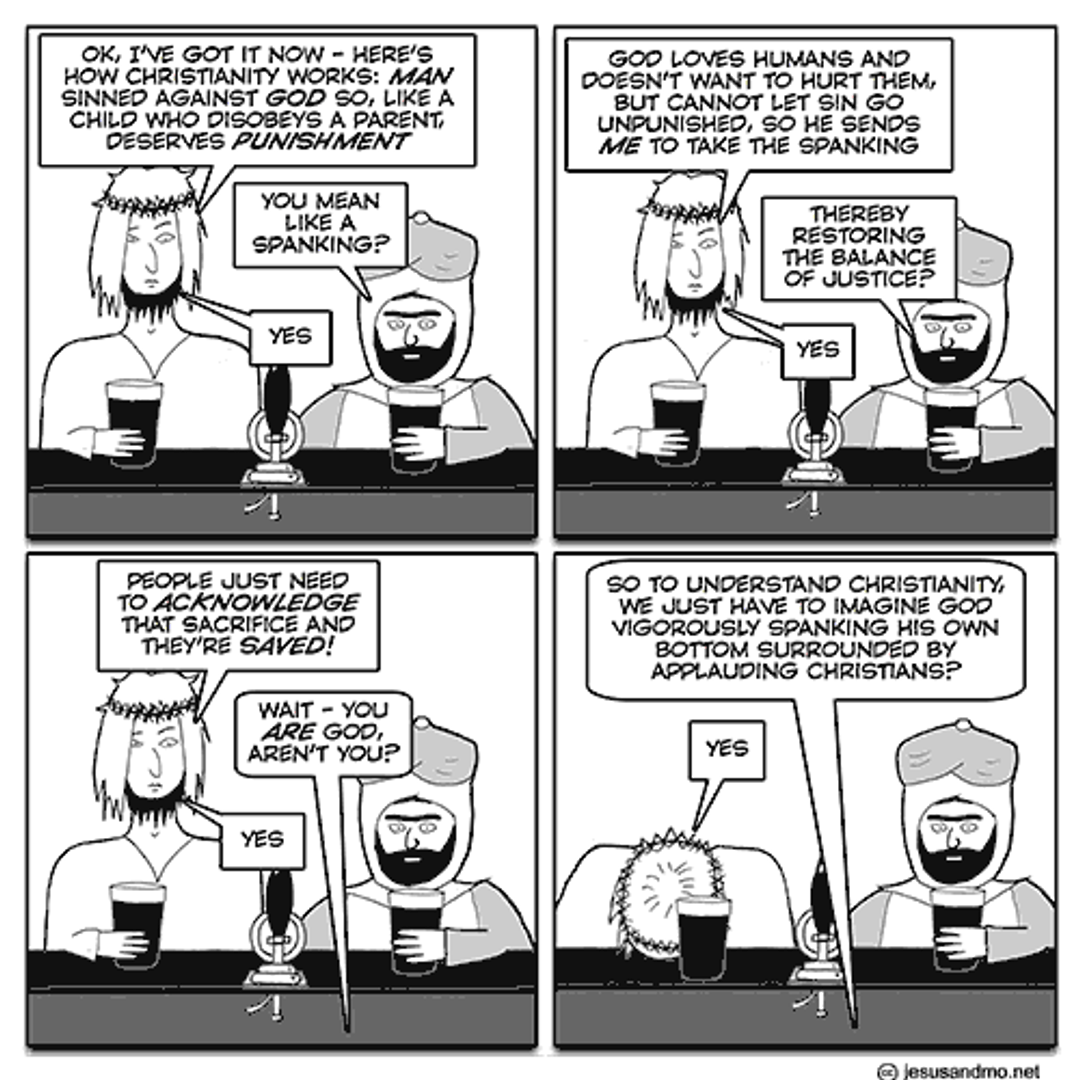
Jesus ‘n’ Mo ‘n’ substitutionary atonement
We have another “Friday Flashback from 9 years ago.” The concept of substitutionary atonement—something that Hitchens used to beef about—has always confused me, as it simply makes no sense. By killing his own son, who is really part of himself, God gave us all the possibility of going to Heaven. Whaaaat?
Mo takes it apart here:
Is the Large Magellanic Cloud a First-Time Visitor?
Our most massive satellite galaxy, the Large Magellanic Cloud (LMC), has been the center of a heated debate in the astrophysics community over the last few years. That debate centers on whether this is the LMC’s first or second “pass” by the Milky Way itself - and it has huge implications for the evolution of our galaxy given the disruption such a large grouping of stars has. A new paper from Scott Lucchini, Jiwon Jesse Han, Sapna Mishra, and Andrew J. Fox and his co-authors, currently available in pre-print on arXiv, provides what they claim to be definitive evidence that this is, in fact, the first time LMC has encountered the Milky Way.
The newly-arrived hen is Vashti
The other day I showed photos of a mallard hen who came to the pond on Wednesday and whose bill markings were strikingly similar to that of Vashti, the hen who departed with her brood of seven a week before last Tuesday. Her behavior, her immediate bonding with Armon, and bill markings all combine to identify her as Vashti, whose brood likely perished after her exit. So it’s bittersweet that she returned again: sadness for the ducklings loss combined with joy and confidence that she’ll breed again. If she does, can we keep her here this time?
Anyway, I attach a few more photos showing a match between Vashti’s bill markings (taken before she fled) and the markings of the “new duck”. Some people were dubious about the hen’s identity, but I’m going with Vashti.
Vashti’s bill is distinguished, on its top side, by a black patch, then a break before the tip, which is again marked with black. Here it is:

Vashti again:

Top of the bill and left side new duck. Notice the two black patches extending ventrally from the left side of the top marking—same as above.

Top of the bill and right side, new duck

The top is a match, and, as I showed last time, so is the right side. Here’s the right side of the new duck again. Notice the match with the photo above: a black patch on the side with a line of speckles to its rear:

New duck, right side:

Given the huge variance in pigmentation of bills among hens, which you’d have to see for yourself to appreciate, the above is enough for me. Our new hen is Vashti. But I’ll also show the left side, for which the photos are not quite as good.
Vashti, left side of bill. There are not many markings but a few black dots below the nostril:

New duck, left side of bill. Notice the line of about five dots below the nostril—same as above.

It’s Vashti, who clearlymade her way back to the familiar pond after losing her brood. There is ample time for her to nest and incubate her eggs again, so I am feeding her a lot to prompt that. She’s bonded with Armon, who never left the pond, and they are showing bonding and courtship behaviors. I am pretty sure she will nest and breed again.
This would not be the first time we’ve had double-brooding here. When Honey stole Dorothy’s brood, getting a batch of 16 to take care of, Dorothy eventually re-nested and produced her own brood, which she did rear to fledging.
Here’s a classic photo of Honey with her mixed brood of 16, half of them ducknapped. She was a great mome, and all of these ducklings fledged. “But isn’t that evolutionarily maladaptive?”, you ask. Perhaps, unless Dorothy and Honey were related. I have no idea if they were, but I think it’s simply a case of a maternal instinct that was coopted, like humans adopting unrelated babies.

Readers’ wildlife photos
Well, brothers and sisters, friends and comrades, this is the last batch of photos I have. If you’re feeling generous and have some good wildlife photos, well, you know what to do.
Today’s lot comes from Ephraim Heller: they are manakins and tanagers from Trinidad and Tobago. Ephraim’s captions are indented, and you can enlarge the photos by clicking on them.
Today we have photos of manakins and tanagers that I photographed on my February visit to Trinidad and Tobago.
The three manakin species in these photographs all engage in lekking. Females choose a partner at the lek, mate, and then depart to build a nest and raise chicks entirely on their own. Males contribute only sperm. This behavior places intense sexual selection pressure on males, driving the evolution of exotic plumage, acrobatic movements, and multi-male performances. I make no comment on potential parallels in human behavior.
Blue-backed manakin (Chiroxiphia pareola) males engage in cooperative lekking. Two males — typically an older dominant individual and a younger subordinate — perform a dance in which they jump over each other on a branch. The female observes, and when she is sufficiently engaged, the subordinate male withdraws and the dominant male completes the mating. In these photos you see one of the males perched on the lekking branch and then performing the jump.


JAC: Here’s a video showing a related lekking species, the Blue manakin (Chiroxiphia caudata) and their remarkable courtship dance. Look at those males lined up, each trying to show he’s a better jumper than the others!
Each white-bearded manakin (Manacus manacus) male clears a small patch of forest floor down to bare earth and maintains one or more bare sticks above it as perches. The display involves rapid leaps between these sticks and the ground accompanied by a shockingly loud cracking sound – it sounds like someone snapping their fingers right next to your ear. It’s produced by the wings connecting above the back, which is enabled by a limb muscle, the scapulohumeralis caudalis, that is the fastest skeletal muscle in any vertebrate. Here you see two white-bearded manakins perched on their lekking branches and preparing to jump to the ground.


JAC: I also added a video of the white-bearded manakin courtship:
The golden-headed manakin (Ceratopipra erythrocephala) male’s lek display includes a “moonwalk” in which it slides backward along a perch. Sadly, I didn’t observe the moonwalk. In these photos the male has the bright yellow head, and you can see a female behind the male in the second photo.


JAC: Here’s a golden-headed manakin male courting, though I can’t really say it’s a “moonwalk.” They also pop their wings.
This gorgeous bay-headed tanager (Tangara gyrola) stopped me dead in my tracks. It has microstructures in its feathers that scatter light to intensify its hues. In addition, a hidden layer of white or black feathers beneath the outer plumage acts as a reflective backing, boosting the brightness and saturation of the visible colors:

The palm tanager (Thraupis palmarum) is one of the most common birds in Trinidad. The second photo is of the nest, which was conveniently located in a planter on our hotel’s balcony:


White-lined tanager (Tachyphonus rufus) males are glossy black, while females are rufous.


The silver-beaked tanager (Ramphocelus carbo):
Pages
