
You are here
News Feeds
How America Lost Its Sense of Humor
In today’s America, humor—like nearly everything else—has become serious business, and in ways at once unusual and plain to see. Never before has every half-drunk joke, or every stumble of language, been so on the record. Welcome to the social media century. Never before have young people been more uptight, more afraid than old people, now labeled as the anxious generation. Never before has stand-up comedy in Republican Texas felt more cutting edge than in New York City.
The comedian Norm Macdonald has called this age a crisis of “clapter”—diagnosing a humorless age where jokes are rewarded with polite applause instead of genuine laughter. It is a mark of social retardation and nervous conformity. A strange fate for one of humanity’s oldest and most complex behaviors. As such, this essay is on the origin of humor, its evolutionary function, and its history in the United States.
The Origin of HumorBabies do it. It exists in every known culture. We even see it in other species. Since Darwin, scientists have developed three ways to test for whether or not a trait evolved by natural selection for adaptive purposes. And by every test, laughter qualifies. That is to say, whatever else humor is, it is first and foremost, a fact of our evolved biology.
To this day, however, neither the scientists nor comedians (nor anyone else for that matter) has been able to produce what might be recognized as “a complete theory of humor.” What follows instead are the core components of a consilient model. These are ideas that do not compete so much as they combine, each explaining a different dimension that converge on a single theme.
1. Humor as play. The most fundamental and widely accepted finding in the study of humor is that it evolved as a function of mammalian play behavior—a way to test limits and roughhouse the rules. Dolphins laugh when they butt heads; elk laugh when they wrestle; and all the apes, including human children, laugh when we are being chased, like playing tag. All of these interactions are games that simulate aggressive predator-prey behavior; like fighting, stalking, hunting, or fleeing, it’s easier to learn the rules of conflict when the danger is make-believe. Laughter, on this account, evolved as a signal to the predator-in-pretend that he is not being perceived as a threat and that playtime can continue.
Laughing out loud is not just a reaction, it is a social tool that helps young mammals learn how to walk the line between aggression and cooperation, between pushing limits and maintaining bonds. It’s a training ground for managing social complexity. And so while we may be the only species that tells jokes, the logic is the same. Louis C.K. explaining that “you should never rape anyone unless you want to cum in them and they won’t let you” or Norm Macdonald reminiscing about “the old days when tweeting meant stabbing a hooker” is what scientists call “verbal play.” Here is how Jerry Seinfeld put it: “Comedy is a very aggressive art form. You put the brain into a vulnerable state [the setup] and then attack and destroy it [the punchline].”
Understanding the role of laughter in distinguishing between aggression and play explains why humor—like no other form of speech—is allowed to not make sense, to cross the line, and to have it not matter. As Louis C.K. often puts it after his punchlines: “I don’t know. I don’t care.”
2. Laughter is a hard to fake signal. Birds laugh, dogs laugh, rats laugh, cows laugh. There are—so far as we have counted—over sixty animal species that laugh. But there is only one species that can fake a laugh, and that’s us. It’s what biologists call nonduchenne laughter (tactical, deliberate, and carefully timed), as opposed to duchenne laughter (involuntary and honest). A duchenne smile—named after anatomist Guillaume Duchenne who first identified it, is characterized by the simultaneous contraction of the zygomatic major muscle (lifting mouth corners) and the orbicularis oculi muscle (crinkling eyes, forming “crow’s feet”), distinguishing it from a forced smile that only uses mouth muscles.
The duchenne smile evolved in humans because we are the only species that has language. In a world where deceiving others has obvious survival and reproductive advantages, language enhances our ability to manipulate beliefs and rig behaviors to our benefit, whether by lying about resources, alliances, or why the basement smells like bleach. In other words, it gives us the ability to influence each other, not just through force or direct observation, but through stories, symbols, and imagination. Try convincing a chimpanzee to give you a banana by promising eternal paradise or warning of a mythical curse and see what happens. Tell the right story to a human, however, and they might just give you all of their arable lands.
All this is to say that once we have language we also have bullshit, and so what we really need is a way to tell who’s full of it. Biologists call it an “honest signal,” and for a slick-tongued species of tricksters, the best we’ve got is duchenne laughter. Less corruptible than speech and harder to counterfeit, it works as a backchannel of communication by revealing genuine and honest feelings inside, unfiltered by words.
Studies suggest that few people can voluntarily produce crow’s feet in their eyes (the telltale sign of duchenne laughter) without feeling genuine joy—it is easy to identify and we respond more positively to it than the fake stuff.
But a laugh, real or not, means little until you know what provoked it.
3. Comedy is surprises. Arguably the most obvious feature of any joke is that the punchline arrives unexpected and upside down. Across cultures and contexts, the most consistent finding in humor research is that without surprise, there is no laugh.
The human brain, at its most basic, is a prediction making machine, honed by natural selection for survival in environments where knowing what’s going to happen before it does keeps you one step ahead of the predators. To know where the predator lurks, when the fruit will ripen, how an ally will behave—all in advance of the fact—is arguably a chief advantage of our big brained species over others. We are, put simply, pattern-seeking junkies—so wired that we are likely to see patterns that don’t exist (patternicity). As such, our awareness is often not of things as they are, but as we expect them to be.
Even our most basic experiences are not records of the present but guesses about what’s to come. Take, for example, drinking water. Our cells do not absorb the intake until about twenty minutes after the fact, but feeling quenched happens almost immediately. It is the brain, anticipating the chemistry that will follow, extending to us in the present the comfort of a future state. Most of life is lived in this way—on credit, in trust—our minds forever writing promissory notes for what the world has not yet delivered.
The advantage of the man with a sense of humor is that he is able to act more rationally by considering multiple angles and weighing their contradictionsBut as much a benefit as there is in good predictions, there is a cost to bad ones. Evolution, therefore, had to do more than just adapt us to anticipate. It had to make us eager to correct our mistakes when reality proved us wrong. Laughter, in this view, evolved as a reward signal for fixing a bad prediction—an outburst of joy that marks the moment our model of the universe just got more accurate. One after another, it is a comedy of errors—predictions misfiring, intentions slipping—that keeps the system honest and the mind awake. As Norm Macdonald explains:
At times, the joy that life attacks me with is unbearable and leads to gasping hysterical laughter. I find myself completely out of control and wonder how life could surprise me again and again and again, so completely. How could a man be a cynic? It is a sin.Yet if laughter were merely a private reward for cognitive course correction, it would be a silent, internal affair. But it isn’t. It is loud, contagious, and social. This is because the same mechanism that helps an individual update their model of the world becomes, in a social species, a powerful tool for establishing shared truths.
4. It’s funny because it’s true. Whether it’s making fun of someone else, making fun of ourselves, or making fun of the situation, we laugh because in some hidden, half-said sort of way, the joke forces us to connect the dots already in our head. It is an unspoken reality suddenly made obvious, but only to the people laughing. Anthropologists call it the encryption model of humor, and it explains humor’s widest social function.
As it suggests, the whole ludic apparatus works like the German Enigma machine of World War II, in which messages were sent via code to receivers who can crack it. In order to “get” a joke, you must share some background knowledge or belief that allows recognition to snap into place. This means that when people are laughing at the same thing, they are effectively signaling that they all possess the same information and preferences, thereby marking themselves as members of the same ingroup.
“You had to be there.” “If you know, you know.” In this way, all jokes are inside jokes, and research shows that the more encrypted comedy is, the funnier people find it. The writer E.B. White once compared explaining a joke to dissecting a frog—you understand it better but the frog dies in the process. Humor is like a bubble, he observed:
It won’t stand much blowing up, and it won’t stand much poking. It has a certain fragility, an evasiveness, which one had best respect. Essentially, it is a complete mystery.And it is this very quality that allows humor to do its dirtiest work—exposing suppressed beliefs, humbling status, challenging groupthink, and revealing unseen truths.
5. We’ve all got a little Jeffrey Dahmer in us—and those of us who deny it rarely laugh at all. Research suggests that people who have a harder time acknowledging difficult truths find less humor in the world. In studies using the self-deception questionnaire, for example, subjects are asked to rate how much they agree (on a scale from “not at all true” to “very true”) with statements such as “More than once it felt good when I heard on the news that someone had been killed” or “I have never done anything that I am ashamed of.” Those who mark more claims as “not true” are scored as higher in self-deception and later observed to laugh less than individuals more able and willing to confess their sins. Other statements on the survey include: “Once in a while I think of things too bad to talk about.” Or: “I have never wanted to rape or be raped by someone.”
If self-deception hides the inconvenient angle, laughter drags it into view by forcing honesty not meant for show.The results reflect two competing adaptations in the evolutionary arms race between liars and lie detectors. On the one hand, self-deception works in service of deceit, allowing lies to roll off the tongue with all the same confident fluency as truth. In other words, by believing our own lies we are less likely to show external cues of deception (e.g., sweaty palms, nervous voice changes, or averted eye contact), which makes them harder to detect. Its function is to protect us from admitting beliefs that might expose weakness, lower status, or trigger shame. Ninety-four percent of professors, for example, think they are in the top half of their field.
But if self-deception hides the inconvenient angle, laughter drags it into view by forcing honesty not meant for show. Chris Rock’s joke that “a man is as faithful as his options,” for example, plays on a familiar tension between our grandiose theories about marriage being a sacrament and our deep animalistic understanding that it’s easy to be faithful if nobody else wants to have sex with you.
Where self-deception narrows the field of vision, humor splits it open. The advantage of the man with a sense of humor is that he is able to act more rationally by considering multiple angles and weighing their contradictions. As Samuel Crothers wrote for The Atlantic in 1899:
The pleasure of humor is of a complex kind. There are some works of art that can be enjoyed by the man of one idea. To enjoy humor one must have at least two ideas. There must be two trains of thought going at full speed in opposite directions, so that there may be a collision. Such an accident does not happen in minds under economical management, that run only one train of thought a day.It is what the poet John Keats called “negative capability”—the ability to keep in mind two incompatible truths that circle one another without resolution. Shakespeare, he argued, possessed this quality to an extraordinary degree, forcing his audience to hold both the positive and negative aspects of a character for as long as possible, denying them the sort of quick and facile judgment most of us make about most things all the time.
6. Funny is when the world won’t fit our ideas. Incongruity theory is the most supported scientific explanation for why humans laugh, and explains laughter as a shock moment of mismatch between the world we know and the world we thought we knew. In other words, comedians tell jokes that violate our expectations, identifying incongruities that can only be resolved by a shift in perspective. The setup creates an expectation, the punchline violates it, and laughter signals the change in perspective.
Take, for example, the old Onion headline: “School Bully Not So Tough Since Being Molested.” The setup primes us to cheer the bully’s downfall … until out of nowhere, like a trigger yanked too soon, the last word detonates that expectation. Had, for example, the line read “School Bully Not So Tough Since Being Cut From The Team”— it would have ended in simple justice, within the range of predicted ends. Instead, “molested” hurls a monkey-wrench perspective onto the tracks. In a flash, it turns the bully we wanted punished into the victim we want to protect—our original point of view bent, broken, flipped end over end like a compass needle snapped loose from north. Put another way, the joke forces contempt and pity to occupy, for a split second, the same moment of experience.
Its feeling is awkward, ambiguous, uncomfortable, bewildering; requiring the mind to twist in on itself, tight and ugly, in order to get the joke. As the character Marlo Stanfield says in season four of The Wire, “[We] want it to be one way. But it’s the other way.”
We want the world to be drawn in clean lines, with answers settled and nonsense gone. But experience proves otherwise.
Humor and Democracy in AmericaIt was for the first time in 1789 that a new generation of men on a whole new continent chose to work with their flaws and make use of the mess. They were a generation of men who laughed at pretension, heckled certainty, and made a sport of nonconformity. This was, in part, because they had an American sense of funny. Only on this side of the Atlantic was humor fully let off the leash, divorced from the polite understanding that jokes ought leave the order intact. In Europe, mockery operated within a fixed aristocratic structure—a pressure valve in a system not designed to change its fundamental hierarchy. In America, however, ridicule was integrated into a self-correcting democratic project.
Historian Henry Steele Commager called American humor a “comedy of circumstance” that made fun of every man, who “at one time or another [had] aimed too high, adventured too boldly [or] boasted too loudly.” It mocked rich people like poor people, made fun of smart people in the same ways as dumb people; because in the United States, no man is allowed to stay king. Commager goes on to describe the American sense of humor like this:
It was fundamentally outrageous, and in this reflected the attitude towards authority and precedent. It celebrated the ludicrous and the grotesque with unruffled gravity … It bore the impress of the frontier long after the frontier had passed. It was leisurely and conversational; the tall story was usually a long story and was designed to be heard rather than read. American humor was shrewd, racy, robust, and masculine … It was generous and good-natured, and malicious only when directed against vanity and pretense. It cultivated understatement not, as with the British, as a sign of sophistication, but as an inverse exaggeration … It was democratic and leveling, took the side of the underdog, ridiculed the great and the proud, and the politician was its natural butt.And as the democratic experiment hurtled forth, so too did its comedic counterpart, growing louder, meaner, and goofier. From the rambling tall tales of the frontier sprang, one after the other, a hard plain line of distinctly American inventions, including vaudeville, the comic strip, sketch shows, and stand-up comedy.
But now, as Americans slip back into the Old World habits we once escaped, both democracy and humor are dying of the same disease.
The Unfunny RevolutionIn 2008, near the peak of his career, Louis C.K. taped what would become one of the most talked-about comedy specials in comedic history. Dedicating the set to his hero George Carlin, who had died earlier that year, Louis began his special with a joke modeled on one of Carlin’s most famous bits—the “seven dirty words”—that in 2008 became “nigger, cunt, faggot.” Operating under the same premise, both jokes asked what kind of society still has forbidden words. Some found it funny, some found it offensive, some found it stupid, and some didn’t care at all. But in 2009, one of the most obscene jokes in American comedy was nominated for an Emmy by the high and mighty Television Academy.
Fifteen years later, that world is unrecognizable. The culture has shifted so completely that now even Jerry Seinfeld—a comedian whose most offensive material pokes fun at airplane food—refuses to play college campuses, citing excessive political correctness. As Chris Rock, another comedian who no longer performs at universities, put it, “You can’t even be offensive on your way to being inoffensive.”
Cartoon by Oliver Ottitsch for SKEPTICThe shift is not just in what Americans find funny. It is a fundamental misunderstanding of the nature and function of humor. In a culture that now treats laughter as a moral act, it’s been bent out of shape by all sides; its purpose twisted into a dog and pony proof of allegiance. On the right, the rules are clear enough—mock the leader, mock the faith, and you’re done. The threat is old school dictatorship. On the left, nobody’s in charge, but everyone’s policing everyone else. The result is a social bureaucracy so sprawling and self-contradictory that no one, least of all the people enforcing it, can tell you where it starts, what it’s for, or whether anyone is still keeping score. Can a man tell a rape joke? Can a woman? Do gay, Black, or fat comedians (or any others belonging to oppressed or marginalized groups) have the exclusive right to make fun of their own group?
But beneath all the shouting lies something simpler: a handful of inconvenient facts that neither orthodoxy can accept.
1. Comedy has no responsibility. Jokes aren’t Hallmark cards. There’s no lesson. No moral mission. Funny has nothing to do with right or wrong, good or bad. If people laugh—the joke works. If they don’t, it doesn’t. It’s that simple. As Seinfeld put it, “The audience is the only judge. If they laugh, it’s funny.”
And whether they laugh for the right reasons, the wrong reasons, or no reason at all, it doesn’t matter. It’s all the same currency. Because again, no committee, no critic, no theoretical or ethical standard, not even comedians themselves, can determine what is funny. Only laughter can.
The impulse to sanitize humor in the name of safety is a well-intentioned but misguided coddling that infantilizes the very people it claims to protect.It is for this reason that comedian Ricky Gervais argues you should never apologize for laughing—because it is an involuntary reflex, born of recognitions we can’t fully name; maddeningly hard to locate, explain, or repeat. Whatever insights, however real, are accidents, not assignments. A joke may be philosophical, but it must not philosophize. It may be moral, but it must not moralize, because life is serious and comedy is not.
2. There is no such thing as punching down. It is a conceit that rests on the fantasy that people exist within a clear hierarchy of oppression and that comedians should consult a moral spreadsheet before telling a joke. Humans, however, are messy, and power is multidimensional. If the joke lands, it’s good, and not because it “punched up,” but because it’s funny. As comedian Rowan Atkinson put it:
You’ve always got to kick up? Really? What if there’s someone extremely smug, arrogant, aggressive, self-satisfied, who happens to be below in society? … There are lots of extremely smug and self-satisfied people in what would be deemed lower down in society, who also deserve to be pulled up.Humor, rather than reinforcing hierarchies, scrambles them, making a carnival of power, where prince and pauper swap faces and butts. People can be both victims and perpetrators at the same time. If a rich guy mocks a poor guy for being poor, he’s an asshole; if a poor guy does it, he’s an asshole too.
The impulse to sanitize humor in the name of safety is a well-intentioned but misguided coddling that infantilizes the very people it claims to protect. To be teased is to be an equal; to be seen as resilient enough to take a joke and confident enough to play along. Because good humor, by refusing to grant anyone a permanent victim’s pass, reminds us that our shared humanity, not our segregated identities, is the ultimate leveler.
3. The subject is not always the target. I heard a joke at an open mic the other day about a newspaper headline that read “World’s Worst Pedophile.” The story was about a man who had molested hundreds of children. After reading the headline, the comedian asked, “Shouldn’t he be the world’s best pedophile? I mean … the world’s worst pedophile—he’s been trying for years. He can’t afford the good candy, so he hands out stale trail mix. His van won’t start …” If you think the joke is making fun of molesting children or that it’s about finding pedophilia funny, you’re an idiot. It’s making fun of reporters and sloppy language.
But even if the joke actually was about pedophilia—as in Louis C.K.’s Saturday Night Live monologue, where he compares the joy of eating his favorite candy bar to what sex with children must be like for a child molester—treating a topic playfully doesn’t erase its gravity; it just recognizes that serious issues need not always be handled seriously.
Forcing comedy to seek 100 percent approval is like demanding a surgeon operate with a butter knife—you remove the danger, but you also remove the point.4. Failure is the process. Even the best comics bomb; but in a decontextualized culture incentivized to screenshot rather than understand, we’ve made a habit of demanding perfection on the first try. The trouble is that, while great jokes look effortless, they’re the end result of a process that’s anything but. As David Chase said about the hundred hour weeks he spent making The Sopranos—“hard work looks like magic.” Seinfeld once said he spent 20 minutes fine-tuning a single syllable. Chris Rock worked on three of his jokes in a recent Netflix special for over a decade. Being funny is hard—and comics need the space to fail. If you’ve ever watched open mics and seen the same comedians go up week after week to tinker with their bits, you know that the difference between killing and bombing often hinges on a single well-timed pause. Perhaps comedian Ari Shaffir summed it up best:
Failing is part of my process … A new bit never works the first time. I figure I have to bomb seven times to make it good. So I tweak it. Then maybe the next time it will do great … but then it will fall flat again. So I’ll make more adjustments. Then it will be great, then it will be terrible again … and all of that is okay.This is why people who understand the function of humor tend to be more forgiving when things go wrong; and comedians are the most likely to forgive a failed joke. Dave Chappelle, for instance, responded to Michael Richards (Kramer on Seinfeld) calling a heckler a “nigger” at the Laugh Factory—an incident widely perceived as genuinely racist—by saying that he learned that he was 20 percent Black and 80 percent comedian:
The Black part of me was offended and hurt, but the comedian part was like, “Whoo, dude is having a bad set. Hang in there, Kramer!”The bottom line is this—good jokes can’t emerge without experimentation. If it kills—great. If it doesn’t, better—it means you’re part of a free society.
5. Risk is the form. Most humor involves taking risks. Larry David, for example, compared stand-up comedy to diving. You get extra points for degree of difficulty. Seinfeld said that jokes are like leaping from one tall building to another—the further the distance, the harder the joke. There is a big payoff if you can bring the audience with you, but if you try to jump too far or the dive is too difficult and you aren’t yet good enough, the joke bombs. This is why the worst thing you can do as a comedian is play it safe. As Patrice O’Neal put it: “The idea of comedy, really, is not [that] everybody should be laughing. It should be about 50 people laughing and 50 people horrified.”
Forcing comedy to seek 100 percent approval is like demanding a surgeon operate with a butter knife—you remove the danger, but you also remove the point.
The Last LaughHumor is not meant to be figured out, put to use, or taken seriously. It is meant to be experienced. But in a botox-bleached nation of caped crusaders wearing noise-cancelling headphones, deaf to anything but our own theme music and the imagined sound of unseen eggshells cracking beneath; Americans are being starved of the freedom to play without purpose.
Like an overzealous gardener who, in his war against the dandelion, has paved his entire yard with concrete, we are succeeding in eradicating the weed of offense but in the process killing the soil where flowers take root.
All of us, each so consumed in our own tiny corner of the universe, must be reminded every now and again that the world is what it is, and our ideas about it are not. It’s a ticklish business.
Bill Maher’s new rule: The King’s speech
Bill Maher’s latest “Real Time” clip argues that we should get rid of the State of the Union Address (coming up Tuesday), at least under Trump. That’s because to Maher it’s ludicrous that Trump keeps appropriating the powers of Congress for himself, violating our Constitutional separation of powers. The speech has become, says Maher, not a summary of how we’re doing, but a series of future Diktats. Congress seems to have become superfluous: a “supporting actor.” In fact, Jefferson didn’t even favor the President speaking to Congress in this way.
Look at these guests: U.S. Representative Lauren Boebert (R-CO) and Texas State Representative James Talarico (D-TX). Boebert looks like she’s been spending some time in a tanning bed.
As Maher says, the real state of the Union is “hopelessly divided.”
A muddled argument: Shermer argues for the reality of free will
Michael Shermer has a new book out called Truth: What it is, How to Find it, and Why it Still Matters, and I’ve mentioned it before. I’m reading it now, and there’s a lot of good stuff in it. But one of the twelve chapters—the one on free will—is, I think, misguided and confusing. In the preceding link you’ll find a video he made about free will, as well as my critique of it. You may not want to read this post if you’ve read the previous one, but the video differs slightly from the article I discuss below.
So here’s my take 2 on Shermer’s views, recently expressed in a longish article in Quillette. (Michael was kind enough to send me a pdf, so I presume he wants my take.) Read it by clicking on the screenshot below, or find it archived for free here.
In short, Shermer is somewhat of a compatibilist—or so I think, for though doesn’t seem to fully on board with libertarian “you-could-have-done-otherwise” free will, but neither does he accept physical determinism. Further, he doesn’t seem to think that “you could have done otherwise” is even testable, as we’re never in the same situation twice.
He’s right about the untestability criterion. But that doesn’t matter, for even if we were in the identical situation, with every molecule in the universe exactly as it was the first time, there are fundamentally unpredictable events of the quantum kind that might lead to slightly different outcomes. And the more distant in the future we look, the more divergent the outcomes will be. I’ve already noted that the future is probably not completely determined because quantum events could be cumulative. In evolution, for instance, natural selection depends on the existence of different forms of genes that arise by mutation. If quantum effects on DNA molecules can lead to different mutations, then the raw material of evolution could differ if the tape of life is rewound, and different things could evolve.
Further, if quantum phenomena affect neurons and behavior, it’s possible—barely, possible, I’d say—that in two identical situations you could behave differently. I don’t believe that, and neither does neuroscientist Robert Sapolsky, but quantum phenomena that affect molecular movement or positions do not give us free will, as our “will”, whatever that is, doesn’t affect the physical behavior of matter. And so, if we use Anthony Cashmore’s definition of “free will” as given in his 2010 paper in PNAS (the paper that made me a determinist), fundamentally unpredictable quantum effects do not efface free will. Cashmore:
I believe that free will is better defined as a belief that there is a component to biological behavior that is something more than the unavoidable consequences of the genetic and environmental history of the individual and the possible stochastic laws of nature.
Cashmore takes care of quantum effects by lumping them as the “possible stochastic laws of nature.” (Some physicists think that quantum mechanics is really deterministic though it seems otherwise.)
But Shermer doesn’t talk much about quantum physics—in fact, he doesn’t mention it at all. He simply argues by assertion, saying that yes, we could have done otherwise, and we could have done so on the rather nebulous bases of “self-organization” and “emergence”. Let’s take the assertions first. I’ll have to quote at greater length than usual:
Since philosophers love to employ thought experiments to test ideas, here’s one for you to consider (feel free to plug yourself and your spouse or significant other into the situation): John Doe is an exceptionally moral person who is happily married to Jane. The chances of John ever cheating on Jane is close to zero. But the odds are not zero because John is human, so let’s say—for the sake of argument—that John has a one-night stand while on the road and Jane finds out. How does John account for his actions? Does he, pace the standard deterministic explanation for human behaviour (as in Harris’s and Sapolsky’s definitions above), say something like this to Jane?
Honey, my will is simply not of my own making. My thoughts and intentions emerge from background causes of which I am unaware and over which I exert no conscious control. I do not have the freedom you think I have. I could not have done otherwise because I am nothing more or less than the cumulative biological and environmental luck, over which I had no control, that brought me to the moment of infidelity…
Could John even finish the thought before the stinging slap of Jane’s hand across his face terminated the rationalisation? If free will is the power to do otherwise, as it is typically defined by philosophers, both John and Jane know that, of course, he could have done otherwise, and she reminds him that should such similar circumstances arise again he damn well better make the right choice… or else.
This is argument against free will by assertion alone. What his wife is evincing here is her illusion of free will. Nobody denies the fact that we feel that we could make real choices. But that doesn’t mean that we do.
But where’s the evidence that John Doe could have refrained from his one-night stand? He is correct in thinking that he could have not done otherwise (how could he unless some undefinable, nonphysical “will” affected his libido?), but his wife, subject to the universal illusion that our behavior is more than “the unavoidable consequences of the genetic and environmental history of the individual and the possible stochastic laws of nature”, believes in some undefinable property called “will” that could change the outcomes of a given situation. She thinks that John could have chosen not to fall prey to the allure of that other woman.
So Jane gives John a slap (that slap, too, was determined). And the slap could change John’s future behavior so that he refrains from other affairs, for, like all vertebrates, we learn from experience. That’s the result of evolution. (Keep kicking a friendly dog and see how long it remains friendly!). He concludes what’s below (bolding is mine): But nobody with any neurons to rub together argues that changing behavior via learning somehow violates determinism.
More from Shermer:
But this is not the universe we live in. In our universe (unlike the one in which thought experiments are run), the Second Law of Thermodynamics and entropy means that time flows forward and no future scenario can ever perfectly match one from the past. As Heraclitus’ idiom informs us, “you can’t step into the same river twice,” because you are different and the river is different. What you did in the past influences what you choose to do next in future circumstances (the technical name for this is “learning”), which are always different from the past. So, while the world is determined, we are active agents in determining our decisions going forward in a self-determined way, in the context of what already happened and what might happen. Our universe is not pre-determined but rather post-determined, and we are part of the causal net of the myriad determining factors to create that post-determined world. Far from self-determinism being a downer, it’s the ultimate upper because it means we can do something about the future, namely, we can change it!
I don’t really understand this paragraph, nor the part in bold. In what sense are we active agents in determining our decisions in the future? Shermer doesn’t tell us, but he seems to be thinking of some nonphysical power of “will” to change the physics that governs our brains and behaviors. In fact, there is redundancy here: we determine our decision because our behavior is self-determined!
Apparently Shermer rejects physical determinism because, given the present, more than one future is possible. The laws of physics are likely to be, at bottom, unpredictable, though their effects on “macro” phenomena are probably minimal, and their effects on the behavior of human and other creatures is unknown. Shermer is even somewhat rude to determinists like Sam Harris and Robert Sapolsky (and, implicitly, me, as I’m with them): we are hidebound reductionists plagued by “physics envy” (bolding is mine):
Do determinists really fall into the trap of pure reductionism? They do. Here is the determinist Robert Sapolsky defending his belief that free will does not exist because single neurons don’t have it: “Individual neurons don’t become causeless causes that defy gravity and help generate free will just because they’re interacting with lots of other neurons.” In fact, billions of interacting neurons is exactly where self-determinism arises. But Sapolsky is having none of that: “A lot of people have linked emergence and free will; I will not consider most of them because, to be frank, I can’t understand what they’re suggesting, and to be franker, I don’t think the lack of comprehension is entirely my fault.”
Determinists like Harris and Sapolsky have physics envy. The history of science is littered with the failed pipe dreams of ever-alluring reductionist schemes to explain the inner workings of the mind—schemes increasingly set forth in the ambitious wake of Descartes’ own famous attempt, some four centuries ago, to reduce all mental functioning to the actions of swirling vortices of atoms, supposedly dancing their way to consciousness. Such Cartesian dreams provide a sense of certainty, but they quickly fade in the face of the complexities of biology. We should be exploring consciousness and choice at the neural level and higher, where the arrow of causal analysis points up toward such principles as emergence and self-organisation.
So what is there to behavior beyond atoms moving around according to physical principles? Shermer doesn’t tell us, but he seems determined (excuse the pun) to convince us that we do have free will, and it seems to be of the libertarian sort! He even evokes the mysteries of consciousness, which many people, including Francis Crick, think is best studied not from a “top down” approach, but from a reductionist “bottom up” approach. And we know from various experiments and observations that we can affect our notion of “will”, making us seem like we have it when we don’t (people who suddenly confabulate a purpose when they behave according to stimulation of the brain), or making us seem like we lack it when we are actually acting deterministically (e.g., ouija boards). We can take away consciousness with anesthesia, restore it again, or alter it with psychedelic drugs. All this implies that yes, consciousness and “will” are both phenomena stemming from physics.
Shermer rejects bottom-up approaches, raising the spectres of “self-organization and emergence” as arguments against Cashmore’s form of free will:
This we have through the sciences of complexity, in which we recognise the properties of self-organisation and emergence that arise out of complex adaptive systems, which grow and learn as they change, and they are autocatalytic—containing self-driving feedback loops. For example:
Water is a self-organised emergent property of a particular arrangement of hydrogen and oxygen molecules.
Complex life is a self-organised emergent property of simple life, where simple prokaryote cells self-organised to become more complex eukaryote cells (the little organelles inside cells were once self-contained independent cells).
Consciousness is a self-organised emergent property of billions of neurons firing in patterns in the brain.
Language is a self-organised emergent property of thousands of words spoken in communication between language users.
That list goes on, but it’s muddled. First, what do we mean by “self-organized” properties? Is water “self organized” beyond behaving in a glass in ways that are consistent with, but not necessarily predictable from, the behavior of a single water molecule? Ditto for complex life. In what sense are life and water “self-organized” rather than “organized by physics”? Yes, there are emergent properties, like the Eroica emerging from the pen of Beethoven, himself an admirable collection of organic molecules with the emergent property of writing great music.
Let’s dismiss “self-organization,” which seems like a buzzword that doesn’t advance Shermer’s argument, and concentrate instead on “emergence.” Yes, water is wet. “Wetness” is a quale evinced in our consciousness, yet the properties of water that make it feel wet are surely consistent with, and result form, the laws of physics, just as the “pressure” of gas in a container is an emergent property of a bunch of gas molecules acting as a group. But nobody says that gas molecules have free will, even though some of their properties are “emergent.”
The issue here is not whether emergence is something predictable from a reductionist analysis, but whether it is something physically consistent with its reductionist constituents. If the laws of physics be true, then that consistency does nothing to efface determinism. Shermer’s failure is that he neglects to tell us the nature of something called a “will” that interposes itself between molecule and behavior. And often, with greater knowledge of physics we can predict emergent properties from a reductionist analysis. (The gas laws are one such thing.)
I’ll draw this to a close now, adding one more note. Shermer’s failure is twofold. He fails to suggest how an undefined “will” can affect the behavior of matter, and he mistakes determinism for predictability, a rookie error. If quantum mechanics is a good explanation of physics, then the future is not 100% predictable, even if we had perfect knowledge of everything, which of course we don’t. And physicists tell me that quantum effects were important at the Big Bang, so at that moment the future of the entire universe was unpredictable. That says nothing about free will.
Shermer closes with another paragraph that I don’t understand; it sounds in some ways (this may anger him, but I apologize) like Deepak Chopra:
It may seem odd to think of yourself as a past-self, present-self, and future self, but as suggested in this language, your “self” is not fixed from birth, destined to a future over which you have no control. We live not only in space, but in time, and as such no matter the pre-conditioning factors nudging you along a given pathway—your genes, upbringing, culture, luck and contingent history—there is always wiggle room to alter future conditions. The river of time flows ever onward and you are part of its future.
Act accordingly.
This is more argument by assertion alone. I’m not sure what he means by “act accordingly”, much less “wiggle room.” Of course we can be influenced by what we read, but we don’t have a “will” that could alter what we do at any given moment. As Cashmore said in his article:
Here I argue that the way we use the concept of free will is nonsensical. The beauty of the mind of man has nothing to do with free will or any unique hold that biology has on select laws of physics or chemistry. This beauty lies in the complexity of the chemistry and cell biology of the brain, which enables a select few of us to compose like Mozart and Verdi, and the rest of us to appreciate listening to these compositions. The reality is, not only do we have no more free will than a fly or a bacterium, in actuality we have no more free will than a bowl of sugar.
I don’t mind being like a bowl of sugar, or, rather, a complex piece of animated meat. I admire Shermer for all he’s done to further skepticism and attack quackery, but I think that on the issue of free will he’s gone awry.
From AI:

Exomoons Could Reveal Themselves Through Lunar Eclipses
Our solar system hosts almost 900 known moons, with more than 400 orbiting the eight planets while the remaining orbit dwarf planets, asteroids, and Trans-Neptunian Objects (TNOs). Of these, only a handful are targets for astrobiology and could potentially support life as we know it, including Jupiter’s moons Europa and Ganymede, and Saturn’s moon Titan and Enceladus. While these moons orbit two of the largest planets in our solar system, what about moons orbiting giant exoplanets, also called exomoons? But, to find life on exomoons, scientists need to find exomoons to begin with.
Best country crossover Songs
It’s Saturday, a day of posting persiflage, and so I proffer another section of my life of “Coyne’s Best songs.” Remember, I’m limited to judging what I’ve heard, and here are what I consider to be. . .
The Best Country Crossover Songs
El Paso Marty Robbins
I’m So Lonesome I Could Cry Hank Williams
End of the World Skeeter Davis
Crazy Patsy Cline (written by Willie Nelson)
We’ll Sing in the Sunshine Gail Garnett
Stand By Your Man Tammy Wynette
Wichita Lineman Glenn Campbell
Gentle on My Mind Glenn Campbell
Galveston Glenn Campbell
Behind Closed Doors Charlie Rich
Ruby (Don’t Take Your Love to Town) Kenny Rogers & the First Edition
Right Time of the Night Jennifer Warnes
I Will Always Love You Dolly Parton
Here You Come Again Dolly Parton
Send Me Down to Tucson Mel Tillis
I Need You LeAnn Rimes
Amy Pure Prairie League
Snowbird Anne Murray
Sixteen Tons Tennessee Ernie Ford
Now not all these songs were recorded to be “country songs,” but all of them are at least countrified—that is, in the stuyle of country music. And I love all of them. Some are now very obscure (e.g., “Send me Down to Tucson,” “Snowbird”, and of course who remembers “Sixteen Tons,” once hugely popular), but all are great music. I’ll put a few up for your listening pleasure. You are invited to note your own country crossover songs in the comments:
You’ll notice that there are three songs featuring Glenn Campbell on the list, and “Galveston” is the least popular of the three, but it’s the one that most moves me (all are wonderful). Campbell, originally a session musician in the famous “Wrecking Crew“, was a world-class guitarist, you’ll see below from his fantastic solo that starts slowly with the melody at 4:27 and then goes off into space. (For another example of his virtuosity, see the section of “Gentle on My Mind” performed live here). “Galveston” was written by Jimmy Webb and released by Campbell in 2003 after it flopped with Don Ho.
The YouTube notes:
From 2002, Glen Campbell & Steve Wariner perform “Galveston”, introduced by Brad Paisley, with video intro that includes comments by Merle Haggard, Keith Urban, Melissa Etheridge, Toby Keith, Radney
Foster, Tracy Byrd, Robert K. Oermann, and Tom Roland.
The performance starts at 2:32, but don’t miss the introductory interviews.
Oh, hell, I’ll put his “Gentle on My Mind” performance below. How many country stars can you recognize?
The inimitable Dolly Parton (“It takes a lot of money to make me look this cheap”), singing one of her more recent hits, “Here You Come Again“, written by the famous duo Barry Mann and Cynthia Weil, and released in 1977.
Another early one from Dolly, written by her and released in 1973. It was her fond farewell to Porter Wagoner, who was her mentor but was also overbearing (they were not romantically involved). A bit from Wikipedia:
Country music singer-songwriter Dolly Parton wrote the song in 1973 for her one-time partner and mentor Porter Wagoner, from whom she was separating professionally after a seven-year partnership. She recorded it in RCA Studio B in Nashville on June 12, 1973.
Author Curtis W. Ellison stated that the song “speaks about the breakup of a relationship between a man and a woman that does not descend into unremitting domestic turmoil, but instead envisions parting with respect – because of the initiative of the woman”. The country love track is set in a time signature of common time with a tempo of 66 beats per minute. (Larghetto/Adagio) Although Parton found much success with the song, many people are unaware of its origin; during an interview, Parton’s manager Danny Nozel said that “one thing we found out from American Idol is that most people don’t know that Dolly Parton wrote [the track]”. During an interview on The Bobby Bones Show, Dolly Parton revealed that she wrote her signature song “Jolene” on the same day that she wrote “I Will Always Love You.” Parton clarified later, “I don’t really know if they were written in the same night.”
LeAnn Rimes may still be around, but she doesn’t have a high profile. Released in 2000, “I Need You” (there’s another country song with the same title) may have been the apogee of Rimes’s career, and it’s a great song. Here it is performed live on the Jay Leno Show in 2000. It may be classified as a “pop ballad,” but I’m putting it in the country crossover category become Rimes was a country singer before this came out.
“We’ll Sing in the Sunshine,” recorded by Gale Garnett in 1964, was a hit on both country-music and pop charts. Who remembers this one? It’s very bittersweet, about a woman who tells her man that they’ll have their day in the sun, but it will last only a year. This is clearly a lip-synch of the original version.
And Skeeter Davis (real name Mary Frances Penick, with a nickname that means “mosquito” in slang) singing “The End of the World” (1962). It’s another lip-synched song, but no less great for it. (Her hair is definitely country here.) She died of breast cancer at 72, performing right up to the end.
Finally, Charlie Rich singing “Behind Closed Doors” (1973), with a theme similar to “Send me Down to Tucson,” but with the latter involving two different women.
I’ve neglected songs by greats like Hank Williams and Patsy Cline, but you can check them out for yourself. Remember that Cline’s big hit “Crazy” (1961) was written by Willie Nelson, who’s still with us.
Caturday felid trifecta: Driverless car kills beloved cat; Nutmeg, the titular mayor of Sellwood, OR; Jonah Goldberg says goodbye to his cat Gracie; and lagniappe
Today’s Caturday report is a bit sad in that two of the items involve moggies who died. But we all do, and sometimes we need to read about people’s reactions to moggies who have crossed the Rainbow Bridge.
The first piece comes from the NYT, and you can read it by clicking the headline or reading the free version archived here. This involved a beloved local cat called Kit Kat, who suffered a needless death from a driverless car.
A recent poster from the supervisor’s Instagram post:

An excerpt:
At Delirium, a dive bar in San Francisco’s Mission District, the décor is dark, the drinks are strong, and the emotions are raw. The punk rockers and old-school city natives here look tough, but they are in mourning.
Kit Kat used to bar-hop along the block, slinking into Delirium for company and chin rubs. Everybody knew the bodega cat, affectionately calling him the Mayor of 16th Street. Kit Kat was their “dawg,” the guys hanging out on the corner said.
But shortly before midnight on Oct. 27, the tabby was run over just outside the bar and left for dead. The culprit?
A robot taxi.
Hundreds of animals are killed by human drivers in San Francisco each year. But the death of a single cat, crushed by the back tire of a Waymo self-driving taxi, has infuriated some residents in the Mission who loved Kit Kat — and led to consternation among those who resent how automation has encroached on so many parts of society.
. . .Kit Kat’s death has sparked outrage and debate for the past three weeks in San Francisco. A feline shrine quickly emerged. Tempers flared on social media, with some bemoaning the way robot taxis had taken over the city and others wondering why there hadn’t been the same level of concern over the San Francisco pedestrians and pets killed by human drivers over the years.
You can see a picture of the shrine below, taken from Facebook;
More:
A city supervisor called for state leaders to give residents local control over self-driving taxis. And, this being San Francisco, there are now rival Kit Kat meme coins inspired by the cat’s demise.
. . . . But all of that is noise at Delirium. Kit Kat was loved there. And now he is gone.
“Kit Kat had star quality,” said Lee Ellsworth, wearing a San Francisco 49ers hat and drinking a can of Pabst Blue Ribbon beer.
. . .Kit Kat’s death has given new fuel to detractors. They argue that robot taxis steal riders from public transit, eliminate jobs for people, enrich Silicon Valley executives — and are just plain creepy.
Jackie Fielder, a progressive San Francisco supervisor who represents the Mission District, has been among the most vocal critics. She introduced a city resolution after Kit Kat’s death that calls for the state Legislature to let voters decide if driverless cars can operate where they live. (Currently, the state regulates autonomous vehicles in California.)
“A human driver can be held accountable, can hop out, say sorry, can be tracked down by police if it’s a hit-and-run,” Ms. Fielder said in an interview. “Here, there is no one to hold accountable.”
. . .Waymo does not dispute that one of its cars killed Kit Kat. The company released a statement saying that when one of its vehicles was picking up passengers, a cat “darted under our vehicle as it was pulling away.”
“We send our deepest sympathies to the cat’s owner and the community who knew and loved him,” Waymo said in a statement.
I think Waymo also made a donation to a cat charity, but that’s not enough. One cat is too much!
What do you think about driverless cars?
The shrine, from Cats Doing Cat Stuff:

A short CNN video showing Kit Kat as well as Jackie Fielder demanding the right of community regulation of self-driving vehicles. I agree!
********************
Willamette Week reports on yet another semi-feral cat who is a mayor (alive this time): Nutmeg, the mayor of a part of Portland called Sellwood, Click to read:
I love how Nutmeg gets carried home every evening! An excerpt:
It’s not clear what drew Nutmeg to the Sellwood CVS. He’s a 14-year-old cat who, for most of his life, has preferred to spend as much time outside as possible. But in October or November of last year, the long-haired ginger started hanging out in the store’s parking lot. Then he figured out how the store’s automatic doors worked and wandered in.
One clue: CVS does carry some pet supplies, and John Burgon, an Executive Security guard, tells WW that Nutmeg once tore into a bag of cat treats and helped himself. He also once broke into the store’s pharmacy, though it’s unclear whether he was attempting a Drugstore Cowboy-style heist or simply exploring a potential career as a pharmacy technician, as his owner, Joe Moore, suggests.
Moore and his wife, Gabi, adopted Nutmeg a year ago after a friend had to rehome him. The cat was born under a trailer in Boone County, West Virginia, and has spent the bulk of his life in Centralia, Wash., as a mostly outdoor cat. The Moores set him up with a heated dog house in the backyard, put a collar and tag on him (along with an AirTag), and let him continue his wandering ways, though they do bring him in at night.
Store manager Mike Rogers says Nutmeg usually comes in early in the evening and hangs out until the store closes at 10. At that point, Joe Moore comes in—the store is about half a block from the Moores’ house—and carries him home.
. . .customers love him, the Moores love knowing he’s somewhere safe, and staff is delighted to have Nutmeg around, providing him with a fleece blanket and on-the-job snacks. Sometimes, Rogers says, he perches on the counter and quietly demands petting from customers.
“He’s basically become our Norm from Cheers.”
Click below go to the Facebook post:
And a video in an Instagram post; if you can’t see it, click “View this post” link to see Nutmeg in the fur:
View this post on Instagram
A post shared by Willamette Week (@willametteweek)
********************
From The Dispatch, a man says farewell to a beloved cat (article archived here):
You can see Gracie above. Here’s an excerpt, but you can read the whole elegy at the free link above:
We got Gracie almost 18 years ago from the shelter. Our daughter, then 5, wanted a kitten. We wanted a kitten. But there was a lady volunteer at the shelter who had a tip for us. People throw around the term “cat lady” a lot, but she was the real thing. I remember her sweater seemed to be on backward, and she gave the distinct impression that the shelter cats were just the surplus from the much larger supply at her house. But she was very kind. More importantly, she knew her cats. In movies, and a few TV shows, one of my favorite bit characters is the racing tout. You know, the shoeshine guy or omnipresent loiterer with a toothpick or cigarillo in his mouth and racing form in his hand who seems to know everything about every horse (“His muddah was a mudder”). That was this lady, but for cats.
She took a shine to us and said something like, “Take a look at that one. I see something special.”
She pointed to a thin gray cat, a few months out of little-kittenhood. She was regal but friendly. Lucy, my daughter, decided she was the one when another family seemed to want her, and Lucy’s jealousy told her we needed to act. We put our names down for her.
But the high-stakes world of cat adoption in the nation’s capital being what it is, we couldn’t just take the yet-to-be-named Gracie home. Because we had a dog, the people at the shelter had to be sure that, Bill Murray’s insinuations about “cats and dogs living together” aside, they would get along. They required an introduction, on the premises. So, we made an appointment and came back a few days later with Cosmo the Wonderdog. We waited in a canine-feline interaction room. They brought in Gracie. Gracie saw Cosmo, and her tail inflated tenfold. Imagine one of those shawarma cones at the gyro joint, but made of fluffy gray fur.
. . .Gracie was the friendliest cat I’ve ever known. After a brief interrogation, she would let anybody rub her belly. She insisted upon sitting on every visitor’s lap—or at least trying. Every cat sitter we’ve ever had fell in love with her, because she was so lovable.
But I know a lot of people don’t want to hear a lot of stories about a cat. Talking about your pets can be a bit like describing your dreams: It’s got to be pretty unusual to be interesting at all. And I know from experience that there are a lot of people who will say, “It’s just a cat.”
No, it’s not.
I feel a strange obligation to explain this to people who don’t get it. And there are a lot of them.
When people say, “It’s just a cat,” or “It’s only a dog,” I hear a confession that they have never loved a cat or dog, not really. Such admissions of emotional ignorance clank off my ear and pinch my heart the same way as hearing that someone’s grandmother was “just an old lady.” No, I am not saying that there’s moral equivalence between people and animals. I’m saying that the love people feel for their animals is a real form of love. The people who leap at the opportunity to take offense, or simply argue, at such comparisons miss the point entirely. They want to drag reason into a realm where reason isn’t all that useful and even less welcome. I’m fine if people think loving animals is irrational in the exact same way I’m fine with people saying loving anything or anyone is irrational. I think they’re wrong. I can give you a rational explanation, a just-so story about evolution and whatnot. The materialists will tell you that love is an evolutionary mechanism necessary for ensuring your genes pass on. Okay, fine, maybe, probably, whatever; but who cares? The only relevant fact is that we love. And so do animals.
. . . and the sad farewell. Pay attention to the Jewish expression, one that I love, and is really the only thing you can say as condolence if you don’t believe in God (and many who do believe say it anyway):
This has been a horrible week in a pretty horrible year. My daughter loved her girl more than anything. I love Lucy more than anything. The pain she went through as we ran out of medical options for Gracie and had not only to say goodbye to Gracie but to be the facilitator of her passing and the end of her suffering was indescribable. Lucy’s pain multiplied my sorrow at losing this wonderful creature who served as a center of gravity in my family. They say you’re only as happy as your least happy child. Well, Lucy’s the only child I have, and so her misery is my own. As a dad, I take some solace in the fact that Lucy will learn important things from all of this, but those lessons are learned over time. This has been some terrible quality time, but it will improve as it melts into quantity time.
One of the best expressions the Jews have given the world is “May their memory be a blessing.” Having lost so many people, and so many animals, I’ve come to have a deep appreciation for this simple condolence. It’s partly why I unapologetically talk about my parents and brother so often. It honors them and my debts to them. But more than that, it brings joy. It keeps them alive in the only way possible in this life. It demonstrates that even when family members depart, the family endures and carries their indelible imprint. Amid all the crying these last few days, we’ve already started telling stories about Gracie and sharing pictures of her. Because her memory is a blessing, not just because we loved this silly creature, but because our family formed in so many ways around her. And family is a blessing, one of the only real ones in life.
********************
Lagniappe: A moggyt photobomb
The man wanted to record the romantic moments he was dancing with his wife, but an uninvited guest joined in. pic.twitter.com/bSjHXygRxs
— The Figen (@TheFigen_) February 13, 2026
And Nimbus, the Mount Washington Observatory Cat:
h/t: Marion
Readers’ wildlife photos
We have yet another batch of photos, this time from reader Jan Malik. Jan’s captions and IDs are indented, and you can enlarge the photos by clicking on them.
During the recent bout of cold weather, I made a short trip to the New Jersey shore—Barnegat Light, a location known for wintering sea ducks. Most of the time it is a great place to see birds (and often harbor seals), but this time, with temperatures around 5°F and an exposed jetty blasted by incessant wind, animals were few and far between. Standing with the sun behind you—the usual orientation for decent photographs—meant exposing your face to the arctic wind, something tolerable only for a few seconds at a time. In these conditions I didn’t stay long, so what I have is a small set of photographs that could be titled: How birds survive bitterly cold weather.
American Herring Gulls (Larus smithsonianus). The sitting bird found a fish (in the lower right corner), but it was completely frozen, and even a perpetually hungry gull couldn’t swallow it. Instead, it was using it as “bait” to lure what I imagine is a female (judging by her slightly smaller size). Gulls normally defend their food aggressively, but they may share it with potential mates as the breeding season approaches. Note that the vocalizing gull is squatting to hide its bare feet and is facing into the wind—both strategies to minimize heat loss:

Barnegat Light lighthouse, built in 1859 and still functional. Note the frozen brackish water at the rock jetty, the result of prolonged low temperatures—a rare sight in New Jersey:

Distant Red‑breasted Merganser (Mergus serrator). The second part of its scientific name refers to its serrated bill. This is a diving duck, so as long as some water remains open it should have access to food. The problem was that the channel was almost frozen solid near the jetty, where the shallow water normally suits these ducks best. In the center of the channel the water was full of drifting ice, and it was there—in deeper water, where catching fish is harder—that this bird had to feed:

A flock of ducks, probably Greater Scaup (Aythya marila). Many birds in the flock were airborne, likely migrating locally in search of warmer weather and ice‑free water. None landed on the ice floes:

A Long‑tailed Duck (Clangula hyemalis) resting on a drifting ice floe and trying to limit heat loss by turning its body into the numbing wind. This one is probably an immature male: it has extensive white plumage but has not yet developed the long tail feathers. Like mergansers and scaup, it is a diving duck that prefers relatively shallow water to the open ocean:

Wintering birds near the lighthouse, likely Yellow‑rumped Warblers (Setophaga coronata). Despite the meaning of the first part of their scientific name (“insect eater”), they are unique among warblers in being able to survive harsh winters by feeding on berries. These birds were staying close to a pine–juniper thicket rich in waxy fruit. It is a small bird, as you can judge by the one perched on an average pinecone. They were puffing up their feathers to maximize insulation and staying low to the ground in sunny spots. This reduced wind exposure somewhat, but even so, with temperatures well below freezing, heat loss for such a small animal must have been substantial:
Another warbler, probably a female or a transitional male:

A large flock of American Robins (Turdus migratorius) near the parking lot. In New Jersey they are “migratorius” only in the sense that they vacate inland areas and winter closer to the barrier islands. This bird also puffs up its feathers considerably, appearing plumper than it really is:

All freshwater sources were frozen. Gulls could drink brackish water, but for songbirds it was a difficult time. A male robin began eating chunks of ice from a nearby snow pile. This is a last resort for birds—usually even in winter some freshwater is available, but not in this weather. Eating snow and ice carries an energy penalty because melting ice requires heat, which birds must then replace by finding more food:

Another wintering songbird, a common year‑round resident, the White‑throated Sparrow (Zonotrichia albicollis). It was searching for anything edible in a snow‑and‑dirt pile left by a snowplow. After spending a little over an hour on the seashore, my face was numb and I retreated to my car. The birds stayed—they were far better prepared to brave the cold than a hairless ape:

Scientists may have found the holy grail of quantum computing
Scientists may have found the holy grail of quantum computing
Generative AI analyzes medical data faster than human research teams
James Webb Space Telescope captures strange magnetic forces warping Uranus
NASA’s Hubble spots nearly invisible “ghost galaxy” made of 99% dark matter
NASA’s Hubble spots nearly invisible “ghost galaxy” made of 99% dark matter
In a 6-3 vote, Supreme Court tanks Trump tariffs
Lordy be, now we have Trump attacking the conservative Supreme Court because it struck down the tariffs he imposed on nearly every country. I am delighted for two reasons. First, because I always said that if anybody is going to stop Trump, it wound have to be the courts, who have now demonstrated some rare unanimity against his nonsense. It heartens me that the Court, right-wing as it is, can still be rational. Second, I have also argued (along with all rational economists) that tariffs are never good, and in the end it is the consumers who suffer.
The 3 dissenters in the vote were Kavanaugh, Alito, and Thomas, with the last two predictable.
So now Trump is frothing at the mouth at the court he though he could count on. And it is the Court of Last Resort. Though he swears he will find a way to circumvent this ruling, I do not think he will. Click below to read, or find the article archived here.
At last, some happy political news. An excerpt, and note that the Chief Justice wrote the opinion, as he can reserve that right for himself:
A Supreme Court decision on Friday striking down President Trump’s sweeping global tariffs dealt a major blow to his economic agenda and brought new uncertainty to global markets struggling to adapt to his whipsawing trade policies.
The court, in a 6-3 decision written by Chief Justice John G. Roberts Jr., ruled that Mr. Trump had exceeded his authority when he imposed tariffs on nearly every U.S. trading partner last year. The ruling prompted a defiant response from the president: In a news conference at the White House, he vowed to restore tariffs using other authority and excoriated the justices who had ruled against him as “fools and lap dogs.”
The ruling threw into doubt a series of trade deals with countries around the world that the administration struck in recent months, and left unclear whether U.S. companies or consumers would be able to reclaim some of the more than $200 billion in fees the federal government has collected since the start of last year. Justice Brett M. Kavanaugh warned in a dissent that any refund process could be a substantial “mess.”
Mr. Trump was the first president to claim that the 1977 emergency statute, which does not mention the word “tariffs,” allowed him to unilaterally impose the duties without congressional approval. Writing for the majority, Chief Justice Roberts said that statute did not. The court’s ruling, backed by justices from across the ideological spectrum, was a rare and significant example of the Supreme Court pushing back on Mr. Trump’s agenda.
A small but vocal group of Republicans in Congress joined Democrats in celebrating the court’s ruling, reflecting frustration that their branch of government has ceded its authority over trade matters to the White House. Senator Mitch McConnell, the Kentucky Republican and former longtime party leader, said the ruling left “no room for doubt” that Mr. Trump’s circumventing of Congress was “illegal.”
Trump learned the bad news at a meeting in the White House, when an aide passed him a note as he was answering questions:
The ruling, Mr. Trump said, was a “disgrace.” Speaking to a crowd of governors, cabinet officials and White House aides, the president lashed out at the court but insisted that he had a contingency plan.
He took one more question from Gov. Josh Stein of North Carolina, a Democrat, about hurricane assistance, but then ended the meeting early. He wanted to work on his response to the ruling, he said.
For Mr. Trump, the Supreme Court decision was not just a political setback, but a personal one. He has promoted tariffs for decades, and has claimed that his sweeping levies resuscitated the economy and revived American manufacturing.
“Tariff is my favorite word in the whole dictionary,” he said Thursday at an event in Rome, Ga.
Data released on Thursday showed Mr. Trump’s tariffs were not having the effect he had promised they would. U.S. imports grew last year, and the trade deficit in goods hit a record high. U.S. manufacturers have also cut more than 80,000 jobs in the past year.
The administration does have other laws it can rely on to try to re-enact the tariffs, but those laws have procedural constraints and might not allow tariffs as expansive as those struck down by the court.
The emergency-economic law invoked by Trump “was designed to address national security concerns and so was designed for flexibility and speed,” said Everett Eissenstat, deputy director of the National Economic Council in Trump’s first term. “Other statutory authorities are not as flexible.”
The president could also seek explicit authorization from Congress to reimpose the sweeping tariffs, though that route appears politically unlikely.
Where is he gonna go now?
NASA's Techno-Wizardry Grants The Perseverance Rover Greater Autonomy
When the Perseverance rover was sent to Mars, it was largely dedicated to astrobiology. It's driving around an ancient paleolake, Jezero Crater, looking for evidence of past life. But the rover mission is also a testbed for greater autonomous operations. Now, NASA has given the inquisitive rover a way to better navigate the Martian surface with less human intervention.
Researchers Examine How We Could Achieve Sustainable Water Systems for Space
If humans want to live in space, whether on spacecraft or the surface of Mars, one of the first problems to solve is that of water for drinking, hygiene, and life-sustaining plants. Even bringing water to the International Space Station (ISS) in low Earth orbit costs on the order of tens of thousands of dollars. Thus, finding efficient, durable, and trustworthy ways to source and reuse water in space is a clear necessity for long-term habitation there.
Fish-based pet food may expose cats and dogs to forever chemicals
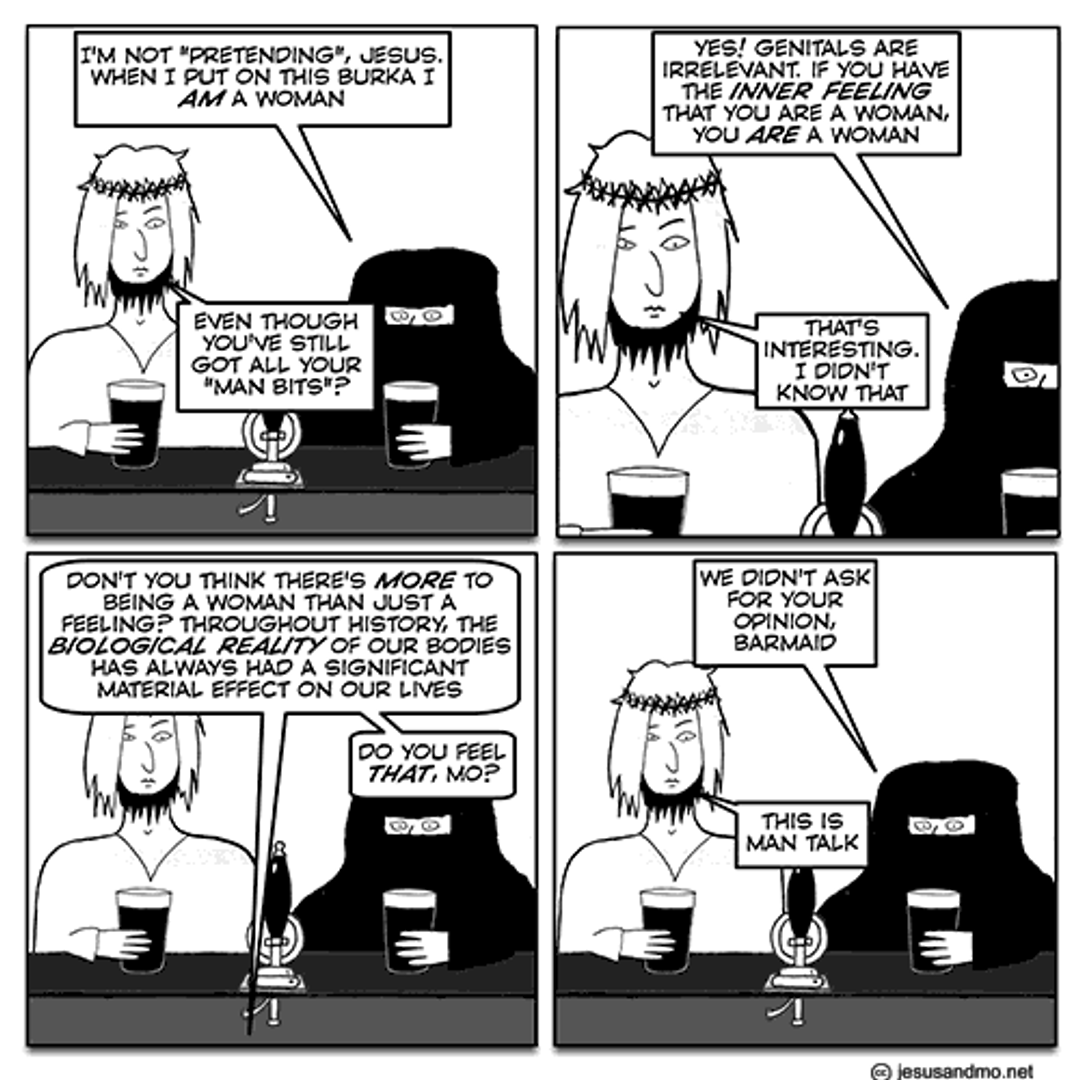
Jesus ‘n’ Mo ‘n’ “woman”
Here Mo puts on a burqa and asserts that he’s a woman because he feels like one. Of course this panel is triggering for “progressives,” and, though the strip is six years old and recycled, the artist says this:
A Friday Flashback from almost exactly six years ago. Lost a couple of patrons that day. Let’s see if it happens again.
I suspect it will!
The University of Chicago funds big project on (Israeli) “scholasticide”
The other day I wrote about a course in “Liberatory Violence” given by U of C professor Alireza Doostdar, a course that seemed to me to be (while probably not violating academic freedom) designed to propagandize students—largely against Israel. (Doostdar has a long history of anti-Israeli activism, and is director of our Center for Middle Eastern Studies and Associate Professor of Islamic Studies and the Anthropology of Religion.) While I can’t say that the course should be deep-sixed, I can say that it’s likely to promote hatred of Jews and Israel, which Doostdar sees as guilty of “Zionist settler colonialism, ethnic cleansing, and apartheid.” Ah, three big lies in one sentence!
But it’s one thing to teach a permissible but dubious course, and another to fund an initiative designed to indict Israel for “scholasticide”: the destruction of Palestinian academia by design. Yes, the Neubauer Collegium for Culture and Society, a unit that “brings unlikely partners together to work on complex problems”, has announced funding for ten new group projects in 2026-2027. Here’s one of them, and, lo and behold, Dr. Doostdar is one of the stars:
Scholasticide in and Beyond Palestine
Jodi Byrd (Race, Diaspora, and Indigeneity), Alireza Doostdar (Divinity School), Eve Ewing (Race, Diaspora, and Indigeneity), Darryl Li (Anthropology)
Bringing together an interdisciplinary team of scholars, this project will use a mixed-methods approach in undertaking empirical research and comparative analysis to investigate “scholasticide” as a critical category for political and historical analysis. In addition to the resident research team, the project will involve a sequence of virtual visiting fellows.
This is another way to use College money to do down Israel, and this I object to. Believe me, if there were a similar project designed to investigate “genocide by Palestinian terror groups,” it would not only not get funded, but would raise an ruckus. This one has elicited nary a peep. I’m wondering whether the University of Chicago even thinks about the optics of giving money for a project like this.
Dennis Prager in The Free Press: Morality can come only from God, so we should at least act as if He exists
With this article by Dennis Prager, the Free Press officially raises its flag as “We are totes pro-religion!” In article after article, the site has touted the benefits of religion as a palliative for an ailing world, but you’ll never read a defense of atheism or nonbelief. Here Dennis Prager, conservative podcaster and founder of an online “university,” touts religion as the only “objective” source of morality. I suspect the “we love religion” mantra of the FP ultimately comes from founder Bari Weiss, who is an observant Jew.
But Prager is wrong on two counts. First, religion is not the only source of morality—or even a good one. Second, there is no “objective” morality. All morality depends on subjective preferences. Granted, many of them are shared by most people, but in the end there is no “objective” morality that one can say is empirically “true”. Is abortion immoral? How about eating animals? What is wrong with killing one person and using their organs to save the lives of several dying people? Can you push a man onto a trolley to save the lives of five others on an adjacent track? If these questions have objective answers, what are they?
First, the FP’s introduction:
If you were to name the defining figures of the 21st-century conservative movement, Dennis Prager would surely rank near the top of the list. A longtime radio host and founder of digital educational platform PragerU, he is one of the world’s best-known public intellectuals, publishing more than a dozen books on religion, morality, and the foundations of Western civilization.
His latest book, “If There Is No God: The Battle Over Who Defines Good and Evil,” hits shelves next week. Drawn from a weekend-long lecture Prager delivered to 74 teenagers in 1992, it is a full-throated defense of objective, biblical morality at a time, he says, when more people dispute its existence than ever before. Though rooted in an earlier moment, the book holds new weight: In 2024, Prager suffered a catastrophic fall that paralyzed him from the waist down.
“A certain percentage of this book,” he reveals in the introduction, “was written by dictation and editing from my hospital bed. Were it not for Joel Alperson, who also organized and recorded the entire weekend, the book would not have been finished. We completed the book together. It is a testament to how important we both consider this work.”
Next week, our Abigail Shrier will interview Prager from his hospital room, so stay tuned for their full conversation. And below, we bring you an exclusive excerpt from his book, answering a question that many of us ask every day: In a world where profoundly evil things happen, how do we raise good people? —The Editors
I’m hoping that Abigail Shrier does not throw softballs at Prager, and asks him about “objective” morality and his evidence for God. But I’m betting she won’t: one doesn’t harass a man recently paralyzed from the waist down, and Shrier is employed by the Free Press.
Click, read, and weep.

At the beginning, Prager raises one of these moral questions, and argues that yes, there’s an objective answer—one that comes from the Bible (bolding is mine):
One of my biggest worries in life is that people these days are animated more by feelings than by values.
Let me explain what I mean. Imagine you are walking along a body of water—a river, lake, or ocean—with your dog, when suddenly you notice your dog has fallen into the water and appears to be drowning. About 100 feet away, you notice a stranger, a person you don’t know, is also drowning. Assuming your dog can’t swim, and also assuming that you would like to save both your dog and the stranger, the question is: Who would you try to save first?
If your inclination is to save your dog, that means you were animated by feelings. Your feelings are understandable, and as I own two dogs, I fully relate. You love your dog more than the stranger, and I do, too.
But the whole point of values is to hold that something is more important than your feelings. There is no ambivalence in the Bible about this. “Thou shalt not murder” is not for one group alone. “Thou shalt not steal” is not for one group alone. It is for every human being. Human beings are created in God’s image. Therefore, human life is sacred and animal life is not. You should save the stranger.
Unfortunately, those universal values are not what we’re teaching people today.. . . .
What? You can’t murder a dog? What if the drowning person is Hitler? And aren’t five human lives on the trolley track worth more than one? What would Jesus do?
And what other Biblical values should we take literally? Should we levy capital punishment for homosexuality? Is it okay to have slaves so long as you don’t beat them too hard? Was it “moral” for the Israelites to kill all the tribes living on their land? Is it okay for God to allow children to die of cancer? (Of course, sophisticated theologians have made up answers to these questions so that, in the end, they find nothing immoral in Scripture.)
When Prager says that our big problem is that feelings have replaced values, I wonder where those “values” come from. Apparently they come from God. But that raises an ancient question: is something good because God dictates it, or did God dictate it because it was good? (This is Plato’s Euthyphro Dilemma.) And if the latter is true, then there is a standard of morality that is independent of God’s dictates.
This is not rocket science. But Prager sticks to the first interpretation, adhering to the “Divine Command Theory“:
In fact, the Bible repeatedly warns people not to rely on their hearts. If you want to know why so many people reject Bible-based religions, there it is: Most people want to be governed by their feelings and not have anyone—be it God or a book—tell them otherwise.
The battle in America and the rest of the Western world today is between the Bible and the heart.
And Prager sticks to his guns, arguing that atheists and agnostics have no guidelines for morality:
Millions of people today are atheist or agnostic. If you are one of them, my goal is not to convince you that God exists. But I am asking you to live as if you believe God exists, and by extension, as if you believe objective good and evil exist.
Why? Because for a good society to maintain itself, we need objective morality. What would happen to math if it were reduced to feeling? There would be no math. Likewise, if we reduce morality to feeling, there would be no morality. In other words, if values and feelings are identical, there would be no such thing as a value.
Imagine a child in kindergarten who sees a box of cookies meant for the whole class and takes them all for himself. Most people would acknowledge that the child has to be taught that this is wrong. But if values were derived from feelings, this child would keep all the cookies on the basis of his personal value that whoever gets to the cookies first gets to keep them. It’s not as though this philosophy is without precedent. It has been the way many of the world’s societies have looked at life: “Might makes right.”
Again, this palaver appears in the Free Press, which apparently thought it worth publishing.
What Prager doesn’t seem to realize is that an atheist can give reasons for adhering to a certain morality, even if in the end those reasons are directed towards confecting a society that (subjectively) seems harmonious. For example, John Rawls used the “veil of ignorance” as a way to structure a moral society. Others, like Sam Harris, are utilitarians or consequentialists, arguing that the moral act is one that most increases the “well being” of the world. But even these more rational moralities have issues, some of which I raised in my questions above. The systems adhere largely to what most people see as “moral”, but they are not really “objective”. They are subjective.
But adhering to the word of the Bible, and twisting it when it doesn’t fit your Procrustean bed of morality, is palpably inferior to reason-based morality. Indeed, the fact that theologians must twist parts of the Bible so that, while seeming to be immoral they turn out to be really moral, shows that there’s no objective morality in scripture.
Does Prager even know his Bible? Have a gander at what he writes here:
That’s precisely why the Ten Commandments outlaw stealing. Because stealing is normal. The whole purpose of moral and legal codes is to forbid people from acting on their natural feelings.
Consider another example, this one far more serious. In virtually every past society, a vast number of women and girls have been raped. In wartime, when victorious armies could essentially do what they wanted, rape was the norm, with few exceptions, such as the American, British, and Israeli armies. Only men whose behavior is guided by values rather than feelings do not rape in such circumstances.
Both of these vastly different examples prove the same thing: To lead good lives, people must first learn Bible-based values, mandated when they are children.
Has he read Numbers 31? Here’s a bit in which, under God’s orders, Moses and his acolytes not only butcher a people, but save the virgin women for sexual slavery (my bolding, text from King James version):
And the Lord spake unto Moses, saying,
2 Avenge the children of Israel of the Midianites: afterward shalt thou be gathered unto thy people.
3 And Moses spake unto the people, saying, Arm some of yourselves unto the war, and let them go against the Midianites, and avenge the Lord of Midian.
4 Of every tribe a thousand, throughout all the tribes of Israel, shall ye send to the war.
5 So there were delivered out of the thousands of Israel, a thousand of every tribe, twelve thousand armed for war.
6 And Moses sent them to the war, a thousand of every tribe, them and Phinehas the son of Eleazar the priest, to the war, with the holy instruments, and the trumpets to blow in his hand.
7 And they warred against the Midianites, as the Lord commanded Moses; and they slew all the males.
8 And they slew the kings of Midian, beside the rest of them that were slain; namely, Evi, and Rekem, and Zur, and Hur, and Reba, five kings of Midian: Balaam also the son of Beor they slew with the sword.
9 And the children of Israel took all the women of Midian captives, and their little ones, and took the spoil of all their cattle, and all their flocks, and all their goods.
10 And they burnt all their cities wherein they dwelt, and all their goodly castles, with fire.
11 And they took all the spoil, and all the prey, both of men and of beasts.
12 And they brought the captives, and the prey, and the spoil, unto Moses, and Eleazar the priest, and unto the congregation of the children of Israel, unto the camp at the plains of Moab, which are by Jordan near Jericho.
13 And Moses, and Eleazar the priest, and all the princes of the congregation, went forth to meet them without the camp.
14 And Moses was wroth with the officers of the host, with the captains over thousands, and captains over hundreds, which came from the battle.
15 And Moses said unto them, Have ye saved all the women alive?
16 Behold, these caused the children of Israel, through the counsel of Balaam, to commit trespass against the Lord in the matter of Peor, and there was a plague among the congregation of the Lord.
17 Now therefore kill every male among the little ones, and kill every woman that hath known man by lying with him.
18 But all the women children, that have not known a man by lying with him, keep alive for yourselves.
I suppose that Prager thinks that not only atheists and agnostics lack moral standards, but that’s also true of all the non-Christians of the world, as morality not based on the Bible is evanescent at best:
Again, you don’t need to believe in God. But deciding between right and wrong is essentially impossible without a value system revealed by God. If there isn’t a God who says pushing little kids down—or raping women—is wrong, then all we have to go by are feelings, and then doing whatever you feel like doing isn’t wrong at all.
We’re not talking about theory. We’re living in a country where every few minutes a woman is raped, every minute a car is stolen, and every few hours a human being is murdered. The people committing these crimes don’t act on the basis of biblical values; they act on the basis of feelings.
This is not a wholesale indictment of feelings. Feelings are what most distinguish humans from robots. Feelings make us feel alive. Without feelings, life wouldn’t be worth living. But feelings alone are morally unreliable. Guided by feelings, every type of behavior is justifiable: If you feel like shoplifting and act on your feelings, you’ll shoplift. If a man is sexually aroused by a woman, he will rape her. And, of course, if you have deeper feelings for your pet than for a stranger, you’ll save your dog and let the stranger drown.
If we rely solely on feelings, everything is justifiable. And a society that justifies everything stands for nothing.
So much for Hindus, Buddhists, and Muslims, who march along with us atheists thinking that nothing is immoral.
This is not only stupid, but it’s not new, either. It was Ivan Karamazov in Dostoevsky’s novel who said, “Without God, everything is permitted.” Prager (and by extension, the Free Press) is making a Swiss cheese of an argument here, one that’s full of holes. If Abigail Shrier doesn’t dismantle it in her interview, I’ll be very disappointed, for I’m a big admirer of her work. And she’s way too smart to buy into Prager’s nonsense.
Here’s Prager’s new book:

Pages
