
You are here
News Feeds
What to read this week: Poisonous People by Leanne ten Brinke
Why is the U.S. fighting Iran?
Several readers astutely mentioned in comments on today’s Hili Dialogue that a primary goal of the American attack on Iran wasn’t to democratize the country, but to remove Iran as a Chinese proxy. As Haviv Rettig Gur, a journalist who writes for the Times of Israel, argues in the piece given below, a mutualistic relationship between Iran and China has developed, with Iran providing China with cheap oil that allows the People’s Republic to build a strategic petroleum reserve (nobody else will buy that oil), and China providing Iran with missiles and sophisticated weapons to go after Israel and the West. As Gur says:
Iran is to America what Hezbollah is to Israel—the smaller second-front proxy you have to take out to have a clean shot at the main foe later on.
This is also why President Trump seems to be pursuing a strange sort of regime change—something very different from what George W. Bush or the neocons meant by the term. Trump doesn’t care one whit about democratization, or, as Venezuela showed us, about changing any element of a regime that doesn’t stand in America’s way. He’s interested in regime change in Iran only because it is fundamentally, in its founding theology, unswervingly anti-American. It is thus not swayable from the Chinese orbit by any other means.
He doesn’t need a democratic Iran, he just needs a not-anti-American Iran.
Why are we so worried about China? Because, says Gur, a potential conflict with China is in the offing—over Taiwan:
The picture that emerges from all of this is of a Chinese forward base, a linchpin of the country’s naval architecture; cyber efforts; an economic Belt and Road influence program—every element of Chinese power projection and empire-building—positioned at the throat of the global oil supply, armed with weapons designed to penetrate advanced American defenses and kill American sailors, and embedded in a strategic architecture whose explicit purpose is to constrain American military freedom in any future conflict over Taiwan.
When Iran began to look like that, it stopped being Israel’s problem and became America’s.
Click below to read, but only if you have a subscription to TFP. They don’t allow their articles to be archived.
Gur begins by noting that this is not one war but two: America’s on the one hand and Israel on the other, with Israel having existential worries as opposed to America’s concern with China:
. . . across the world, from Brazil to Beijing, London to Karachi, the argument is the same: America is fighting Israel’s war.
But this isn’t true. And the confusion matters, because if you misread what this war is actually about, you will misread everything that follows.
This is not a war about Israel. This is not a war for Israel’s sake. Israel is a beneficiary, a capable and willing local partner, but it is not the reason America is in this fight. America is playing a much bigger game, about more than what happens in the Middle East. The subtext, that Israel exercises outsize influence or “drags Americans into wars they don’t want,” borders on the conspiratorial.
This isn’t one war, but two. There is a regional chessboard, on which Israel, Iran, Saudi Arabia, Qatar, and the other Gulf states all play. Iran’s proxies, its drones and ballistic missiles, its nuclear ambitions, its funding of Hezbollah and the Houthis: All of that belongs primarily to this smaller game. Israel has always understood this board. So have the Saudis. So has everyone in the neighborhood.
But there is a second chessboard, vastly larger, on which the United States and China are the primary players. On this board, the central question of the next 30 years is being worked out: whether the American-led global order survives, or whether China displaces it. Every significant American foreign policy decision, from the pivot to Asia to the tariff wars to the posture in the Pacific, is ultimately a move on this board.
Of course dodos like me (I never claimed to be a pundit) have missed all this, but Gur gives reasons why the U.S. decided to attack now (remember that China has said it will go after Taiwan within seven years):
. . . Reports emerged in late February of a near-finalized deal to supply Iran with supersonic anti-ship cruise missiles capable of speeds exceeding Mach 3 and engineered to evade the Aegis defense systems deployed on American carrier strike groups. China was replacing Iranian government and military software with closed Chinese systems, hardening Iran against CIA and Mossad cyber operations. Joint naval exercises between China, Russia, and Iran in the Straits of Hormuz were becoming regular events, building real-time operational familiarity between the three navies. Iran had switched from the GPS system to the Chinese BeiDou system. And Iran was providing China with the port at Jask, as part of China’s “string of pearls” base system in the Indian Ocean.
The picture that emerges from all of this is of a Chinese forward base, a linchpin of the country’s naval architecture; cyber efforts; an economic Belt and Road influence program—every element of Chinese power projection and empire-building—positioned at the throat of the global oil supply, armed with weapons designed to penetrate advanced American defenses and kill American sailors, and embedded in a strategic architecture whose explicit purpose is to constrain American military freedom in any future conflict over Taiwan.
Gur adds that the U.S. has had a hard time articulating this, but I can understand why they would not want to, even if that articulation would lessen America’s opposition to the war (more than 50%). But it wouldn’t, since the American public doesn’t think much about China.
Now the first thing I asked myself why I saw Gur’s thesis was this: What is the evidence that this is the real American strategy? Here is what counts as evidence:
The Americans went to war together with the Israelis because that’s the best way to fight a war like this. Having a capable and loyal local ally willing to deal damage and absorb blowback lowers the costs to America and increases the chances of success. If America ever finds itself in a kinetic fight with China, it presumably expects Japan and Taiwan and South Korea to play a similar role in the fighting. It’s one hell of an operational advantage.
To Gur, the targets give away Trump’s intentions:
. . .In the first 24 hours of the war, American strikes, as confirmed by U.S. Central Command (CENTCOM), focused on Iranian naval vessels, submarines, ports, and anti-ship missile positions along the southern coast. The port of Bandar Abbas, headquarters of the Islamic Revolutionary Guard Corps Navy, was hit. So was Jask, which China had hoped would become a permanent naval foothold on the Indian Ocean. Isfahan and Tabriz, hubs of ballistic missile production and drone assembly, were struck. The goal, explicitly stated by American officials, was not merely to degrade existing stockpiles but to destroy the industrial base from which those weapons are produced, so that China cannot spend the next few years quietly rebuilding it.
President Trump announced the operation in terms that could not have been more direct, explicitly mentioning all those elements of Iranian power—the navy, the missile production sites—that would serve as that second front in a war with China.
Many of these targets so central to CENTCOM’s efforts are no threat whatsoever to Israel.
So far from China: crickets. It’s been silent and has left Iran hanging. In truth, there’s little that China can do save join the war itself—and it’s clearly not keen to do that. As for Trump’s notable omission of words about freeing the Iranian people, or creating a democracy in Iran, Gur says “He doesn’t need a democratic Iran, he just needs a not-anti-American Iran.” Finally, as to why the U.S. has remained mum about what are supposedly its real goals, Gur says this:
So why can’t Secretary Rubio say it? Why hem and haw and offer half-hearted non-explanations to a question that has set the conservative movement aflame?
One obvious answer: They don’t want to push the Chinese to more overt responses. One should always give one’s enemy an excuse not to respond in kind, on the off chance that they don’t want to. It’s a sensible ambiguity on the world stage, but it’s causing damage at home. It may be time for the administration to speak clearly on its grand strategy—not in policy papers, but in clearly articulated statements that actually answer the good-faith questions of a great many Americans.
America went to war in Iran because Iran made itself a Chinese weapon. It didn’t need to do this, to invest so much of the administration’s political capital and of the military’s firepower, just to shore up a second-run Israeli operation. This isn’t about Israel. Iran has been a growing threat to Israel for decades, and yet Trump has always resisted intervening.
As I said, I’m no pundit, and although this all sounds plausible, it hasn’t convinced me completely. Gur makes a good argument, and one that several readers agree with. Perhaps they’re right, and if so kudos to them. But I’m depressed at the thought that if Gur is right, Trump doesn’t give a fig for freeing the beleaguered Iranian people, or about creating a democratic regime. The Iranian people are hoping for that, and perhaps we’re deceiving them.
And if we ever go to war with China, Ceiling Cat help us all!
World’s smallest OLED pixel could transform smart glasses
A simple hand photo may be the key to detecting a serious disease
Cosmic Collaboration: Euclid and Hubble Team Up to Capture the Cat's Eye Nebula
It's hard to turn away from a picture of the Cat's Eye Nebula, even if you've seen it dozens of times. It may be the most visually compelling planetary nebula out there, with its billowing, layered shrouds and its intricate structure. NASA and the ESA have combined images of the Cat's Eye from the Euclid and Hubble space telescopes for a fresh look at a favourite and historical cosmic object.
Sea levels around the world are much higher than we thought
Andrew Doyle’s video retrospective of wokeness
Andrew Doyle, the creator of both Jonathan Pie and Titania McGrath (both of whom some people still take seriously), has taken out after wokeness in the article below from his own site (free to access). It contains 20 short but inadvertently funny videos documenting the “woke era”—an era that Doyle sees as circling the drain. (I wish!). Here’s his intro:
There is little doubt that historians of the future are going to look back on the ‘woke’ era with utter bafflement. How is it that intelligent people were suddenly caught up in this identity-obsessed hysteria? Why did they forget that free speech mattered? Or that human beings cannot change sex? Or that judging people by the colour of their skin rather than the content of their character was a bad thing?
The lunacy was so intense that these same historians will probably have to be persuaded that any of it happened at all. So I thought it would be helpful to compile some of the more ludicrous and shocking video clips from this recent culture war. A kind of digital time capsule, if you will, for the sceptics of the future.
Woke may not have ended, but with any luck we are over the worst of it. With that in mind, here are my top twenty snapshots of this bonkers period of our history. Enjoy!
Here are the 20 topics; I’ve put asterisks next to my favorites. Some of the topics include more than one video. Do watch them all; it’s a good summary of how crazy things have gotten.
- The homophobic horses
- The no-no square*
- Gay conversion therapy goes mainstream
- The abolition of history
- The alphabet soup (starring Justin Trudeau)
- Queers for Palestine*
- Problematic allies
- “Progressive” racism
- Pronoun lunacy, starring Kamala Harris and Jeremy Corbyn*
- Student meltdown (the Christakis incident at Yale about the Halloween-costume fracas. It’s worth finding the whole thing on YouTube.)*
- You ain’t black
- Humza Yousef’s own goal
- Childhood indoctrination
- Male breastfeeding*
- Politicans forget about biology
- Thought police*
- Misogyny becomes “progressive”
- Everyone is a Nazi*
- Osama bin Laden gets some new fans (his “Letter to the American people” that the young wokesters so admired was removed from the Guardian, but can be seen here (and read about it here).
- The sancification of drag
I suppose my overall favorite is #2: the “no-no square”, described this way:
In Finland, Oulu city council established a €2.5 million project to address the rising cases of sexual assaults by migrants. It was called ‘Safe Oulu’, and this was the official dance.
This performative “dance” is supposed to reduce sexual assault, as if people don’t already know where are the parts that shouldn’t be touched.
Top predators still prowled the seas after the biggest mass extinction
Jesus ‘n’ Mo ‘n’ insults
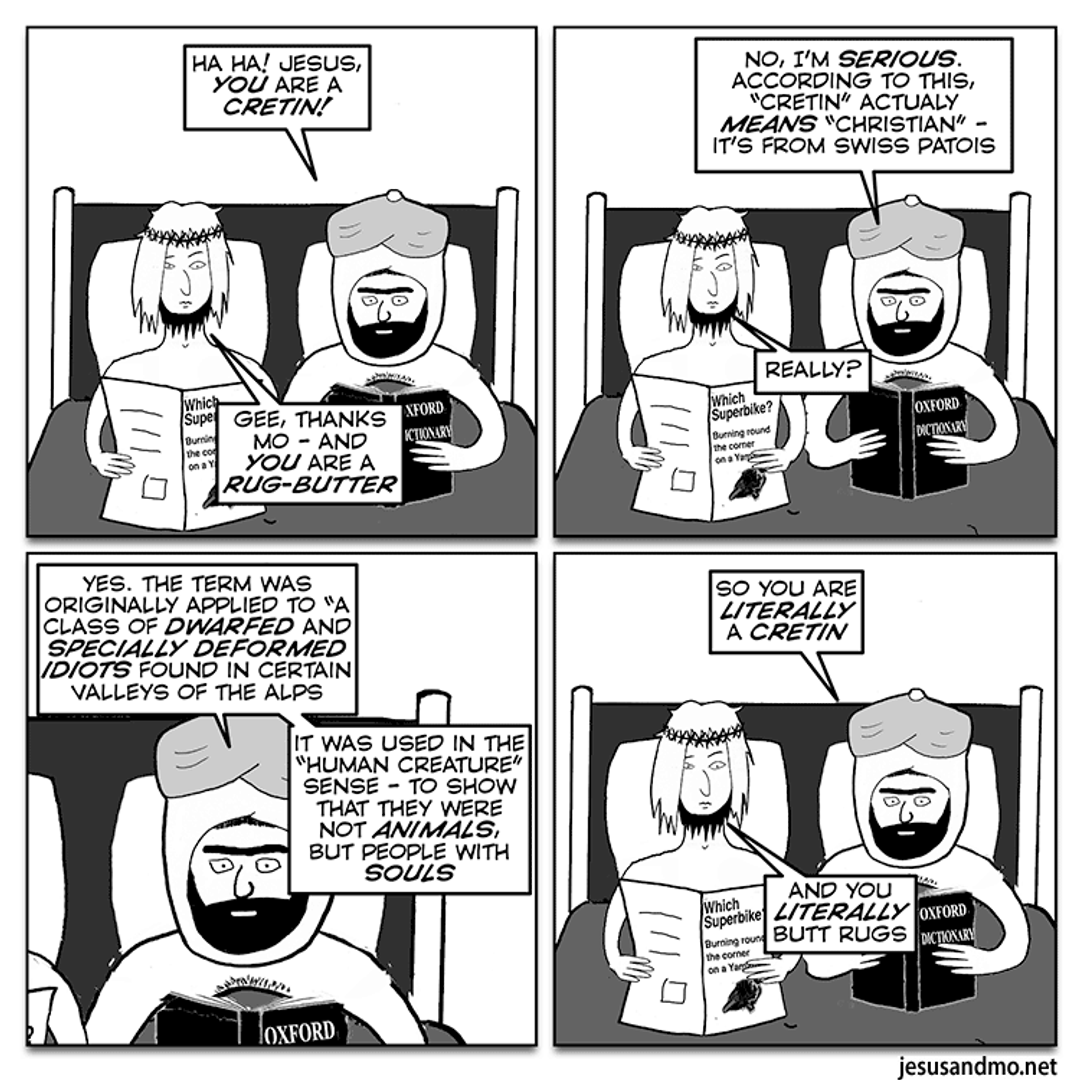
Today’s Jesus and Mo strip, called “alps2” is “A resurrection. . . from 2008”.
And Mo is basically right on the etymology, at least according to this NPR site:
Cretin is a word derived from an 18th century Swiss-French word meaning “Christian.” The connection is basically pious, asserting that a mentally innocent person so-labeled is possessed of a Christian soul by way of baptism and is worthy of our mercy and pity.
As for “rug-butter,” I couldn’t find it but assume it is a derogatory reference to Muslims worshiping on prayer rugs, touching their heads to the ground. But no, Jessus is not literally a cretin as he’s neither deformed nor hails from the Swiss Alps. But I guess Mo literally butts rugs, though I’ve never seen him kneeling in prayer.
Readers’ wildlife photos
We have a few more batches in the queue now, but it’s never enough.
And today we’re featuring lovely bird photos from Ephraim Heller. I had no idea this gorgeous creature existed! Ephraim’s ID and captions are indented, and, as usual, you can enlarge the photos by clicking on them.
I never had a favorite bird. Oh, sure, I’ve seen plenty of bewitching bee-eaters, mesmerizing manakins and motmots and macaws, plummy pigeons, parrots and pheasants, and tangy toucans and tanagers, but they never held my attention.
In Trinidad I first met a tufted coquette (Lophornis ornatus):

My coquette is 6.6 centimeters (2.6 in) long and weighs just 2.3 grams (0.081 oz) – much smaller than my thumb! My coquette doesn’t eat at hummingbird feeders with the big boys – its bill is too short:

Its food is nectar, taken from a variety of flowers, and some small invertebrates. Across hummingbirds, specialization often involves bill length and curvature for particular flowers; my coquette is relatively unspecialized in bill morphology. My coquette often must sneak nectar from the territories of other hummingbirds. With its small size and steady flight, my coquette resembles a large bee as it moves from flower to flower:

Many hummingbird genera have territorial males, but the combination of extreme ornamentation, very small body size, and intense aggression is a hallmark of Lophornis.


There are 11 species in the genus Lophornis, all as beautiful as my coquette. The name Lophornis combines Greek for “crest” (lophos) and “bird” (ornis), calling out a shared trait of all the birds in this genus:

Per the Merriam-Webster dictionary, a coquette is “a woman who endeavors without sincere affection to gain the attention and admiration of men.” But I forgive my coquette. The females are more subdued than the males, but still marvelous:

In French my coquette is called “Coquette huppe-col,” which literally translates to “tufted collar coquette.” That sounds lovely in French. In German it is called “Schmuckelfe,” which combines the literal terms “jewelry or ornament” and “elf or fairy.” To my ear, “jeweled fairy” sounds more pleasant and less insulting than “schmuckelfe”:

Latest Science on Origins of SARS-CoV-2
Six years after the COVID-19 pandemic, which had claimed over 7 million lives worldwide by April 2024 (figures are no longer being tracked), we are still debating the origins of this novel virus. The intelligence community is divided between the zoonotic hypothesis (the virus evolved in animal reservoirs and then crossed over to humans) and the lab leak hypothesis. Essentially the consensus […]
The post Latest Science on Origins of SARS-CoV-2 first appeared on Science-Based Medicine.Claude AI: Why are there so many internet outages?
How worried should you be about microplastics?
Neutrinos could explain why matter survived the Big Bang
Neutrinos could explain why matter survived the Big Bang
Red Dwarf Stars Might Starve Alien Plants of the "Quality" Light They Need to Breathe
Red dwarfs make up the vast majority of stars in the galaxy. Such ubiquity means they host the majority of rocky exoplanets we’ve found so far - which in turn makes them interesting for astrobiological surveys. However, there’s a catch - astrobiologists aren’t sure the light from these stars can actually support oxygen-producing life. A new paper, available in pre-print on arXiv, by Giovanni Covone and Amedeo Balbi, suggests that they might not - when it comes to stellar light, quality is just as important as quantity. And according to their calculations, Earth-like biospheres are incredibly difficult to sustain around red dwarfs.
Free Will, Determinism, and Compatibilism: Shermer Responds to Jerry Coyne
On his February 22, 2026 blog the estimable evolutionary biologist, outspoken atheist, and (relevant here) staunch defender of determinism, Jerry Coyne, takes me to task for presenting “a muddled argument” in my case for compatiblism (in an excerpt in Quillette), which was based on a longer chapter in my book Truth: What it is, How to Find it, and Why it Still Matters.
First, let me acknowledge that this chapter in my book is in Part III, or “Known Unknownables.” Following Donald Rumsfeld’s famous epistemological trilemma, that includes “Known Knowns” (things we know that we know), “Known Unknowns” (things we know that we do not know), and “Known Unknowables” (things that are not ultimately knowable).
In this section of the book I include consciousness (the easy problem is understanding the neural wiring; the hard problem that I claim to be unknowable is what it’s like to be the wiring), God (I know of no scientific experiments or rational arguments that can prove its existence one way or the other), and why there is something rather than nothing (what do you mean by nothing, anyway?). So, in a sense, Jerry’s determinist position is, in my understanding of the problem, no more or less likely to be true, depending on how one defines the problem itself. I have defined it in a way that compatibilism works, whereas Jerry has defined it so that determinism works.
Second, this is why I reference the survey by David Chalmers, the philosopher who made famous the “hard problem of consciousness,” along with his colleague David Bourget. They asked 3,226 philosophy professors and graduate students to weigh in on 30 different subjects. Here is what they found regarding the free will issue:
Accept or lean toward:
Compatibilism
59.1%
Libertarianism
13.7%
No free will
12.2%
Other
14.9%
Now, on one level, it is irrelevant how many people believe something, along the lines of what Philip K. Dick meant when he defined reality “as that which, when you stop believing in it, doesn’t go away.” Yet, as I argue, there is something revealing about these figures. Namely, if the most qualified people to assess a problem are not in agreement on an answer—and the free-will/determinism problem has been around for thousands of years—it may be that it is an insoluble one, a known unknowable.
Third, therefore, it is entirely possible that a highly qualified, educated, and intelligent thinker like Jerry Coyne can make a compelling case for determinism, while at the same time a highly qualified, educated, and intelligent thinker like the late Daniel Dennett can make an equally compelling case for compatibilism (and Coyne and Dennett have locked horns on this very matter).
I agree with Jerry and Dan that we live in a determined universe governed by laws of nature. But I disagree with Jerry that this eliminates free will, or if you prefer “volition” or “choice” (again, this entire field is, to use Jerry’s term, “muddled” with confusion of terminology). My compatibilist work-around is “self-determinism,” in which while we live under the causal net of a determined universe, we are part of that causal net ourselves, helping to determine the future as it unfolds before us, and of which we are a part. My compatibilist position is based on the best understanding of physics today. Let me explain.
Physicists tell us that the Second Law of Thermodynamics, or entropy, means that time flows forward, and therefore no future scenario can ever perfectly match one from the past. As Heraclitus’ idiom informs us, “you cannot step into the same river twice,” because you are different and the river is different. What you did in the past influences what you choose to do next in future circumstances, which are always different from the past. So, while the world is determined, we are active agents in determining our decisions going forward in a self-determined way, in the context of what already happened and what might happen. Thus, our universe is not pre-determined in a block-universe way (in which past, present, and future exist simultaneously) but rather post-determined (after the fact we can look back to determine the causal connections), and we are part of the causal net of the myriad determining factors to create that post-determined world.
(Jerry inquires why I didn’t discuss quantum uncertainty in my analysis. The reason is that Dennett debunked this decades ago in Elbow Room: The Varieties of Free Will Worth Wanting, when he pointed out that any such quantum effects that alter other deterministic physical laws would not grant any type of free will or volition, for it would just mean that some percentage of your “decisions” are just random noise in the machine.)
Given the muddleness of terminology here, let me bring in the philosopher Christian List and his three requirements of volition from his book Why Free Will is Real:
- Intentional agency—the capacity to form an intention to pursue different possibilities;
- Alternative possibilities—the capacity to consider several possibilities for action (this is the “could have done otherwise” element);
- Causal control—the capacity to take action to move toward one of those possibilities.
As List explains in more detail:
Specifically, we need to know whether what the person did was freely performed, as characterized by the three bullet points above. Was it an intentional action? Could the person have done otherwise? Was the person in control? Or, if what the person did was not freely performed, we need to know whether the person’s free will was at least implicated in the run-up to it: Was there a free decision to get drunk in the first place, for instance? Of course, moral responsibility might well require more than that…but I do take the presence of free will somewhere along the relevant chain of events to be a necessary condition for a salient form of moral responsibility.Of course, Jerry and other determinists like Robert Sapolsky and Sam Harris could just redefine the problem by saying that even the capacity to form an intention was pre-determined by atoms, molecules, and neurons, as is the capacity to consider several possibilities for action and the capacity to take such action. This is why I quoted Dan Dennett from my podcast conversation with him on this very challenge:
Determinism doesn’t tie your hands, nor does it prevent you from making and then reconsidering decisions, turning over a new leaf, learning from your mistakes. Determinism is not a puppeteer controlling you. If you’re a normal adult, you have enough self-control to maintain your autonomy, and hence responsibility, in a world full of seductions and distractions.Since determinists often reference people suffering from extreme drug addiction or alcoholism, or those with a brain tumor that led to their bad behavior, like Charles Whitman in the Texas school tower shooting incident, I asked Dan about Sam Harris’s quote that “it’s tumors all the way down,” and Robert Sapolsky’s descriptor that “it’s turtles all the way down.” Here Dennett identifies the error in this line of reasoning:
Well, I like the way you put it very much, Michael, because I think you put your finger on the mistake that Sapolsky is making there. And Sam Harris makes it too. No, it’s not tumors all the way down. It’s machinery all the way down. But there’s good machinery and there’s bad machinery. And if we have bad machinery, then yes, we’re disabled to some degree. But what about people who have good machinery? They’re not disabled. Why can’t we hold them responsible? Now, some people are, alas, through no fault of their own, not responsible for what they do. And that might well include people with terrible, terrible youths, who didn’t get a good upbringing, or who had a horrific upbringing. And so we have to decide, as society, given that this is a dangerous person, what’s the humane, good thing to do? I don’t think there’s an algorithm or a bright line for distinguishing somebody whose brain is good enough from somebody whose brain is a little too disabled. We just have to make the decision.Dennett then brings home real world examples:
We do it all the time. You’ve got to be 16 to get a driver’s license. Some 15-year-olds would be perfectly safe as drivers. Some 21-year-olds would not. But the law has to have a bright line and so it chooses one. We might argue whether we want to raise it or lower it, the way the drinking age has been raised or lowered, or the way the driving age has been raised or lowered. We have to have a policy and we have to stick to it and we can change it as we learn more and more. But what we don’t do is just say, “Oh, it’s disability all the way down.” No, you’re not disabled, I’m not disabled. I want to be held responsible. I think you want to be held responsible too.Coyne is unhappy with my invoking of “emergence” and says I’m being rude to him and Sapolsky and Harris in accusing them of “physics envy,” but that’s what it is! Here, for example, is Sapolsky defending his belief that free will does not exist because single neurons don’t have it: “Individual neurons don’t become causeless causes that defy gravity and help generate free will just because they’re interacting with lots of other neurons.”
In fact, billions of interacting neurons is exactly where self-determinism (or volition or free will) arises. This is why I like to ask determinists: Where is inflation in the laws and principles of physics, biology, or neuroscience? It’s not, because inflation is an emergent property arising from millions of individuals in economic exchange, a subject properly described by economists, not physicists, biologists, or neuroscientists.
Rather than quoting myself again, I will invoke the geneticist and neuroscientist Kevin Mitchell from his book Free Agents, in which he shows that the determinist’s reductionistic approach to understanding human thought and behavior is not just wrong, but wrong-headed! How?
Basic laws of physics that deal only with energy and matter and fundamental forces cannot explain what life is or its defining property: living organisms do things, for reasons, as causal agents in their own right. They are driven not by energy but by information. And the meaning of that information is embodied in the structure of the system itself, based on its history. In short, there are fundamentally distinct types of causation at play in living organisms by virtue of their organization. That extension through time generates a new kind of causation that is not seen in most physical process, one based on a record of history in which information about past events continues to play a causal role in the present.Thus, I conclude that the free will/determinism issue is an insoluble problem because we may be ultimately talking past one another at different levels of causality: the reductionist’s atoms, molecules, and neurons versus the emergentist’s brains, people, and societies.
Choose a side. The choice is yours!
Some Extremophiles Could Survive an Asteroid Impact on Mars, and the Dangerous Journey to Earth
Panspermia is the idea that life was spread from world to world somehow. New research shows that one type of Earthly extremophile can survive the extremely high pressure from asteroid impacts on Mars, be blasted into space, and maybe even survive the journey to Earth.
Scientists build a “periodic table” for AI
Scientists capture a magnetic flip in 140 trillionths of a second
Pages
