
You are here
News Feeds
Here are the tree frogs!
Did you spot all three California tree frogs in this morning’s photo? Here’s the “reveal” shot, with the three amphibians circled by Robert Lang:

Rick Beato’s top 40 albums of all time: my take
I simply can’t bear to write anything about war or Trump today, though doubtlessly something related will pop up when I write the news for tomorrow’s Hili post. But until then I want to keep it lighthearted. The Great Duck Egress still weighs heavy on me.
It’s sad that I discovered Rick Beato so late in my life, as I generally share his taste in music, though I remain largely stuck in music of the Sixties through the early Seventies, while he’s much more open to newer music. However, his education and ear make him a great educator, and since I’ve watched his videos I’ve become a lot more attentive in listening to music, especially in understanding what makes my favorite songs my favorite songs. His analyses of “what makes this song great” are my favorites.
In this video Beato lists what he sees at the top 40 “greatest sounding albums of all time,” and by that he means that all the songs on the album are good—but not only good but that sound good. In other words, I think he’s choosing albums that show musicality throughout—that stimulate both the ear and the emotions.
I confess that I don’t know about a third of the albums he mentions, and I don’t share his opinion about many of the ones I do know. Below I’ve put the 12 albums that I have heard and which I think deserve consideration for the list. But many better albums are missing. For example, he gives the Beatles’ “Revolver” an honorable mention, but wouldn’t any of the Beatles albums after “Rubber Soul” be better music than Sufjean Stevens or Seal, good as they are? Apparently Mr Beato wants a variety of artists.
Note that the albums I list are not identical to the songs that Beato plays to exemplify the album, but, as he says, “Any of the songs from these albums are phenomenally great songs.” I am not sure I agree, though I do agree that his exemplar songs are great.
I list below the albums that I both know of and agree are excellent albums, but I would not say they belong on a list of best-sounding albums. Where is Dylan’s “Highway 61 Revisited”? And Joni Mitchell’s “Blue” and “For the Roses” are, to me, at least as “musical” as “Court and Spark.” “Aja” is a dubious choice for Steely Dan; I prefer “Can’t Buy a Thrill” or especially “Katy Lied.” But of course if you included the Beatles or others of that quality, the list would be heavily weighted with just a few artists.
My opinions are of course subjective, and everyone will see omissions on Beato’s list, or inclusions that don’t merit mention. That said, here is where I agree with Beato: these albnums are great as wholes—but not the best albums of all time, not by a long shot.
#35: Bonnie Raitt, “Luck of the Draw”
#32: Tears for Fears, “Song from the Big Chair”.
#29 Sufjean Stevens, “Jacksonville”
#28 Sarah McLaughlin, “Fumbling towards Ecstasy”
#27 Chicago, “Greatest Hits”
#16 The Rolling Stones, “Let it Bleed”
#9 Seal, Seal
Here’s where I started agreeing more with Beato:
#6 The Beach Boys,”Pet Sounds”
#4 Steely Dan, “Aja”
#3 Stevie Wonder “Songs in the Key of Life”
#2 Joni Mitchell, “Court and Spark”
#1 John Coltrane, Jonny Hartman “John Coltane and Johnny Hartman”, which Beato describes as “Probably the most beautifully recorded record ever. “
Honorable Mention (there are several): one is the Beatles “Revolver”
I was delighted to see Coltrane and Hartman nab the top spot, and it’s one of my favorite jazz albums. To me, it is the greatest jazz album of modern times (by that I mean albums released after 1955). But Coltrane/Hartman is jazz, not rock, pop, or folk like the others, and I’m not sure why Beato put it on the list. If you’re going to include jazz in the list of all-time best albums, well, you’re playing a whole new ballgame.
The entire Coltrane/Hartman album in its original incarnation is on YouTube, and I’ve put it below so you can have the pleasure of listening to it. It’s only 31 minutes long, so you have time to hear it today. It’s the album I would give people who weren’t familiar with jazz to ease them into the genre, and I gave it to several women I fancied as a nuptial gift: the musical equivalent of a spider proffering to his swain a silk-wrapped fly.
Anyway, here’s Beato’s list. Don’t confuse his exemplar songs with the quality of the album itself; Beato is touting the album but selling it with a snippet of one of its songs.
Here’s the entire Coltrane/Hartman album. Coltrane is at his best, not too out there to put off newbies, but soft and ballad-y. Most of all his renditions blend perfectly with the smoky voice of Johnny Hartman, an underrated singer. (Hartman died at 60 of lung cancer, and I’m sure his voice reflected many cigarettes.)
Embryos made without sperm or eggs reveal why many pregnancies fail
Why the Second Full Moon of May is a ‘Blue Minimoon’
There’s nothing like a random celestial coincidence, turned good internet meme. In this case, the chance event is this weekend’s Full Moon, which also happens to be the second Full Moon of May, and is also the most distant and visually smallest Full Moon of the year.
Wealthy people with environmental ideals are the biggest emitters
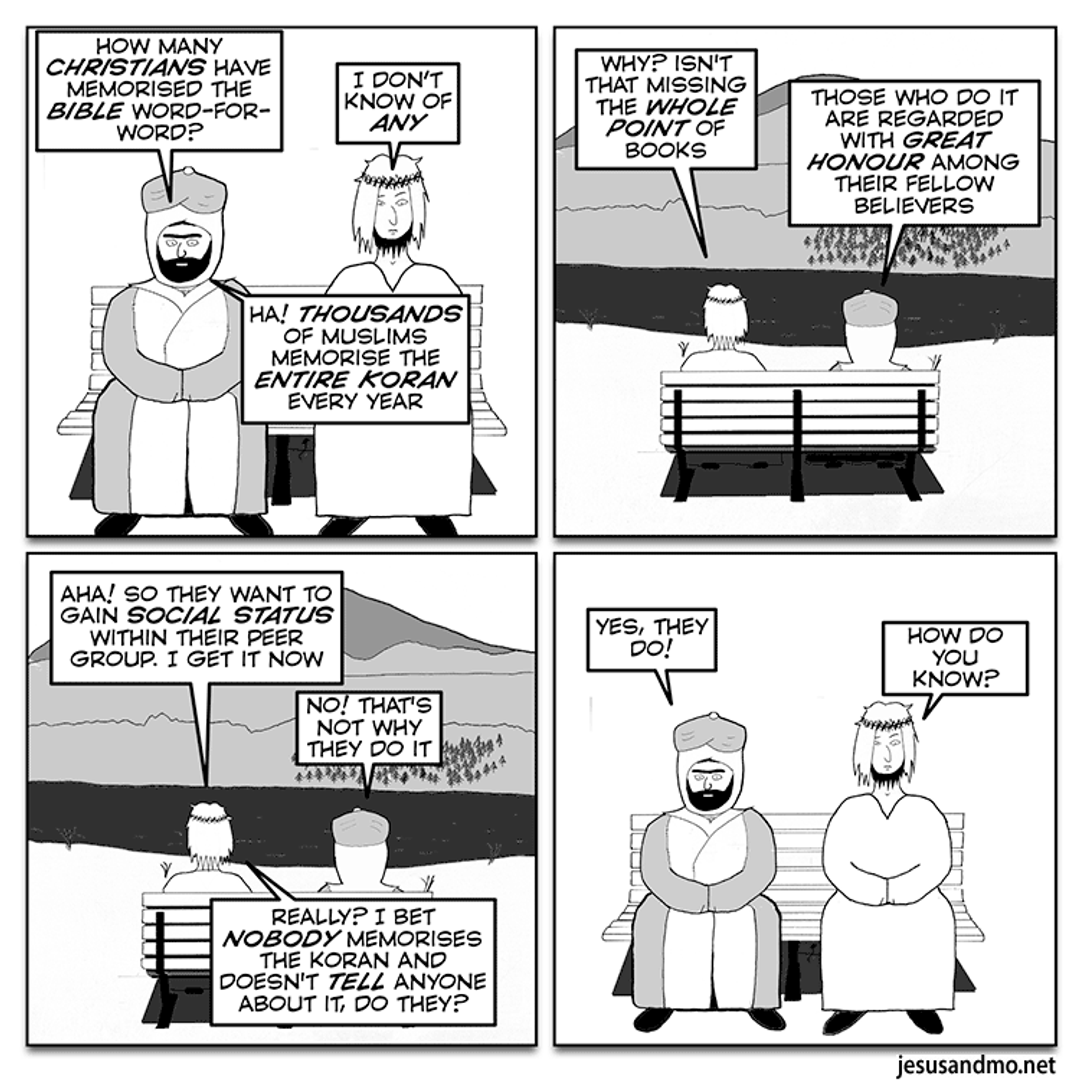
Jesus ‘n’ Mo ‘n’ Hafiz
In today’s Jesus and Mo strip, called “peer”, Mo asserts that many Muslims have memorized the Qur’an word for word. The belief that the book is literally true is ubiquitous among Muslims; one poll by Pew showed this:
Only Muslims in sub-Saharan Africa were asked whether they view the Quran as the word of God or a book written by men; across most of the African nations polled, nine-in-ten or more Muslims say that the Quran is the word of God, including more than seven-in-ten who believe it should be taken literally, word for word.
But how many Muslims have memorized the entire word of God? Mo implies many, but Jesus calls to his attention that there’s confirmation bias.
The strip came with a short note saying, “It’s called Hifaz,” which is the name for the practice of memorizing the whole Qur’an And indeed, there are sites that will, for a fee, help you memorize the entire book.
Scientists break 30-year superconductivity record at normal pressure
Readers’ wildlife photos
Today we have some intertidal photos taken in California by UC Davis math professor Abby Thompson. Abby’s captions and IDs are indented, and you can enlarge her photos by clicking on them.
May is a great month on the California coast, with extreme high and low tides. Here are some photos from the most recent, excellent, set:
Pollicipes polymerus (Gooseneck barnacles). I’ve shown these, and some relatives, several times before, but they’re amazing animals. In case you think it’s too many barnacles, Darwin spent eight years looking at barnacles. “Originally planning a brief month-long study to establish his credentials in invertebrate zoology, he became deeply immersed and cataloged every known living and fossil species.” (Google AI). I’m not sure what the green is doing here, presumably just growing on top of the animals. Some relatives of the nudibranchs stay green from what they eat, and retain bits with the ability to photosynthesize, most famously the adorable leaf sheep:.

Dendronotus venustus (nudibranch):

Paciocinebrina lurida (a snail):

Tonicella lokii (flame-lined chiton):

Genus Tegula (maybe) (another snail). There was a hermit crab living in the shell- I didn’t get a good photo of him. I’m not sure the genus is correct, but the shell was so pretty I wanted to post it:

Nucella ostrina (Northern striped dogwinkle). About the common name—well, it has stripes. And it’s a “winkle” (a word you have to love), or “little whelk”. The dog part, I dunno. They’re very common, and voracious. Some species of Nucella (not sure about this one) can be used to make a deep purple dye, which used to be hard to come by. There’s a fun account of making the dye here, although I’m afraid many snails must have been sacrificed in the process:

Paradialychone ecaudata (worm):

Limpet, probably Lottia pelta (shield limpet). The little lacy edge is tentacles: “Pallial tentacles are tiny, sensory structures lining the mantle margin (pallium) of limpets. . . The tips and shafts of these tentacles are covered in dense tufts of non-motile cilia, which act as sensory receptors.” (Google AI):

Seagulls at sunset:

As always, thanks to experts on inaturalist for help with some IDs. Camera is an Olympus TG-7.
NASA plans a base on the moon spanning hundreds of square kilometres
Injectable Peptides – The New Snake Oil
We are going backwards. Hopefully this will be temporary trend, but it has been consistent for the past few decades. Prior to the FDA we had the “wild west” of patent medicines – anyone could put anything in a bottle and sell it with any claims. It was up to the average person to decide if a product was safe or effective. […]
The post Injectable Peptides – The New Snake Oil first appeared on Science-Based Medicine.Spot the tree frogs!
It’s been a long time since we’ve had a “spot the. . . ” challenge, but Robert Lang submitted one. His caption, indented below, tells you that there are three frogs in the photo. Can you spot them all? There will be a reveal at 11:30 a.m. Robert wrote this:
It’s been a while since you’ve had a “Spot the…” photo, and I think this one qualifies. Here we’re looking for California Tree Frogs (Pseudacris cadaverina). The first one is obvious. The challenge is to spot the other two (total of three). This was taken in the Arroyo Seco in Southern California, on the way up the creek bed to Royal Falls.
Of course you must click the photo to enlarge it for starting your search. PLEASE DO NOT GIVE THE ANSWER IN THE COMMENTS so that everyone can have a go without pointers.

Why Airport Rules (Almost) Never Change
Once rules are introduced, they are difficult to change—especially when they’re of the bureaucratic variety.
What got me thinking about this was a recent trip where security forced me to throw away an assortment of fancy hair products. They did not conform to the rules, I was told. I spent the rest of my vacation enduring perpetually bad hair days. Thanks, TSA. You’re the reason I’m still single.
What made things worse: if you were to combine all my liquids into a single container, they would have fit within the limit. But the individual containers were too large to all squeeze into the delicate plastic bag presented to me. Illegal, apparently. The monotone security agent surveyed my belongings and even labelled some solids as liquids. I was in no position to argue. But my inside voice screamed: This is dumb. Like I’m going to kill someone with my extra 5 mL of eye cream, mixed with 10 mL of hair gel and 20 mL of deodorant.
The truth is, on this particular trip, I was unlucky. It’s not the first time I’ve crammed a bunch of tiny containers into my carry-on. It’s a bit like Russian roulette: will they let the items through, or won’t they? Travel sure is fun these days.
Historically, airport security rules have been reactionary—instituted in response to specific terrorist threats or plots, and once implemented, nearly impossible to walk back. But not always. After nearly two and a half decades, the TSA ended the “shoes off” rule in July 2025, and Canada said it would follow suit. Though, enforcement remains somewhat airport and even security lane dependent.
The shoes off policy was directly linked to Richard Reid, an al-Qaeda operative, who in 2001 boarded an American Airlines flight from Paris to Miami with plastic explosives hidden in his shoes. He attempted to ignite them mid-flight before passengers and crew overpowered and restrained him. So not only did Reid try to murder people, his legacy is years of stinky security lines.
The liquid restriction traces back to a 2006 transatlantic aircraft plot, in which terrorists planned to smuggle liquid chemicals onboard disguised as drinks or toiletries and mix them in-flight. The plot was foiled before it even got off the ground: MI5 and police had spent months gathering intelligence and monitoring suspects. The attack was stopped through investigation—not airport checkpoints. And yet, almost overnight, a global 100 mL / 3-1-1 rule was put in place.
Could the attack have succeeded? Yes. And that’s the argument for keeping the rule. Surely the inconvenience of restricting toiletries and buying overpriced airport water is worth it if it saves lives, right? It’s a reasonable position.
Except that technology has largely made it unnecessary. Some Irish airports installed advanced 3D CT scanners capable of analysing the chemical composition of liquids, briefly allowing passengers to carry larger quantities onboard. Standardization and certification issues led the EU to temporarily reinstate the 100 mL limit in 2024, but Dublin fully lifted the restriction again in September 2025.
Some UK airports briefly tested relaxed liquid rules before the government paused the rollout in 2024, but as of January 2026, Heathrow Airport is allowing passengers to bring up to 2 L of liquids in their carry-on and not have to take out their electronics.
The direction of travel (so to speak) points toward eventually relaxing these rules globally—but the journey has been slow, contingent on the widespread installation of standardised 3D CT scanners, and complicated by cost (the tech upgrade at Heathrow cost around $1.35B).
Perhaps most instructive is Israel … the focus is on the person, not the contents of their bag. Security officers ask probing questions to profile each traveller and assess behaviour.Australia permits liquids above 100 mL on domestic flights, which are considered lower-risk; the Australian Security Intelligence Organisation focuses on early plot detection, while airports use randomised screenings, explosive residue swabs, advanced scanners, and behaviour-trained staff.
Perhaps most instructive is Israel. Given the constant threat of terrorism, security at Ben Gurion Airport is extraordinarily rigorous—and yet the 100 mL rule isn’t applied particularly strictly. The focus is on the person, not the contents of their bag. Security officers ask probing questions to profile each traveller and assess behaviour. Low-risk passengers are processed faster with fewer restrictions; higher-risk passengers face far more thorough inspection. There are also multiple security layers, including checkpoints before you reach the airport and an embedded security presence within the terminal itself.
Profiling—which is done in all airports to different degrees—isn’t always so considerate of deontological ethics, weighing utilitarian security above that of individual rights or fairness. As those who tend to frequently be picked for additional searches and checks know, they are rarely as random as is claimed—and not always particularly comfortable (ask me how I know!). People are generally profiled on two things: behavior (like signs of stress, fear, agitation, deception) and demographics (real or perceived). The latter cannot be helped. It is, of course, not fair for the individual traveller to be profiled based on their race, religion, appearance, or age—and in practice people get wrongly sorted into these categories all the time as well. At the heart of the debate is the collective benefit versus the violation of certain rights for groups or individuals.
There are also, of course, debates on the effectiveness of profiling and whether it provides a false sense of security when we should be instead investing in better security systems that don’t rely on neither discrimination nor human intuition, as security expert Bruce Schneier argued in his widely publicized debate with Sam Harris. Harris argued that profiling is reasonable given the strong likelihood that threats of terrorism come predominantly from Muslims and urged Schneier not to underestimate the “talent that neurologically intact observers (not to mentioned trained screeners, like those who work for El Al) have for spotting high-risk individuals.”
The problem is that once a safety rule exists, removing it becomes its own political liability. Imagine a politician signing off on lifting the liquid restriction—and then someone detonates a plane using liquid explosives.Ultimately all security requires us to complete a cost-trade analysis. What’s the cost? What’s the level on the infringement on universal and individual rights? Potential for abuse? Discrimination?
I, for one, have no interest in undergoing a strip search every time I fly. But I’m willing to undergo a scan at the airport, even if it doesn’t make me particularly enthused. Such are trade-offs.
What’s striking is that most of these measures were introduced as temporary responses to threats the public could understand as credible. The problem is that once a safety rule exists, removing it becomes its own political liability. Imagine a politician signing off on lifting the liquid restriction—and then someone detonates a plane using liquid explosives. Their political career would be over.
“The reason why once a rule is introduced, it stays is because there is a slanted accountability system in airport security,” says Justin Crabbe, commercial pilot, travel expert, and CEO and founder of private jet booking platform Jettly. “Regulators face grave repercussions if restrictions are removed. But they are not punished for retaining inconvenient rules. Security agencies know they would be blamed if an attack occurred after a rule was dropped.” Bureaucratic inertia compounds this, he argues: “Coordination between the TSA and ICAO takes years. Any change in protocol must be thoroughly tested and backed by solid evidence.”
Security theatre also plays a role: the visible performance of safety makes people feel protected, giving politicians a further incentive to retain policies even when their practical value is limited. And frustration, Crabbe notes, won’t actually drive change—because it won’t keep people from flying. “The industry would rather avoid regulatory battles than focus on customer convenience,” he says.
So for now, we put up with the inconveniences.
First quantum grandfather clock could probe where gravity comes from
NASA’s Webb telescope discovers a planet where rock clouds vanish every night
NASA’s Fermi telescope reveals the power source behind monster supernovae
We may finally know why gold stays so shiny
NASA TESS Reveals Epic All-Sky Map of Distant Worlds
You’re on a camping trip with your family and your parents tell you to turn off all the lights. But, of course, your little brother wants to shine his flashlight directly at the sky saying aliens will see it. You finally get him to shut off his flashlight, and you give your eyes a few minutes to adjust to the darkness. As they do, more and more stars begin to appear in the night sky that were initially hidden beneath the glare of your (loser) brother’s flashlight. As the stars get brighter and increase in number, you start firing off a slew of questions in your head: How far away are they? Are there planets around them? What kinds of life are on those planets?
Astronomers Observe the Most Chemically Primitive Galaxy in the Early Universe
An international team led by Associate Professor Kimihiko Nakajima of Kanazawa University has captured a rare look at the early universe. Using the James Webb Space Telescope (JWST) and the power of gravitational lensing, the team achieved a definitive characterization of LAP1-B, an ultra-faint galaxy from 13 billion years ago.
Where Are All the Intermediate Mass Black Holes? Microlensing Fast Radio Bursts Might Reveal Them
In the heirarchy of black holes, intermediate mass black holes (IMBH) lie in between stellar mass black holes and supermassive black holes. But the problem is that we've never found one. There have been hints, but nothing conclusive. Could gravitational microlensing of Fast Radio Bursts help find them?
When the Sun Tries to Explode and Fails
Scientists have captured one of the most detailed observations ever of a failed solar eruption, a powerful blast from the Sun that built into what should have been a billion tonne plasma ejection, then stalled and collapsed back to the surface. Using data from five spacecraft simultaneously, the team identified a double magnetic process that strangled the eruption from both above and below.
Pages
