
You are here
News Feeds
Readers’ wildlife photos
Abby Thompson of UC Davis has sent in some pictures of California tidepool organisms, as well as a video. Abby’s captions are indented and you can enlarge her photos by clicking on them.
Late January-early March tidepools, plus an octopus.
Bryozoans:

Lepas anatifera (pelagic gooseneck barnacle). Usually found clinging to something drifting around in the open ocean (the “pelagic” part of their name), these were on a large log washed up on shore:

Intertidal zones, illustrated. A well-placed vertical rock face, like this one, exhibits the idea of the different intertidal “zones”, each of which has its own specific collection of inhabitants. You can see mussels and barnacles clustered at the top (in the “high intertidal”), exposed to the air as soon as the tide goes out even a little. There are smaller colonial anemones next, beneath them the orange and purple ochre stars, and below those, arriving at the low intertidal level, some giant green anemones. If you peer into the water under the open giant green anemone, you’ll see a crab, probably a rock crab. There’s some back and forth- there are a few giant green anemones pretty high up in this photo- but the general idea holds.
This reflects each animal’s differing tolerance for specific conditions- time out of the water as the tide goes out, harshness of wave actions, etc. The nudibranchs (next few pictures) are usually in the very low intertidal:

Orienthella piunca (nudibranch):

Hermissenda opalescens (nudibranch):

Doto amyra (nudibranch). Visible through the translucent skin on its back are lobules of the “ovotestis” (thanks inaturalist expert! ). From google AI: “Ovotestes in nudibranchs are specialized, hermaphroditic reproductive glands that produce both male (sperm) and female (oocytes/eggs) gametes simultaneously”:

More eggs, this time from a snail in the genus Amphissa. I like the pointy egg casings, like wizards’ hats:

And here’s an adult of the genus- almost certainly Amphissa versicolor, but it’s an unusual color (they’re usually shades of orange or brown/tan):

In honor of Ghost the octopus, and also because I’ve finally figured out how to include videos, below is a clip from 2021 of an East Pacific red octopus (Octopus rubescens), cruising around the rocks (out of the water!) at low tide. I’ve only seen one twice, probably because they’re too cleverly camouflaged (possibly just too clever) for me to spot. This guy was about the size of a human hand, a miniature compared to the 50 pound Ghost.
Point Reyes peninsula at sunset:

Camera: Olympus TG-7.
This quantum computing breakthrough may not be what it seemed
Pulsars Rewrite the Rules
For decades, astronomers thought they knew that pulsars broadcast their signatight beams of radio waves fired from near the surface, close to the magnetic poles. A new study of nearly 200 of the fastest spinning pulsars in the universe has just turned that idea on its head. It turns out these extraordinary objects are broadcasting from two completely separate locations at once, and one of them lies right at the outer edge of their magnetic grip on space itself.
How the Solar Wind Really Works
The Sun doesn't just pump out light and heat, it blasts a continuous stream of charged particles across the Solar System, and that solar wind is far more complex than it looks. Hidden within it are waves that act as invisible middlemen, constantly shuffling energy between particles as the wind expands outward. Now, thanks to the European Space Agency's Solar Orbiter spacecraft, we have our clearest picture yet of how those waves behave close to the Sun itself.
World's smallest QR code, smaller than bacteria, could store data for centuries
Scientists just found a way to store massive data using light in 3 dimensions
Scientists just found a way to store massive data using light in 3 dimensions
Blocking out the Stellar Lighthouses
Finding another Earth is one of the greatest scientific challenges of our time and the biggest obstacle isn't the distance, it's the glare. An Earth like planet orbiting a Sun like star is ten billion times fainter than its host. A team of NASA engineers at the Jet Propulsion Laboratory are developing a remarkable piece of optical wizardry that could solve the problem of seeing planets hidden by the stellar glare and they're already within striking distance of the performance needed to make it work.
A Galactic Wind Caught in the Act
Twelve million light years away, a galaxy is throwing a tantrum on a cosmic scale. M82, the Cigar Galaxy is forming stars at ten times the rate of our own Milky Way, and all that frenzied activity has been blasting superheated gas outward in a colossal wind stretching 40,000 light years. Scientists have long known the wind exists, but now, for the first time, they've measured exactly how fast it's moving and the answer raises as many questions as it answers.
Bennu’s Rugged Rocks Explained by Deep Internal Cracks
Asteroids don’t get the love they deserve. They don’t get “cool points” because they’re not a planet or a potential life-harboring moon. They’re “just a bunch of rocks”. But asteroids are so much more, as they are time capsules of the early solar system that have survived billions of years untouched by weathering or plate tectonics. One of the most intriguing asteroids that has been explored is asteroid Bennu, and specifically how its physical characteristics greater differed from Earth-based observations in 2007 after NASA OSIRIS-REx spacecraft visited Bennu in 2018.
Exomoons Could Be Habitable for Billions of Years, Provided they have Hydrogen Atmospheres
Liquid water is considered essential for life. Surprisingly, however, stable conditions that are conducive to life could exist far from any sun. A research team from the Excellence Cluster ORIGINS at LMU and the Max Planck Institute for Extraterrestrial Physics (MPE) has shown that moons around free-floating planets can keep their water oceans liquid for up to 4.3 billion years by virtue of dense hydrogen atmospheres and tidal heating—that is to say, for almost as long as Earth has existed and sufficient time for complex life to develop.
Caturday felid trifecat: Library accepts cat photos in lieu of late fees; the history of Downing Street cats; lost cat reunites with family after five years; and lagniappe
Yes, I know I’ve misspelled “trifecta” in the title, but that’s deliberate. Today we have the usual three items for Caturday, plus two lagniappes.
First, a heartening story from the 100 Libraries Magazine. Click to read.
The Worcester Public Library in Massachusetts is, well, let them announce it:
Photo courtesy of the Worcester Public Library
From the text:
Embracing the spirit of the program, library patrons are encouraged to swap traditional monetary payments for a simple yet delightful alternative—a photo or drawing of a cat. Executive Director Jason Homer extends a warm invitation to all, regardless of feline companionship status.
“Even if you don’t have a cat in your life, you can still draw one,” Mr. Homer expressed to NBC Boston, highlighting the inclusive nature of the initiative. From domestic cats to majestic big cats like tigers and lions, all submissions are welcome with open arms.
Recognizing that accidents happen and fees can sometimes hinder access to library resources, the library hopes to extend a gesture of goodwill and understanding through this unique initiative.
Why March Meowness?
The inspiration behind “March Meowness” stems from a noticeable increase in overdue fines among young patrons, a trend exacerbated by the challenges posed by the pandemic. However, what started as a simple solution to address financial barriers quickly blossomed into something much more profound. Within just the first five days of its launch, the program had already cleared over 400 accounts, underscoring its immediate impact and resonance within the community.
In essence, “March Meowness” transcends the realm of library fines, serving as a testament to the power of creativity, compassion, and community spirit. Through a simple yet meaningful gesture, the Worcester Public Library not only alleviates financial burdens but also reaffirms its role as a cornerstone of the community—a place where everyone is welcome, regardless of their ability to pay. As patrons flock to share their beloved feline companions or imaginative renditions thereof, the library continues to serve as a beacon of hope, connection, and joy in uncertain times.
And here, from TikTok, is a wall o’cats showing how many people donated photos in lieu of fines (sound up):
@worcesterpublibIt was a valiant effort by our staff to try to get a many cat photos as possible up on our cat walls at several of our locations. We ran out of time and staff, but did our best! We hope you enjoyed this a much as we did! #catsoftiktok #catstagram #cats #librarytok #librarytiktok #library #worcesterma #mywpl #MarchMeowness #viral #fyp #fypシ #fypage #foryou #foryoupage #foryourpage
♬ Come Check This (Quickie Edit) – FETISH
And from the NBC Evening News, where we learn that photos have been sent to the library from all over the world. The response would not be nearly as awesome if they wanted dog pictures, because cats rule the internet.
********************
In honor of Larry the Cat‘s 15th birthday and 5 years of service as Chief Mouser to the Cabinet Office, Mark Felton Productions has put out a lovely 11-minute video detailing the history of Downing Street Cats beginning on June 3, 1929 when the government authorized the position. Rufus was the first Downing Street cat, replaced by Peter, and so on (one was also called “The Munich Mouser,” who was staffed by Neville “Peace in Our Time” Chamberlain.
It’s a great video, so watch.
Here’s a timeline of all the 10 Downing Street cats (via Wikipedia), and the parthy of the PM’s who staffed them. Click to enlarge.

********************
From the UPI’s “odd news” we have the story of a lost cat who came home after five years:
From the text:
A Maryland family whose pet cat went missing five years ago were reunited with the pet when she turned up in a stranger’s basement.
Melissa and Brooke Garci said Aremis, their indoor/outdoor cat, wandered away from home in Hickory in September 2021 and never came back.
The family canvassed the neighborhood and put up flyers, but there was no trace of Artemis.
The Harford County Humane Society said a woman came to the facility in February with a cat she found in her unfinished basement.
The shelter scanned the feline for a microchip, which identified her as Artemis.
“I was like, I couldn’t cry yet because I was in disbelief, but when I saw her, I was like, ‘OMG, she looks exactly the same,'” Brooke Garci told CBS Baltimore. “It was a beautiful thing.”
The humane society said the reunion was a reminder of the importance of having pets microchipped.
Always get your cat chipped, even if it’s an indoor cat. They can escape, you know, as Artemis did. 40% of lost cats with chips are returned to their owners. (Be sure your chip is updated if you move or change your phone number.)
Here’s a video of the grand reunion (warning, there are d*gs as well):
********************x
Lagniappe: Two cat videos from The Good News girl:
Kiki the School Cat:
Reader’s wildlife photos
Today Athayde Tonhasca Júnior is back with one of his patented text-and-photo posts, which have always been very informative. Today he talks about palms and their pollinators in one area of Brazil. Athayde’s captions are indented, and you can enlarge his photos by clicking on them.
Beneficial saboteurs
It’s approaching midday somewhere in the caatinga, northeastern Brazil’s hinterland, and the temperature will soon hit the 40o C mark. All is quiet, as most animals are sensibly sheltering from the sizzling sun. The vegetation looks dead and stunted, but it is in fact quiescent, in a state of dormancy that helps plants endure the heat and drought until the rainy season arrives.
Fig.1. The caatinga vegetation in northeastern Brazil looks dead during dry season, but palm trees are green year round:

One palm tree, however, known locally as licuri (Syagrus coronata), doesn’t seem bothered by the harsh climate; it is verdant and in full bloom. The plant is monoecious, that is, it produces separate male and female flowers in the same individual. Male flowers grow at the end of large (~90 cm long) inflorescences, while the female flowers are at the base. Anthesis (the stage at which a flower is open and functional) is asynchronous: male flowers open first, releasing pollen and scent for 7 to 10 days. These flowers then shrivel and fall off. In about two weeks, it’s the female flowers’ turn; they are open for 10 to 15 days. Plants also bloom asynchronously, so at any given time of the year there are licuri flowers.
Fig.2. Licuri inflorescences © Drumond, 2007:

These flowery details may seem like too much information, but they are important for understanding the plant’s relationship with one of its most important flower visitors, the weevil Anchylorhynchus trapezicollis.
Like the overwhelming majority of the ~83.000 known species of weevil (family Curculionidae), A. trapezicollis feeds on plant tissues. Attracted by the scent of male flowers, a beetle uses its big schnozzle (in fact its rostrum, the snout-like projection from the head) to pry flowers open and take their pollen. While feeding, the beetle ends up with pollen grains attached to its body. As male flowers open at different times, there’s isn’t much food to be consumed in one sitting. The beetle is then encouraged to move to another plant, taking with it pollen that will result in cross pollination if the insect lands on a receptive female flower.
Fig.3. An A. trapezicollis in action on a licuri flower © Bruno de Medeiros, iNaturalist.Lu:
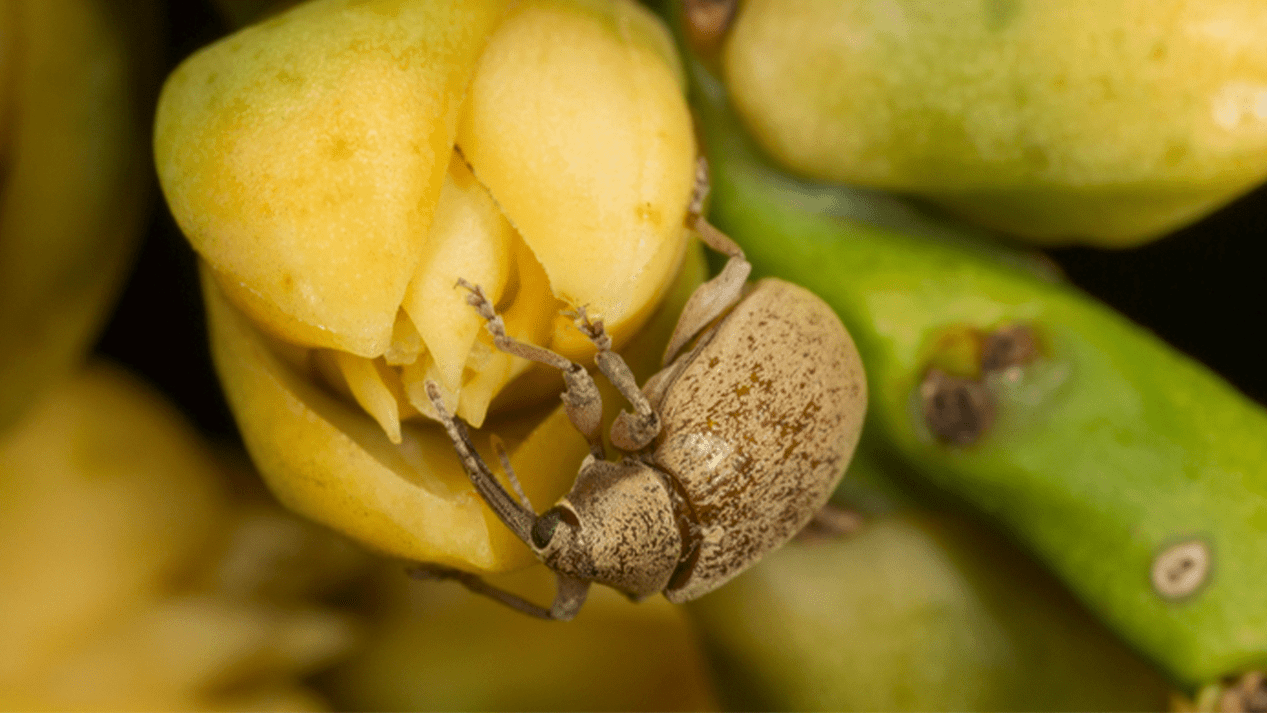
After feeding, a female beetle looks for female flowers to lay her eggs between the petals and sepals. The resulting larvae are cannibals: one larva will eat any competitor in the same flower. As they grow older, the little darlings shift their attention to developing fruits, which are aborted and fall off. Because it destroys forming fruits to complete its life cycle, A. trapezicollis is a seed predator. But for the cost of a portion of its fruits, the licuri palm is pollinated. This form of mutualism is known as brood-site pollination or nursery pollination, a trade-off association that has evolved for the yucca and the yucca moth, figs and fig wasps, and several other plant-insect partnerships.
Fig. 4. The licuri‘s trunk ends in a distinct crown of slightly arched leaves, a feature that inspired its specific epithet coronata (crowned) © Kelen P. Soares, Flora e Funga do Brasil:

Other weevils and bees also pollinate licuri, but A. trapezicollis seems to be the most important agent (Medeiros et al., 2019). This tight relationship has profound ecological consequences.
It is said that everything from a pig can be used except the oink, but licuri is not far behind in relation to its usefulness to humans. Its apical meristem (palm heart) is edible; the leaves are the source of a high quality wax, building materials, hats, baskets, sleeping mats and other handicrafts; ground-up leaves are fed to livestock in times of food scarcity; the tasty seeds (endosperm or nuts) are eaten raw or roasted, or added to confectionery and local dishes; oil extracted from seeds is used for lighting and the manufacture of soap, perfumes and other products.
Fig.5. The greenish pulp (mesocarp), brown hard shell (endocarp) and the nutritious white nut (kernel) of a licuri fruit © B. Phalan, Wikimedia Commons:


Humans are not the only creatures to benefit from licuri: many animals take the wholesome fruits. Among them, the Lear’s macaw (Anodorhynchus leari), an endemic and endangered species, for which licuri nuts represent the bulk of its nutrition.
Fig.6. Lear’s macaws, big fans of licuri nuts © João Quental, Wikimedia Commons:


There you have it: a palm tree of unordinary value, from people’s welfare and economy to endangered macaws and wildlife in general, is greatly dependent on pollination provided by unassuming weevils. And this is not an isolated case. More than 200 palm species (family Arecaceae) are pollinated by weevils, and so are many other plants from different lineages (Haran et al., 2023). The ‘million dollar weevil’ (Elaeidobius kamerunicus) illustrates well the relevance of these insects as pollinators. This beetle was introduced from Africa to Asia to help improve pollination of cultivated African oil palm (Elaeis guineensis), resulting in considerable increase in yields.
When we think of pollinators, bees, flies and moths are most likely to come to mind, as they contribute to the reproduction of crops and wildflowers familiar to us. Adding weevils to this select club may sound peculiar: after all, many weevils are pests capable of inflicting enormous damage on cultivated plants, trees and stored products (you may have had your pantry invaded by weevils). But that would be a parochial view. For millions of people in tropical and subtropical regions, palm trees are more than props in holiday brochures: they are crucial for wildlife food chains, human nutrition, building materials and commodities such as medicines, industrial products and fibre. A great deal of these benefits depends on a range of poorly known, frequently dismissed and often vilified weevils.
Fig.7. Six species of weevil known to be involved in brood-site pollination © Haran et al., 2023:

References
Drumond, M.A. 2007. Documentos, 199. Embrapa Semi-Árido.
Haran, J. et al. 2023. Most diverse, most neglected: weevils (Coleoptera: Curculionoidea) are ubiquitous specialized brood-site pollinators of tropical flora. Peer Community Journal 3: e49.
Medeiros, B.A.S. et al. 2019. Flower visitors of the licuri palm (Syagrus coronata): brood pollinators coexist with a diverse community of antagonists and mutualists. Biological Journal of the Linnean Society 126: 666-687.
Solar cells just did the “impossible” with this 130% breakthrough
This new carbon material could make carbon capture far more affordable
After 20 years, scientists finally explain the Crab Pulsar’s strange “zebra stripes”
Mars-Like Worlds Near M-Dwarfs May Lose Air in Millions of Years
The criteria for finding an Earth-like planet unofficially comes down to two things: water and the habitable zone. But a phenomenon known as atmospheric escape often “escapes” the minds of many astronomy fans, and it turns out that atmospheric escape is one of the key characteristics for finding an Earth-like world. Although extensive research has been conducted on how the planet Mars might have lost its atmosphere, and potentially the ability to sustain life, how would the atmosphere enveloping a Mars-like exoplanet respond to stars different from our own?
The Peptide Craze: Biohacking and Human Guinea Pigs
On February 27, 2026, Robert F. Kennedy Jr. appeared on Joe Rogan’s podcast and announced that the FDA is preparing to move approximately 14 experimental peptide compounds off its restricted list and back into the hands of compounding pharmacies. He called himself a “big fan” of peptides. He said he expected the announcement “within a couple of weeks.”
One industry executive responded with what he called a prediction: “We’re about to unleash one of the biggest medical experiments in the history of America onto Americans as the test subjects.” He meant it as a good thing.
In response, first let me tell you about a patient of mine. Two weeks before I wrote this, a 40-year-old man came into my clinic in acute distress. He was intelligent, fit, and successful—and he was terrified. His throat was swelling. Hives covered his body. He was struggling to breathe. And … he had been injecting a peptide “stack” he’d ordered online. He’d been at it for exactly two weeks.
That timing is not a coincidence. Two weeks is how long it takes for our immune systems to mount a full IgE-mediated allergic response to a new foreign substance—the same mechanism behind severe penicillin reactions. With a slightly higher dose, or a slightly longer drive to my clinic, he could have gone into full anaphylaxis. He responded quickly to epinephrine and antihistamines. He will be fine. But his immune system now has a permanent record of that peptide as a lethal enemy. Any future exposure risks a faster, more severe reaction.
This is the experiment that is about to be released on the American public.
A New Label on Old Snake OilQuackery has long been handy with new names. “Remedies,” “tonics,” “panaceas,” and “snake oil” gave way to “complementary and alternative medicine,” which gave way to “integrative” and “functional” medicine. Today’s label is “biohacking”—and its latest product line is peptides.
To be clear: some self-experimentation is entirely reasonable. Adjusting your diet, sleep schedule, or exercise routine can have rapid results and manageable risks. That is not what I am cautioning about. I am writing about people who order vials of white powder from overseas websites, mix them with water in their kitchens, and inject themselves based on advice from social media influencers and, now, the Secretary of Health and Human Services.
This is the actual evidence base: rodent studies, discontinued trials, and anecdotes from podcast guests with financial stakes in the outcome.If you spend any time in online “wellness” spaces, you have encountered the pitch. Coaches, longevity clinics, and podcasters hawking discount codes are aggressively marketing injectable grey-market chemicals that promise to “optimize your metabolic pathways,” “boost your immune system,” “detoxify your cellular matrix,” and “address the root cause of aging.” They claim these compounds will dramatically increase muscle mass, melt body fat, skyrocket libido, erase wrinkles, and heal injuries without the inconvenience of waiting for evidence.
As I tell my patients: if a drug could genuinely do any of that, we would all know about it. It would be very hard to hide. You would not be buying it through an internet loophole labeled “not for human consumption.” Nor would there be proclamations about what “they” don’t want you to know about this new remedy.
What Peptides Actually ArePeptides are real, biologically important, and increasingly valuable. They are short chains of amino acids—smaller versions of proteins—that often function as chemical messengers in the body. Insulin is a peptide. More than 40 peptide hormones are known in humans, governing everything from blood pressure to appetite to milk production. The body’s own peptides act quickly: released, delivered to a specific receptor, then broken down by enzymes within minutes.
Medicine has successfully harnessed this biology. There are now more than 100 FDA-approved peptide drugs on the market. The GLP-1 medications—Ozempic, Wegovy, and their weight-loss relatives—have genuinely revolutionized the treatment of diabetes and obesity. Peptide pharmacology is good, productive science, and anyone who tells you the FDA is categorically hostile to peptides is simply wrong.
The compounds being sold by anti-aging clinics and wellness websites are a different kettle of goo. These are unapproved, experimental, synthetic molecules manufactured in a regulatory and industrial grey zone. They are sold with legally evasive disclaimers—”for research purposes only,” “not for human consumption”—while being marketed with explicit instructions for human injection. Many are synthesized in foreign facilities and imported for sale online. The FDA does not approve them. Independent quality testing is essentially nonexistent.
The Appeal-to-Nature Fallacy, Wearing a Lab CoatPeptide sellers claim their products are “gentle” and “natural” because the body already produces similar molecules. This argument collapses on inspection.
Because our natural peptides are removed by enzymes within minutes, lab-made versions must be chemically engineered to survive much longer in the bloodstream. This is why an Ozempic injection can last a week. The molecule is altered—designed to evade the very mechanisms that keep natural signaling tight, targeted, and controlled. Calling a chemically tweaked, enzyme-resistant synthetic compound ordered from an overseas supplier a “natural holistic remedy” is a remarkable feat of cognitive dissonance.
The natural precedent proves nothing about safety or efficacy at supraphysiological doses. The dose, the duration, the delivery route, and the molecular structure all matter enormously. This is not ideology. It is pharmacology.
The Wolverine Stack and Tooth Fairy ScienceOne popular combination—BPC-157 and TB-500—is marketed as the “Wolverine Stack,” named after the X-Men character’s mutant regenerative ability. Sellers claim it heals torn ligaments, repairs damaged tissue, and accelerates recovery from virtually any injury.
BPC-157 is a synthetic analog of a compound found in human stomach juice. In rats and cell cultures, it has shown interesting tissue-regeneration effects. There is no robust human clinical trial evidence that BPC-157 accelerates injury recovery, reduces inflammation, or supports gut health. A Phase I trial conducted in 2015 on 42 volunteers was discontinued and no results were ever published. The only human data in the published literature consist of a retrospective analysis of 12 patients and a pilot study with two participants. Based on this, influencers and longevity clinics sell it as a proven cure-all. At a MAHA (Make America Healthy Again) summit in Washington last November, a panelist told the audience his grandmother was taking it and that “it’s just one example of these products that can change people’s lives.” The audience clapped and whooped.
Then there are the peptides that are alleged to pump up growth hormone—CJC-1295 and Ipamorelin—heavily marketed to men hoping to reclaim muscle and youth without effort. What rat data actually showed for Ipamorelin was increased body weight and increased fat. Its only significant human clinical trial, investigating bowel function after surgery, found it no more effective than placebo. As for CJC-1295: clinical trials investigating it as a treatment for HIV patients were permanently halted after a participant died of a heart attack.
This is the actual evidence base: rodent studies, discontinued trials, and anecdotes from podcast guests with financial stakes in the outcome. The plural of anecdote is not data.
Downplaying RisksThe FDA’s 2023 decision to move many of these compounds to its Category 2 restricted list was not arbitrary bureaucratic overreach. It was grounded in specific, documented biology.
BPC-157 promotes angiogenesis—the formation of new blood vessels. This sounds appealing for tendon repair. It is considerably less appealing when you consider that angiogenesis is also precisely what early-stage, undetected cancers need to grow and spread. (Oncologists have long sought anti-angiogenesis drugs to attenuate the growth of blood vessels to cancerous tumors.) A person injecting unapproved angiogenic compounds has no way of knowing whether they are healing a joint or feeding a tumor. Growth hormone secretagogues carry documented risks of acromegaly—the pathological and irreversible enlargement of bones and organs from excess growth hormone exposure.
Then there is immunogenicity, the actual problem illustrated by my patient. Because synthetic peptides are engineered to persist in the bloodstream far longer than natural ones, the immune system frequently recognizes them as foreign invaders. It builds antibodies. In the best case, those antibodies simply neutralize the drug, rendering it ineffective. In worse cases, they trigger escalating allergic responses. In the worst cases, they cause anaphylaxis.
There is no quality control. There is no chain of custody. The buyer has no reliable way to know what is actually in the vial.Then there is contamination. Grey-market peptide vials from unregulated sources often contain chemical residues from synthesis, heavy metals, bacterial contamination, or simply the wrong compound entirely. There is no quality control. There is no chain of custody. The buyer has no reliable way to know what is actually in the vial.
We are already seeing the collateral damage. Bad injections have produced hospitalizations for muscle paralysis, scarring, and sepsis. In Las Vegas, two women were hospitalized with swollen tongues, respiratory distress, and elevated heart rates—classic anaphylaxis—following peptide injections at an anti-aging festival. Medical journals have reported cases of necrotizing pancreatitis directly linked to unregulated peptide use.
The MAHA ParadoxHere is where the story becomes increasingly interesting, and particularly strange.
Kennedy is not entirely wrong about one thing. When the FDA moved these compounds to Category 2 in 2023, it did not eliminate demand. It drove patients toward Chinese suppliers and grey-market “research chemical” vendors with no oversight whatsoever. Kennedy acknowledged this directly, stating that the restrictions “created the gray market.” There is a narrow, genuine point buried here: regulated compounding pharmacy access, with physician oversight and USP-compliant quality controls, is meaningfully safer than a vial of white powder ordered from an overseas website.
But reclassification from Category 2 to Category 1 does not mean FDA approval. It does not mean these compounds are safe or effective. It means licensed compounding pharmacies would be permitted to prepare them under physician prescription for individual patients. The evidence base does not change. The angiogenesis risk does not change. The immunogenicity risk does not change. The absence of human clinical trial data does not change. What changes is the supply chain—and while that matters for contamination risk, it does nothing about the fundamental problem that we do not know what these compounds actually do in human beings at the doses being used.
Meanwhile, the people celebrating the loudest have the most to gain financially. Brigham Buhler, the compounding pharmacy and wellness clinic owner, who has Kennedy’s ear and has been loudly predicting regulatory liberation on podcasts, owns the businesses that would compound and sell these newly accessible peptides. At the MAHA summit last November, he moderated a discussion on compounding pharmacies, and declared, “I think the future is bright with peptides.” The audience, again, clapped and cheered. The financial conflicts of interest here are not subtle.
Eric Topol, director of the Scripps Research Translational Institute, identified the deeper contradiction more sharply than I could: “These are the same people that won’t take a vaccine that’s been shown to work in millions of people.”
Read that again. The MAHA movement—which has spent years amplifying vaccine hesitancy, questioning FDA-approved treatments, and casting pharmaceutical medicine as a corrupt conspiracy—is now enthusiastically championing the mass use of unapproved synthetic compounds based on rodent studies and podcast testimonials. They claim that the FDA was corrupt and captured when it approved vaccines backed by Phase III trials enrolling tens of thousands of participants. It is apparently now a liberating force when it opens the door to peptides with two-patient pilot studies.
The standard of evidence, it turns out, is not a principle. It is a preference.
A Multi-Million Dollar ExperimentThe market is already staggering. U.S. Customs data show that imports of peptide and hormone compounds reached $328 million in just the first three quarters of 2024—up from $164 million during the same period the year before. That was before a sitting cabinet secretary went on the most popular podcast in America to announce that the regulatory gates are opening.
Wellness clinics function as middlemen, lending a veneer of medical legitimacy while requiring patients to sign waivers acknowledging the substances are experimental—a maneuver that transfers liability to the patient. The proponents of “functional” medicine who accuse conventional physicians of “just pushing pills” are simultaneously instructing patients to inject unapproved synthetic compounds mixed in their own kitchens. This is not a contradiction they appear to notice.
Patients frustrated by the pace of conventional healing, or simply hoping to optimize bodies that are already healthy, are understandable targets for this marketing. But enthusiasm and financial interest are not substitutes for evidence.
Caveat EmptorPeptide pharmacology is a burgeoning field of research. FDA-approved peptide drugs have produced genuine medical advances. The problem is not peptides. The problem is the systematic exploitation of public enthusiasm for that science to sell unproven, potentially dangerous compounds to people willing to self-inject in pursuit of a shortcut—and now, the prospect of that exploitation being scaled and legitimized by federal policy.
Here is a simple test. If a compound genuinely possessed the ability to burn fat, build muscle, regenerate tissue, and reverse aging without meaningful adverse effects, it would not need to be endorsed on a podcast. It would not need a cabinet secretary to rescue it from regulatory scrutiny. It would survive clinical trials. It would earn FDA approval. It would be prescribed by physicians and covered by insurance.
It would simply be called medicine.
The man whose throat was swelling in my clinic was not a fool. He was a careful, educated person who trusted the wrong sources. He got lucky. As the regulatory gates open and the market expands, not everyone will.
A Signal From Before the Stars
On 12 November 2025, LIGO picked up a gravitational wave signal that stopped astronomers in their tracks. The object that produced it was too small to be any known type of black hole, smaller in fact, than our own Sun. If confirmed, it would be something that has never been directly detected before, a primordial black hole forged in the violent chaos of the first fraction of a second after the Big Bang. Now two astrophysicists believe they can explain exactly what LIGO found and why it could crack open one of the deepest mysteries in cosmology.
Hunting Moon Water With Neutrons
Water is the difference between a temporary visit and a permanent home. If humanity is serious about building a lasting presence on the Moon, finding usable ice near the lunar south pole isn't just a scientific curiosity, it's a practical necessity. Now NASA is sending a clever instrument that hunts for water without digging a single hole, using the behaviour of subatomic particles to sniff out hidden ice deposits up to three feet underground.
Pages
