
You are here
News Feeds
Dogs may make us more caring and sociable by changing our microbiome
How deliberately giving people illnesses is supercharging medicine
Planned satellite launches could ruin Hubble Space Telescope images
These Two Galaxies Are Tying The Knot And Producing Stars
The European Space Agency has release its ESA/Webb Picture of the Month and it features a pair of dwarf galaxies engaged in a tentative dance, like nervous partners at a social. The pair are a staggering 24 million light-years away. But even at that great distance, the pair of galaxies is the closest-known interacting pair of dwarfs, other than the Milky Way's Magellanic Clouds, where both the stellar populations and the gas bridge linking the galaxies have been observed.
Jesus ‘n’ Mo ‘n’ imperfection
The latest Jesus and Mo strip, called “cruelty”, came with the note, “Those poor boys. Has she no feelings?”
The barmaid stymies the boys with her humility, for neither of them could ever echo her sentiments.

Readers’ wildlife photos
We’re down to one contributor (fortunately, Rik Gern, who sent today’s photos has several submissions), but I’d appreciate your good wildlife photos if you have them. Thanks!
As I said, Rik Gern, from Austin Texas, sent some photos, and they’re of fungi. Rik’s captions and IDs are below, and you can enlarge the pictures by clicking on them.
Here is a collection of four mushroom species found in Wisconsin’s north woods last September, as identified by iNaturalist.
Our first specimen is an Earthy powdercap (Cystoderma amianthinum). The environment in which I found it was in accordance with Wikipedia’s description (“damp mossy grassland, in coniferous forest clearings”), but an image search made me dubious. Perhaps some well informed readers can weigh in. Whatever its true identity, it was plentiful in mossy clearings.
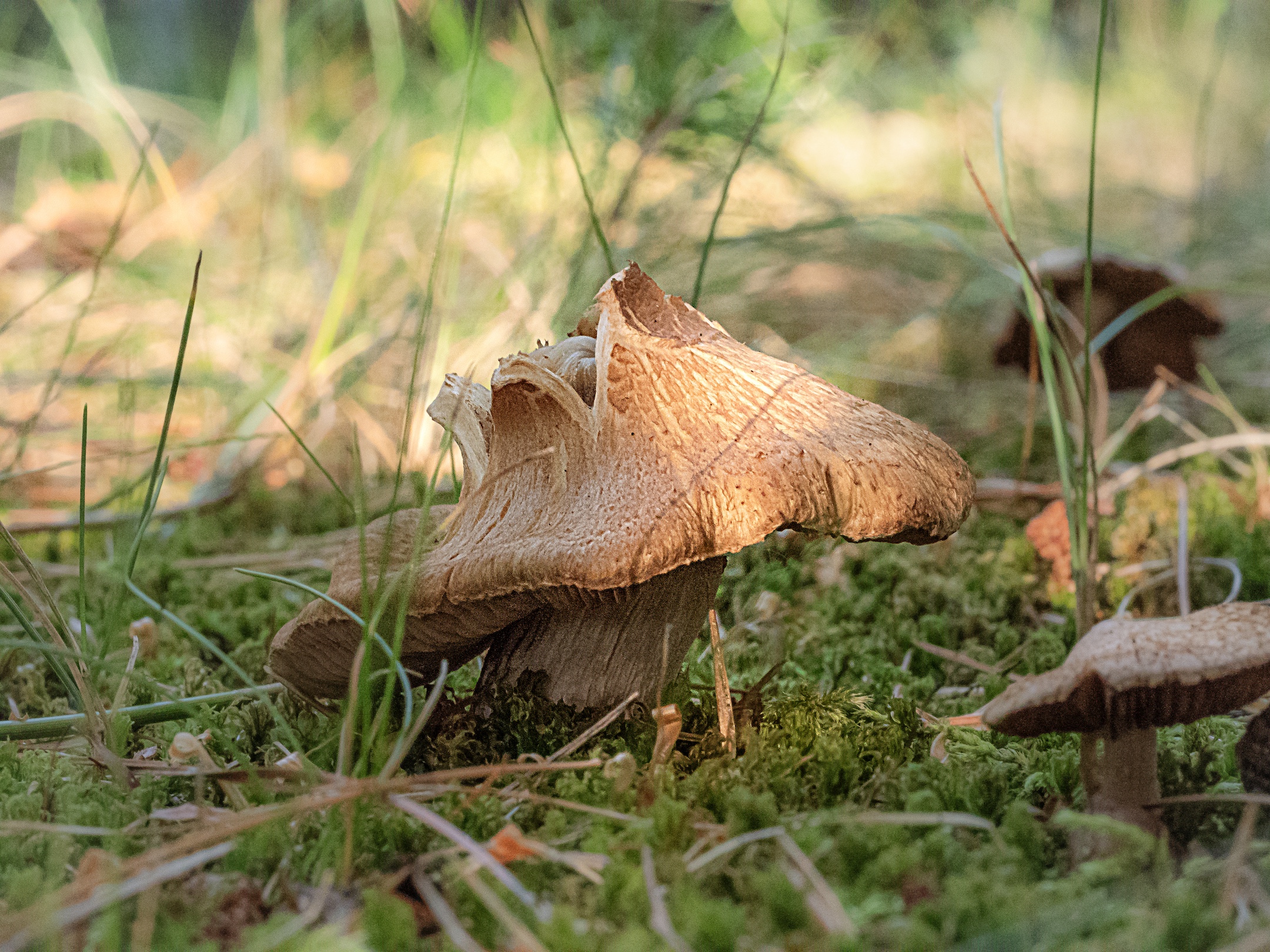
Next we have three photos of the Funeral bell (Galerina marginata). The name provides a not-so-subtle clue that the mushroom is highly poisonous and should not be consumed.


I love the coloring on the cap of the Fragile brittlegill (Russula fragilis):


The last mushroom in this set, Fly agaric (Amanita muscaria, four photos) is a classic storybook/fairytale mushroom! It’s supposed to have psychotropic effects once you boil away the toxins, but I’ll leave it to the more dedicated cosmic cowboys to test that hypothesis. Judging from the pictures on Wikipedia, I’d guess that his one is the subspecies flavivolvata, known as American fly agaric:


JWST finds a Milky Way twin born shockingly early in the Universe
The solar mission that survived disaster and found 5,000 comets
Forming moon may have taken three big impacts early in Earth’s history
The War Over Ultraprocessed Foods
Recently the city of San Francisco sued several food giants (Kraft Heinz, Mondelez and Coca-Cola) for deceptively marketing “ultraprocessed foods” and then externalizing the resulting health care costs onto the public. They cite a recent Lancet review which concludes: “The totality of the evidence supports the thesis that displacement of long-established dietary patterns by ultra-processed foods is a key driver of the […]
The post The War Over Ultraprocessed Foods first appeared on Science-Based Medicine.How to Catch a Comet That Hasn't Been Discovered Yet
There’s been a lot of speculation recently about interstellar visitor 3I/ATLAS - much of which is probably caused by low quality data given that we have to observe it from either Earth, or in some case Mars. In either case it’s much further away that what would be the ideal. But that might not be the case for a future interstellar object. The European Space Agency (ESA) is planning a mission that could potentially visit a new interstellar visitor, or a comet that is making its first pass into the inner solar system. But, given the constraints of the mission, any such potential target object would have to meet a string of conditions. A new paper by lead Professor Colin Snodgrass of the University of Edinburgh of his colleagues, discusses what those conditions are, and assesses the likelihood that we’ll find a good candidate within a reasonable time of the mission's launch.
Space is filling with junk and scientists have a fix
I’m Trans. This Is My Story
I was born in the late 1970s, back when “transgender” wasn’t a word you’d see on television, let alone in a school curriculum. Back then, there was only “he” or “she,” and if you didn’t fit neatly into one of those boxes, you were expected to hide it. I learned early that whatever I was didn’t fit, and that saying so could make me a target.
I remember being six years old, draping a towel over my head and pretending it was long hair. I wasn’t rebelling against anything. I was aligning myself, in the only way I knew how, with what felt true. It took years before I discovered there were others like me and decades before society began to admit that such people even existed. The shame came later, when I learned that such feelings were unspeakable.
My first experiences with desire were tangled up with fear. As a teenager, I was drawn to boys but couldn’t imagine anyone seeing me that way. Every crush came with an undercurrent of panic: If he knew who I really am, he’d hate me. And all of them did. The first time I came out to someone I liked, he laughed and told his friends. The next day at school, the whispering started. Within a week, I had no friends left.
Transition isn’t a lifestyle. It’s a form of care that restores equilibrium.For trans women of my generation, that kind of rejection was typical. You learn to move through the world invisible because being seen too clearly can be dangerous. It still can be. Even now in my 40s I find myself editing how I walk, how I speak, how I dress in public. Not out of vanity, but self-preservation.
But when I say that being trans is the last thing I want people to notice about me, it’s not from shame, it’s because being trans should be irrelevant to my humanity. It’s a rare medical condition, not an identity that defines the whole of a person. I’d rather be recognized for my work, my sense of humor, my curiosity, and my contributions to the world than for the fact that I had to undergo medical treatment to live comfortably in my body. Transition isn’t a lifestyle. It’s a form of care that restores equilibrium. A way to make the physical self match the internal one so that life can finally move beyond gender altogether.
That’s why I bristle at the way trans discourse has evolved in the past few years. I’m grateful that young people today have the language, visibility, and community. But I also worry that online activists (many of them very young!) speak about gender transition as if it were a simple matter of identity affirmation rather than the profound, irreversible medical journey it is. Hormone therapy and surgery are not accessories to self-expression. They are life-altering interventions that carry serious physical and emotional consequences.
To conflate transient identity exploration with the rare and lifelong condition experienced by people like me is to risk harm.We are also witnessing an unprecedented rise in gender dysphoria among adolescents and young adults, particularly girls transitioning to be boys (I intentionally use “boys” here instead of “men”). While I don’t doubt that some number of them are trans—trans people have existed in every culture throughout history and we are not going anywhere anytime soon—the sudden increase suggests many are likely grappling with broader questions of identity, anxiety, and belonging rather than a deep-seated, persistent dysphoria, and latch onto gender identity because it is so visible and so celebrated today. But to conflate transient identity exploration with the rare and lifelong condition experienced by people like me is to risk harm. The medical establishment must be able to tell the difference, without fear of being called bigoted for doing so!
I say all this not to gatekeep, but to underscore the gravity of what transition entails. I’ve had surgeries that permanently changed my body. I inject hormones, knowing they’ll likely to affect my liver, my bones, and my fertility. I made these decisions as an adult, after years of therapy and reflection. I don’t regret them for a second but I also wouldn’t wish their necessity on anyone.
Caution is not cruelty. It’s compassion informed by reality.They are serious medical interventions that alter the body permanently, often with side effects that require lifelong management. For adults, with informed consent and psychological support, they can be lifesaving. For children and adolescents, whose identities are still in flux, such decisions must be approached with restraint and rigorous oversight. Caution is not cruelty. It’s compassion informed by reality.
Gender-affirming care saves lives, no matter what anyone says. I know this because it saved mine. But that doesn’t mean it should be prescribed without deep, individualized assessment, especially for children and adolescents who are still developing their sense of self. Puberty blockers and cross-sex hormones are not toys, and it’s not transphobic to say so. The medical community must balance compassion with caution. Both can coexist.
At the same time, we cannot let this conversation become an excuse for cruelty. The backlash against gender medicine has brought out voices who see our existence itself as pathology. They call for bans, restrictions, and “re-education,” pretending that trans lives can be legislated out of reality. And many more make disparaging jokes about genitals or trans people supposedly not knowing that plastic surgery cannot change biology. These people are not protecting children. They are using them as pawns.
The surgeries and hormones are not what make us who we are.What gets lost in the shouting is the truth most trans adults live quietly every day: We don’t want special treatment! We just want to be left in peace! To work, to love, to grow old without fear. The surgeries and hormones are not what make us who we are. They are tools that allow us to stop fighting our reflection and start living!
I wish more activists today understood that dignity doesn’t come from angry rhetoric or slogans. It comes from honesty. And honesty means acknowledging not just the courage, but also the risk and the pain it takes to become yourself. It also means being truthful about those things with our youth.
Trans rights are human rights, not because trans people are flawless or because half-naked activists shout it at a protest, but because no one should have to justify their existence. Defending trans rights means defending the right to live truthfully and safely. But truth also demands clarity: transition is not something to be entered into lightly, nor denied to those who need it. The middle ground—careful, evidence-based, compassionate medicine—is where reason lives. And it’s where our humanity should, too.
To Celebrate 25 Years In Service, The Gemini Observatory Imaged The Butterfly Nebula
To celebrate 25 years since the completion of the International Gemini Observatory, students in Chile voted for the Gemini South telescope to image NGC 6302 — a billowing planetary nebula that resembles a cosmic butterfly. The International Gemini Observatory is partly funded by the U.S. National Science Foundation (NSF) and operated by NSF NOIRLab.
Ancient human artefacts found near caves in Arabian desert
Why quantum mechanics says the past isn’t real
The Knotty Problem of Matter Asymmetry Might Be Solved By Extending Physics
Why is the Universe filled with matter? Why isn't it an equal amount of matter and antimatter? We still don't know the answer, but a new approach looks at the symmetries of extended models of particle physics and finds a possible path forward. It's a knotty problem that may just have a knotty solution.
Black hole entropy hints at a surprising truth about our universe
Readers’ wildlife photos
Today we have some lovely parrot photos by Scott Ritchie from Cairns in Oz (his Facebook page is here). Scott’s captions are indented, and you can enlarge his photos by clicking on them.
And on to New South Wales. First stop, Eden. This is at the southeaster-most point where Australia turns north. The first night we drove down to the end of the beach along an elevated ridge. There, I heard the unmistakable almost cat-like call, but softer, of the Yellow tailed Black Cockatoo [Zanda funerea]. Here are some images I got of this small group that was feeding in Banksia seeds along the road. I particularly like the yellow cheek and the nice soft masklike feathers around their beak. There’s a story to tell here that will be given in the photos below.
Yellow-tailed Black Cockatoos (YTBC), love Banksia seeds:

Indeed, they become single-minded in their pursuit of these seeds. Taste pretty good:

But while they’re chewing away, there could be danger about. Raptors could suddenly appear from the sky and clean them up. Have them for dinner, literally:

These are smart group, smart birds that travel in small parties—perhaps a family group. And they usually have a sentinel bird. This bird perches high in a tree, eyes peeled for signs of trouble. He called out my presence straight away. He’s often calling by chirping away to his mates. Everything’s fine. Enjoy your meal. I particularly like the cute little mask that they wear over the bill. Reminds me of the Covid mask, the P95:

Anyway, the Cockeys continue to feed:

And they are loving it!:

All of a sudden the sentinel urgently calls. You can see his mask, pulled up even higher, with urgent calls “Warning, warning. Incoming. Take flight now.”:

And sudden suddenly off they go, flying as one right over my head!:

And who should fly by, who may have had his eyes on the cockies, but a White-bellied Sea-eagle [Icthyophaga leucogaster]. He passes behind and flies down the beach:

And is chased by a Masked Lapwing [Vanellus miles] screaming “stay away stay away!” The YTBC warning system worked!:

Can viral relationship tests really tell you about your relationship?
Pages
