
You are here
News Feeds
Astronomers just watched a black hole twist spacetime
Using Bent Light to Map Complex Planetary Architectures
With new technologies comes new discoveries. Or so Spider Man’s Uncle Ben might have said if he was an astronomer. Or a scientist more generally - but in astronomy that saying is more true than many other disciplines, as many discoveries are entirely dependent on the technology - the telescope, imager, or processing algorithm, used to collect data on them. A new piece of technology, the Nancy Grace Roman Space Telescope, is exciting scientists enough that they are even starting to predict what kind of discoveries it might make. One such type of discovery, described in a pre-print paper on arXiv by Vito Saggese of the Italian National Institute for Astrophysics and his co-authors on the Roman Galactic Exoplanet Survey Project Infrastructure Team, is the discovery of many more multiplantery exoplanet systems an astronomical phenomena Roman is well placed to detect - microlensing.
Readers’ wildlife photos
We are back today with a series of underwater photos of SHARKS taken by Peter Klaver. Peter’s captions are indented, and you can enlarge the photos by clicking on them.
During scuba diving off Bimini, Bahamas my scuba diving buddies and I went on two hammerhead shark feeding dives. The waters around Bimini are home to the Great hammerhead, Sphyrna mokarran, that typically grows to over 4m and over 400 kg. We saw several smaller ones and a large female that one of our dive guides said was ~14 feet long.
While the shark feed dives are not a very natural setting, such objections quickly disappeared from my mind as I saw a nearly half metric ton shark sometimes pass by less than 1 foot away from me. Below are some video frames, with a few divers (further away from the camera than the shark admittedly, making the shark look bigger) included in the last frame for size.


Send in your cat photos!
Once again I proffer a reminder to send in your photo of cats with a Christmas theme (or Hanukkah theme, as we now have several Jewish cats). The instructions are here and we have acquired the requisite 20 photos for posting. (Note: no AI pictures like the one I made below.)
Remember, one photo per submission, please! I’ll make the Deadline 9 a.m. December 24; the day before Koynezaa.

ALS and the market for false hope
Amyotrophic lateral sclerosis (ALS) is probably one of the most devastating diagnoses that we should all hope to never hear. Also known as Lou Gehrig’s disease, or motor neuron disease, ALS is a progressive neurodegenerative disorder that affects the nerve cells in the brain and spinal cord that are responsible for controlling voluntary muscles. As the disease advances, both upper and lower […]
The post ALS and the market for false hope first appeared on Science-Based Medicine.Scientists spent 10 years chasing a particle that wasn’t there
AI detects cancer but it’s also reading who you are
Strange lemon-shaped exoplanet defies the rules of planet formation
Scientists prove “impossible” Earth-to-space quantum link is feasible
Scientists prove “impossible” Earth-to-space quantum link is feasible
Comet 3I/ATLAS Has A Green Glow In New Color Images From Gemini North
Gemini North captured new images of Comet 3I/ATLAS after it reemerged from behind the Sun on its path out of the Solar System. The data were collected during a Shadow the Scientists session — a unique outreach initiative that invites students around the world to join researchers as they observe the Universe on the world’s most advanced telescopes.
Chronic fatigue syndrome seems to have a very strong genetic element
A quantum mystery that stumped scientists for decades is solved
ESA's XMM-Newton Examines Comet 3I/ATLAS Prior to Closest Earth Passage Friday
Everyone’s favorite interstellar comet posed for one more portrait recently. The European Space Agency’s XMM-Newton mission nabbed 3I/ATLAS on December 3rd from about 283 million kilometers distant. This comes as the comet is set to make its closest passage versus Earth this coming Friday, on December 19th.
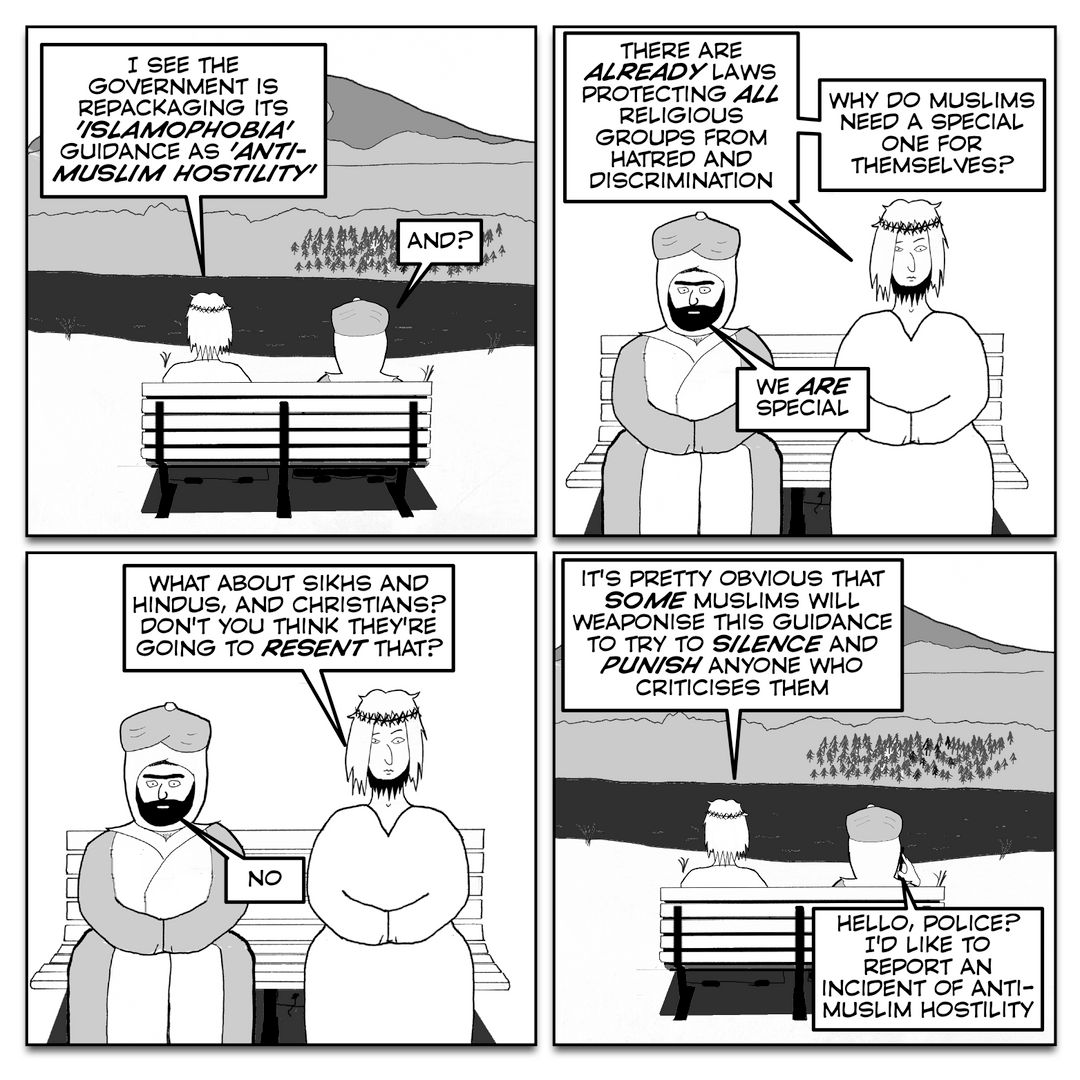
Jesus ‘n’ Mo ‘n’ “Islamophobia”
The latest Jesus and Mo strip, called “obvious”, came with a note and a link:
They UK gov just aren’t going to let this one go, for some reason: https://www.bbc.co.uk/news/articles/cjrjzp42v4zo
It’s paywalled, but you can find the full article archived here; it’s titled, “Ministers finalising definition of anti-Muslim hatred.” Here’s an excerpt (for some reason the BBC turns every sentence into a paragraph). I’ve put the draft definition in bold.
The government is considering a draft definition of anti-Muslim hatred which does not include the term “Islamophobia”.
The BBC has seen the form of words from the Islamophobia/Anti-Muslim hatred working group, which the government has taken to stakeholders for consultation.
Free speech campaigners have expressed concerns that protections for “Islamophobia” would mean it would not be possible to criticise the religion itself.
Members of the working group argue the definition protects individuals while avoiding overreach.
A working group was established in February to provide the government with a working definition of anti-Muslim hatred/Islamophobia.
A working group was established in February to provide the government with a working definition of anti-Muslim hatred/Islamophobia.
They submitted their proposal to the government in October.The definition will be non-statutory, meaning it is not set in law or legally binding, but will provide a form of words public bodies can adopt.
It provides guidance to the government and other bodies on what constitutes unacceptable treatment of Muslims, aiming to help them better understand and quantify prejudice and hate crimes against this group.
The draft definition is: “Anti-Muslim hostility is engaging in or encouraging criminal acts, including acts of violence, vandalism of property, and harassment and intimidation whether physical, verbal, written or electronically communicated, which is directed at Muslims or those perceived to be Muslims because of their religion, ethnicity or appearance.
“It is also the prejudicial stereotyping and racialisation of Muslims, as part of a collective group with set characteristics, to stir up hatred against them, irrespective of their actual opinions, beliefs or actions as individuals.
“It is engaging in prohibited discrimination where the relevant conduct – including the creation or use of practices and biases within institutions – is intended to disadvantage Muslims in public and economic life.”
In today’s cartoon, Jesus is right: if all religions are protected from hatred and discrimination, there’s no need to single out Muslims, giving them their own special protection that’s identical to everyone else’s. If the government wants to protect everyone equally, they only have to change the draft definition from “Anti-Muslim hostility” to “Anti-religious hostility.” Jesus points this out:
So Long 2025
This will be my last post of the year and as usual I like to look back at how SBM is doing. We have now completed 17 years as a blog, which I think is something in itself. As always I have to thank David Gorski and all of the regular contributors here for their tireless work without any compensation except fulfilling […]
The post So Long 2025 first appeared on Science-Based Medicine.Send in your cat photos!
Once again I tender a reminder to send in your photo of cats with a Christmas theme (or Hanukkah theme, as we now have five Jewish cats). The instructions are here and we have acquired the requisite 20 photos for posting. (Note: the picture I generated the drawing below by AI we don’t want those!)
Remember, one photo per submission, please! I’ll make the Deadline 9 a.m. December 24; the day before Koynezaa.

Why Most Exoplanets Are Magma Worlds
In astronomy, there is a concept called “degeneracy”. It has nothing to do with delinquent people, but instead is used to describe data that could be interpreted multiple ways. In some cases, that interpretation is translated into exciting new possibilities. But many times, when that happens, other, more mundane explanations are ignored for the publicity that the more interesting possibilities provide. That seems to have been the case for many “sub-Neptune” exoplanets discovered recently. Some theories have described them as Hycean worlds - worlds that are filled with water oceans or ice. But a new paper from Robb Calder of the University of Cambridge and his co-authors shows that, most likely, these planets are almost all made of molten lava instead.
Cosmology’s Great Debate began a century ago – and is still going
A hidden star found where dust shouldn’t exist
Pages
