
You are here
Science
The taboo idea you can’t discuss in academia
My friend the Belgian philosopher Maarten Boudry is writing about what he calls, correctly, “the most dangerous idea in academia”—an idea that can get you banned or even fired if you even suggest it. It is, of course, the notion that different “races” differ on average in IQ or intelligence. It’s such a hot potato that many people think that research looking for any differences should be banned or strongly discouraged. (This, of course, is because any potential outcome save exact equality among groups is said to inevitably cause racism and bigotry.)
I’ll leave aside here the idea of what “races” are, for Luana and I explained our take in our Skeptical Inquirer paper “The Ideological Subversion of Biology.” We can use instead either the notion of “self-defined races” (the boxes one ticks on a form) or, as Luana and I wrote, human populations:
Before we handle this hot potato, we emphasize that we prefer the words ethnicity or even geographic populations to race, because the last term, due to its historical association with racism, has simply become too polarizing. Further, old racial designations such as white, black, and Asian came with the erroneous view that races are easily distinguished by a few traits, are geographically delimited, and have substantial genetic differences. In fact, the human species today comprises geographically continuous groups that have only small to modest differences in the frequencies of genetic variants, and there are groups within groups: potentially an unlimited number of “races.” Still, human populations do show genetic differences from place to place, and those small differences, summed over thousands of genes, add up to substantial and often diagnostic differences between populations.
We discuss some differences between populations and self-diagnosed “races” that are known. There are also known differences in IQ, but the taboo question is whether any of those difference reside in the genes. On this subject I, like Maarten, am agnostic, as I simply don’t know the literature well enough (and am not sufficiently interested in it) to form an opinion.
Click on the screenshot below to read Maarten’s take:
Maarten was impelled to write the piece because one of his colleagues at Ghent University, Nathan Cofnas, is in big trouble because he’s promoted the most inflammatory version of The Forbidden Question: that a substantial portion of the differences in IQ between American blacks and whites (a phenotypic difference of about 15 points) is genetic:
My guest Han van der Maas, a renowned intelligence researcher at the University of Amsterdam, explained that individual IQ differences are highly heritable, but that he does not believe in differences between ethnic groups. His statistical and methodological arguments (e.g. Simpson’s paradox) convinced me at the time. Still, he hedged his bets: future evidence might yet reveal such differences, and we should not try to cancel researchers who claim such differences are real.
Forty-five colleagues from my former philosophy department (and hundreds more in a letter to the rector) clearly think otherwise. They are urging the rector to fire Nathan Cofnas because he claims that the IQ gap between racial groups such as whites and blacks in the US—differences that are themselves well documented—have largely genetic causes, rather than environmental ones like socio-economic disadvantage or discrimination. He makes the same claim about the higher scores of East Asians and Jews (which exceed those of white Europeans, by the way). They dismiss all of this as “pseudoscience and racism.”
The question is whether Cofnas should be fired for his claim, and whether the research supposedly supporting it should be banned. I would argue that the answer to both questions is “no”, but researchers have to be very careful and sensitive in pursuing it. Maarten quotes the paper by Luana and me about this (his words indented, ours doubly indented):
Now, I perfectly understand why many people are shocked by Cofnas’s claims, and I agree that such hypotheses should be treated with utmost caution. As my friend Jerry Coyne wrote with Luana Maroja in their influential article The Ideological Subversion of Biology:
In light of the checkered history of this work, it behooves any researcher to tread lightly, for virtually any outcome save worldwide identity of populations could be used to buttress bias and bigotry.
Still, this clearly falls within the scope of academic freedom. If you are not prepared to extend academic freedom to ideas you fiercely disagree with, you do not really believe in academic freedom.
In light of calls for Cofnas’s firing, a number of people have signed an open letter defending Cofnas’s right to study this topic (or any reasonable topic); the letter is at the link below:
My colleagues Peter Singer, Francesca Minerva and Jeff McMahan wrote an open letter defending the academic freedom of Nathan Cofnas. I have signed it as well, together with luminaries such as Steven Pinker, Alan Sokal , Susan Blackmore, Scott Aaronson, and Bryan Caplan. Here it is in full:
And the letter, which is short:
A statement in support of Nathan Cofnas’s Right to Academic Freedom of Expression
Two separate statements have recently been issued by members of Ghent University, in Belgium, calling on the university to rescind the appointment of Nathan Cofnas as a postdoctoral researcher. One claims that his views “violate the university’s code of ethics and are morally beneath contempt”.
We oppose this attack on academic freedom. While we are not endorsing any specific claims Cofnas has made, we believe that academics must be able to put forward controversial or provocative claims without fear of losing their employment. Of course, other academics should be free to criticise or repudiate those claims.
The statements mentioned above do not even attempt to engage with Cofnas’s empirical claims. Disagreements, whether about empirical claims, ethical principles, or the interpretation of the ethical code of a university, should be settled through free inquiry and open, civil discussion.
We commend Petra De Sutter, Rector of Ghent University, for her statement to the Belgian newspaper De Morgen, that “As a university, we have a responsibility to create space for debate, but also to ensure an environment where people feel heard and respected.”
We agree that creating space for debate is an essential element of a university, and that space for debate should not be closed unless this is a last resort to prevent a clear threat of lasting substantial harm.
Note that the letter takes no position on the data itself; it’s a letter about whether Cofnas should be granted academic freedom to do his work. As Maarten himself says, “As most of the signatories, I do not endorse Nathan Cofnas’s claims and remain agnostic on the issue.” Luana and I, along with 145 other academics, signed this letter, with some signers named above.
It’s a sign of the ideologically-infused and chilling atmosphere in biology that one has to think for even a second before agreeing with the letter. Now you might think that finding genetically-based IQ differences betwen populations might cause “a clear threat of lasting substantial harm,” but for reasons outlined in our paper, Luana and I don’t agree. There are potential upsides in such data, just as there are potential upsides in looking at interpopulation data on medical conditions (the goal is to help individuals, not to demonize one group or another). After all, we don’t even know how the data will come out.
And it’s not at all clear whether finding out that an interpopulation difference has genetic causes will lead to increased bigotry. Since genetic contributions to being gay have been found, prejudice against gays has decreased, not increased. If you reject free will and accept determinism due to genes, physics, and one’s environment, one might see genetically-based differences as “forgiving,” for you cannot be blamed for the genes you get from your parents and that reflect long evolutionary histories.
Maarten goes on to show the difference in long-distance running abilities between Ethiopians and Kenyans on one hand and the rest of the world on the other (these are population differences rather than differences between the classically-defined “races”. Though I don’t know whether there have been tests to show that these differences are genetic (potential studies could include adoption at birth, rearing in different environments, and so on), I would be willing to bet that they are. But, as Maarten says, “measuring intelligence is far more complicated than crossing a finish line.”
Boudry adds that Cofnas has sometimes been brusque in his public pronouncements about his work, but this is not uncommon among academics:
Finally, what about Nathan Cofnas’s vigorous activism alongside his academic work? It is true that Cofnas is far less measured in his Substack posts than in his academic publications on IQ. For instance, his flippant way of expressing a statistical point about the racial IQ gap in academic achievement (similar to the point above about long-distance running) seems almost deliberately incendiary:
Under a colorblind system that judged applicants only by academic qualifications, blacks would make up 0.7% of Harvard students. […] In a meritocracy, Harvard faculty would be recruited from the best of the best students, which means the number of black professors would approach 0%.
Cofnas is also very combative in his attacks on “woke ideology”, and he genuinely believes only a “hereditarian revolution” can truly dismantle it—otherwise, we’ll be stuck fighting symptoms rather than root causes:
Until we defeat the taboo on hereditarianism, our victories will always be temporary. Every time we cut off a tentacle of the DEI monster, it will grow back.
I’m not convinced, but it’s a clever argument, and I’d encourage you to check it out with an open mind.
Finally, Maarten points out one harmful side effect of demonizing people for the kind of work they do in academia:
Calling for the dismissal of anyone who even touches the third rail of ethnic differences in IQ is also strategically unwise. Such attempts often fuel the phenomenon of “red-pilling.” When academics appear determined to suppress a dangerous idea at all costs, people naturally become suspicious: What are they trying to hide? The result is a further erosion of trust in academia.
And that is not just a made-up reason. When the public perceives scientists to be espousing a political or ideological cause in their research, their view of science is eroded. Have a look at this paper showing that when the journal Nature, in a first, endorsed a political candidate (Joe Biden) for U.S. President in 2020, it reduced the public trust not just in the journal, but in scientists themselves.
Do weigh in below, and because the issue is a sensitive one, you might want to answer this poll.
Note: There is a poll embedded within this post, please visit the site to participate in this post's poll.Private company to land on asteroid Apophis as it flies close to Earth
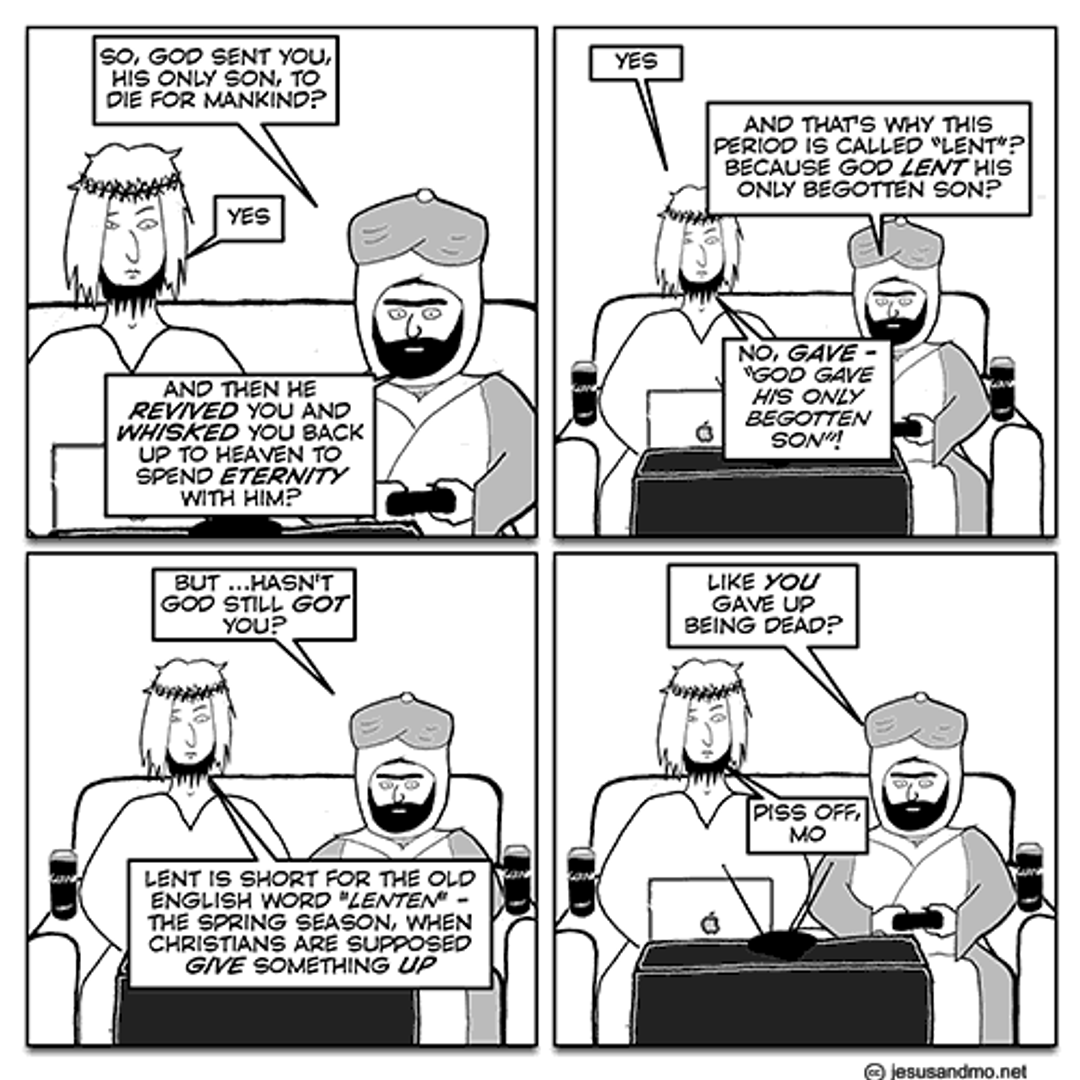
Jesus ‘n’ Mo ‘n’ Lent
The Jesus and Mo artist has recycled an old strip for Lent, which goes from Feb. 18 through April 2. The caption is this:
Friday Flashback – because we’re in the middle of Lent. You didn’t forget, did you? Heathens!
Mo shows here that he has at least a tad of a sense of humor.
The Sun’s Long-Lived Active Regions Are Massive Flare Factories—But We Don’t Know Why
Space weather is a fascinating subject, but one we still have a lot to learn about. One of the main components of it is the active regions (ARs) of the Sun. These huge concentrations of magnetic fields show up throughout the Sun’s photosphere and are the primary source of solar flares and coronal mass ejections (CMEs). They can be simple pairings of magnetic flux or huge, magnetically complex tangles that spend weeks creating massive solar storms before dissipating. But tracking the longest lived of these ARs has been a headache for solar physicists, and a recent paper by Emily Mason and Kara Kniezewski, published in The Astrophysical Journal, both dives into this tracking problem and uncovers some interesting features of the Sun’s most persistent ARs.
Scientists solve 12,800-year-old climate mystery hidden in Greenland ice
A negative attitude towards ageing is making you age faster
Astronomers discover nearby galaxy was shattered by cosmic crash
Scientists turn CO2 into fuel using breakthrough single-atom catalyst
Vaccines Work. Here’s Why We Care About Your Unvaccinated Child.
While normal people don't want any child to suffer or die because their parents were tricked by disinformation, the leaders of the anti-vaccine movement, who profit by lying about vaccines, don't care at all.
The post Vaccines Work. Here’s Why We Care About Your Unvaccinated Child. first appeared on Science-Based Medicine.Canada Allocates $200 Million Towards the Creation of Nation's First Spaceport
Minister of National Defence David McGuinty announced on Monday, March 16th, that the Canadian government is committing $200 million to develop Canada's first commercial spaceport in Nova Scotia, which will be run by Maritime Launch Services.
The Crab Pulsar's Puzzling Emissions Finally Explained.
Pulsars are rapidly rotating neutron stars. The Crab Pulsar, an often studied supernova remnant, is known for its unusual radio emission patterns. New researchs says it's because of a "tug-of-war" between magnetism and gravity. Gravity acts as a focusing lens and plasma in the magnetosphere acts as a defocusing lens.
Sometimes You Get Lucky, Just Like the Hubble Did When It Caught This Comet Disintegrating
A team of astronomers were fortunate when their original comet target couldn't be observed with the Hubble. They quickly pivoted to a different target, and caught Comet K1 in the process of breaking apart. This gave them an excellent opportunity to learn more about the doomed object.
Probiotic cream that ramps up heat production could prevent frostbite
Banksy unmasked: Reuters investigation finally reveals the identity of the pseudonymous and elusive renegade artist
Banksy is a pseudonym for a street artist who became a famous and high-priced “establishment’ artist, all the while remaining completely unknown—until now. (Actually, the Daily Mail had correctly guessed his identity in 2008). Banksy started drawing graffiti in Bristol, England, and then began using stencils, which were quicker to put up—making him less likely to get caught. But he did get caught in 2000 for vandalizing a billboard in New York, and for that he had to disclose his real name. A spiffy piece of detective work published in Reuters two days ago, shows that the Mail was correct, and that Banksy is in fact a 50-53-year old white man named Robin Gunningham. He remains a multimillionaire.
His most famous work can be seen here: “Girl with Balloon,” showing a girl trying to catch the string of a heart-shaped balloon. It’s been sold in several versions, including one on paper that was deliberately shredded by a machine inside its frame while it was being auctioned off at Sotheby’s. Here’s the event, and the video—showing the preparation—was clearly made by Banksy. It was another of his pranks, but one that was viewed (and priced as) Banksy art itself.
And the explanation (note what the shredded artwork went for!):
On 5 October 2018, a 2006 framed copy of the artwork was auctioned at Sotheby’s selling for £1,042,000 – a record high for the artist. Moments after the closing bid, the artwork began to self-destruct by means of a hidden mechanical paper shredder that Banksy had built into the frame bottom. Only the lower half shredded. Banksy released an image of the shredding on Instagram with the words “Going, going gone..”. Sotheby’s said, “We have not experienced this situation in the past where a painting spontaneously shredded”, leading some market watchers to speculate the remains of the painting will be worth even more. Banksy released a video of the shredding and how the shredder was installed into the frame in case the picture ever went up for auction.
The woman who won the bidding at the auction decided to go through with the purchase. The partially shredded work has been given a new title, Love Is in the Bin, and was authenticated by Banksy’s authentication body Pest Control. Sotheby’s released a statement that called it “the first artwork in history to have been created live during an auction.” Love Is in the Bin was itself sold at Sotheby’s for £18 million in October 2021.
Note that the price shot up after the drawing was shredded! It is considered an “art intervention“!
Bansky is both political (and pro-Palestinian) as well as mischievous. And filthy rich. If you’re into art, or want to see how the mystery of his identity was solved for good, click on the Reuter’s screenshot below or see the article archived for free here. There’s also a short take at Entertainment Weekly.
It’s a long but fascinating investigation, and if you’ve been following Banksy over the years, you’ll want to read it. But I’ve taken excerpts from condensed summary from EW:
One of the art world’s biggest modern mysteries may have just been solved.
A new report claims to have once-and-for-all unmasked the elusive graffiti artist Banksy, who has been operating under complete anonymity since the early 1990s.
The investigation, published Friday by Reuters, combs through and eventually sets aside some of the buzzier theories as to the “Girl with Balloon” artist’s true identity. Is he the Massive Attack frontman Robert Del Naja? Or the street artist Thierry Guetta, also known as Mr. Brainwash, who was the subject of the Oscar-nominated documentary Exit Through the Gift Shop, which Banksy directed and — completely disguised, of course — also featured in?
After nearly three decades of speculation, journalists Simon Gardner, James Pearson, and Blake Morrison claim “beyond dispute” that Banksy is a man named Robin Gunningham.
. . . The final identification started with a clue from Banksy Captured, a 2019 memoir from Steve Lazarides, who managed the artist from the late 1990s through 2008. The year that book was published, Lazarides posted a photo from 2000 of an “aborted Banksy work” to his Instagram — a defaced Marc Jacobs billboard in New York City that was left incomplete after authorities allegedly arrested the artist.
. . .Police documents and a court file relating to the arrest that Reuters unearthed repeatedly make reference to Gunningham — who signed his own name at the bottom of a written confession.
Though police sought to charge Gunningham with a felony, he was released and the charges were reduced to a misdemeanor after posting $1,500 bail, temporarily turning over his passport, and completing five days of community service.
. . .This isn’t the first time Gunningham has been suspected as the real hand behind the mysterious graffiti artist. The Daily Mail pointed the finger at Gunningham in 2008, the same year he legally changed his name to David Jones. But suspicions persisted around figures like Del Naja, Guetta, and British politician Billy Gannon.
Banksy started out as a guerrilla artist whose quickly rendered, stencil-like illustrations with an often highly political charge garnered him instant notoriety. He has made work in innocuous corners of major metropolitan cities like London and New York City, but has also become known for provocative illustrations left in conflict zones like Ukraine and the Palestinian West Bank.
And, from the Reuters exposé, here’s how he was caught and identified:
In September 2000, Banksy was shifting from painting freehand to using stencils, a method suited for repetition and speed. But when he climbed up on [Gallerist Ivy] Brown’s roof to have at the billboard, he painted freehand.
The half-finished image resembled a billboard Banksy saw in Steven Spielberg’s “Jaws.” In his 2023 “Cut & Run” exhibition in Glasgow, the artist said the movie scene inspired him to get into graffiti. In “Jaws,” someone doctored a tourism billboard depicting a woman on an inflatable raft in the sea. The vandal added a shark fin and gave the woman bulging eyes and a speech bubble: “HELP!!! SHARK.” [JAC: The Reuters site has a photo of the doctored billboard.]
In a painting spree, Lazarides wrote, Banksy “doctored the Marc Jacobs Men billboard so that the model had goofy teeth” and drew a “giant speech bubble” that was strangely empty.
That’s because New York police caught Banksy before he could finish.. . . . . at 4:20 a.m. on September 18, 2000, authorities found a man defacing a billboard on the roof of 675 Hudson Street. Because damages exceeded $1,500, police sought to charge him with a felony. Among the documents is the man’s handwritten confession.
Within hours of his arrest, documents show, the man was assigned a public defender. That afternoon, he was released after agreeing to temporarily turn over his passport.
The court file shows he would later post $1,500 bail in exchange for his passport. The felony charges were reduced to a misdemeanor charge of disorderly conduct. He paid a fine and fees totaling $310, and by early 2001, he completed his sentence of five days of community service, the records show. On the bail form, he gave his address as 160 E. 25th Street in New York, the location of one of Manhattan’s most eccentric hotels.
. . . When Banksy was busted in 2000, he wasn’t on the New York Police Department’s radar, said Steve Mona, the now-retired lieutenant who ran the 75-member vandal squad back then. The police had no idea they had nabbed “Banksy” because the artist had only recently begun employing the style and pseudonym that would make him famous.
Given Banksy’s celebrity, the name of the culprit now takes on significance. It wasn’t Del Naja who defaced the billboard atop 675 Hudson Street. The man who confessed was Robin Gunningham.
In addition to his signature, Gunningham is repeatedly named in court and police documents related to the arrest.
The Reuters piece photos of his signed confession, with “Robin Gunningham” appearing at the bottom, barely legible. The rest of the excerpts are from Reuters:
The Mail on Sunday had been right in 2008 in making the case that Gunningham was Banksy. In hindsight, Gunningham’s effort to hide his identity began falling apart with his September 2000 arrest in New York. Records of the bust existed and they contained his real name. The books by former manager Lazarides wouldn’t be published until 2019. But the photos and the details Lazarides included about the arrest enabled us to pinpoint where Banksy was apprehended and the ad he defaced.
There’s one more bit of evidence that is telling. In 2022, Bansky did seven famous murals in Ukraine (you can see them here) but there was no record that a “Robin Gunningham” ever entered Ukraine (remember, he had a passport). Reuters reveals that Bansky had since adopted the name of “David Jones.” This was verified by several documents, but Reuters isn’t making them public out of the desire to preserve some of Gunningham’s information, including his address. (The documents are, however, apparently available publicly.)
At any rate, Bansky did enter Ukraine at the same time as his painting partner, Robert Del Naja, and the crucial evidence was found:
On October 28, 2022, the day Duley and Del Naja entered Ukraine, a “David Jones” also crossed the border at the same location, according to a source familiar with immigration procedures. The source also told us the date of birth listed on Jones’ passport. It was the same as Robin Gunningham’s birthday.
According to the source, records also indicate Jones left Ukraine on November 2, 2022, the same day Del Naja departed.
I don’t know what will happen now: will Gunningham still use the name “Bansky,” turn out art under his birth name, Robin Gunningham, or use his changed name, David Jones? My guess is that whatever name he uses, he’ll still make art, and perhaps mysteriously, but now that he’s known, perhaps the work won’t be worth as much as it was when Banksy was a ghost.
Here’s an Instagram Post purporting to show two photos of Gunningham. You can see more at this Google Search page.

The Moon's Going To Get Crowded - We Should Protect Our Heritage On It While We Still Can
In 1959, the Luna 2 probe from the Soviet Union became the very first human-made object to reach our closest celestial neighbor. In the decades since, we have been leaving footprints - both literally and figuratively - all over the Moon. Today, there are over 100 metric tons of human-made material resting on the Moon’s surface - everything from advanced cameras and sensors to literal human waste. But that’s nothing compared to what’s to come. NASA predicts the next decade will see over 100 new lunar missions, equaling or exceeding all the missions previously flown. Which brings up a pressing question about all the stuff that’s already there - how do we protect that history? A new paper by Teasel Muir-Harmony, the Curator of the Space History Department of the Smithsonian and Todd Mosher, a Scholar in Residence at University of Colorado, Boulder, reports on a Smithsonian National Air and Space Museum and the American Institute of Aeronautics and Astronautics Summit on Outer Space Heritage that dives into the legal, scientific, and engineering hurdles of preserving these historic sites.
Eclipse Study Tracks Turbulence Through the Solar Corona
It was an amazing sight witnessed by many during the April 2024 total solar eclipse. For a few precious moments, it seemed like a celestial dimmer switch was thrown, as the Moon eclipsed the Sun. It was one of the very few times you could actually see prominences and the pearly white corona of the Sun in person, without the aid of special equipment. Now, a recent study out of the University of Hawai’i has linked high resolution images taken during totality with observations from missions orbiting the Sun, in an effort to chronicle the evolution of space weather.
JUICE is Planning To Do Science On Jupiter's "Minor" Moons Too
The European Space Agency’s (ESA’s) Jupiter Icy Moons Explorer (JUICE) probe is on its (very long) way to Jupiter, and will finally arrive at the King of Planets in 2031. Its primary mission is to focus on the “big three” icy moons - Ganymede, Europa, and Callisto. But while JUICE is busy mapping Ganymede’s magnetic field, it will also be keeping a sharp eye on the other 94 moons in the Jupiter system. A recent paper published in Space Science Reviews by Tilmann Denk of DLR, Germany’s space research association, and his co-authors showcases just how much “bonus science” JUICE is expected to squeeze out of these other targets.
Physicists discover a heavy cousin of the proton at CERN’s Large Hadron Collider
Mathematician wins 2026 Abel prize for solving 60-year-old mystery
Physicists create formula for how many times you can fold a crêpe
Pages
