
You are here
News Feeds
Do Dwarf Galaxies Merge In The Milky Way's Halo?
Our current understanding of the Cosmos shows that structures emerge hierarchically. First there are dark matter densities, then dwarf galaxies. Those dwarfs then merge to form more massive galaxies, which merge together into even larger galaxies. Evidence of dwarf galaxy mergers is difficult to obtain, but new research found some in the Milky Way's halo.
It would be a mistake to rush into an under-16 social media ban
Bored of snakes and ladders? Some maths can help bring back the fun
A remarkable book on quantum mechanics reveals a really big idea
New Scientist recommends pioneering artist Ryoji Ikeda's new work
Fascinating but flawed book explores how sickness shapes our lives
How your health is being commodified by social media
Engaging look at friction shows how it keeps our world rubbing along
Think of a card, any card – but make it science
Michael Shermer on free will
Michael Shermer‘s new book is out, and in the video below, 55 minutes long, he gives an oral summary of its contents (a link to the book is at the bottom). The video was sent to me by reader Barry, who called my attention to the section on free will, and I’ve started the video at the 45-minutes mark—right when Shermer discusses the intractability of the “hard problem” of consciousness and then segues to free will. Here are the YouTube notes.
In this episode, Michael Shermer walks through the core ideas behind his new book Truth: What It Is, How to Find It, and Why It Still Matters, breaking down how humans confuse meaning with reality, stories with facts, and confidence with correctness.
I’ve put a few remarks about Shermer’s view of free will, which seems to me confused, below the video.
Shermer avers that he’s a compatibilist: someone who accepts both determinism and free will. As Wikipedia puts it under “compatibilism“:
Compatibilism is the belief that free will and determinism are mutually compatible and that it is possible to believe in both without being logically inconsistent.
And yet Shermer says he’s not a determinist, although he does define free will as “libertarian, could-have-done-otherwise” free will. Shermer rejects libertarian free will because he says it’s dualistic, drawing a distinction between mind and matter, and here he’s absolutely right.
But then he argues that “determinists are wrong”! Why? He doesn’t say, but makes a confusing argument that the “could-have-done-otherwise” notion of free will is bogus because it involves replaying a tape of what happens when an instant of “choice” occurs. Shermer says that if this is the contention, then of course you will do the same thing when you replay that instant, but argues that this is simply because you’re replaying a tape that already has a known consequence, like replaying a record. But if he thinks that, then what does he mean by saying that libertarian free will, which is the contention that replaying the tape could yield a different consequence, is wrong? He says that replaying the tape will always give the same result because it’s a tape. But that is not the argument that physical determinists make. The argument is that you are starting a fresh tape at the moment of choice, but it will always give the same result—absent any quantum effects (see below).
Shermer contends that “the past is determined, but the future isn’t”. He doesn’t explain why, but here again I agree with his claim that the future is not absolutely determined. But Shermer doesn’t explain why it isn’t. I will: the future is not completely determined only insofar as fundamentally unpredictable physical effects occur—that is, quantum effects, which as far as we know defy absolute predictability. We know quantum effects applied at the Big Bang, so at that moment the future of the universe was not predetermined.
But do quantum effects apply to human behavior and “choice”? Perhaps; we just don’t know. Maybe an electron in a neuron in your brain will jump at the moment you’re ordering dinner, so you order fish instead of a hamburger. If that could happen—and again we don’t know if it does—then yes, you could have done something other than what you did. However, because there’s no mind/body dualism, there is no way that you had any agency in moving that electron; it just happened. Is that what Shermer means by “free will”? If so, it’s a lame kind of free will, because the average person who believes in free will thinks in a dualistic way. Although they don’t say this expicitly, they contend that they have agency that can affect our neurons, brains and behavior.
I’ve written before about how predictability doesn’t equate to determinism, and by determinism I mean physical determinism, defined by Anthony Cashmore this way (this paper is what made me a determinist):
I believe that free will is better defined as a belief that there is a component to biological behavior that is something more than the unavoidable consequences of the genetic and environmental history of the individual and the possible stochastic laws of nature.
Cashmore adds that the environment is still “chemistry”, which of course is also “physics”:
Here, in some ways, it might be more appropriate to replace “genetic and environmental history” with “chemistry”—however, in this instance these terms are likely to be similar and the former is the one commonly used in such discussions.
In other words, to Cashmore (and to me) this form of free will involves dualism. It’s woo. Cashmore, who admits that unpredictable quantum effects can lead to a universe where pure predictability is impossible, adds that that still does not give us free will as defined above—free will not governed by the laws of physics.
We know now that on a macro level, predictability is quite good: we can predict, using classical mechanics, when solar eclipses will occur, where the planets will be in ten years, and we can also use classical mechanics to put people on the Moon. But since classical mechanics is simply a reification on a large scale of quantum mechanics, the future is not completely predictable as quantum effects accumulate. I’ve used as an example the possibility that genetic mutations could be quantum phenomena in some way. If that’s the case, then we can’t predict at a given moment what mutations will occur, and if that is the case, then the raw material for evolution is unpredictable, which further means that evolution is unpredictable.
Nevertheless, because our behaviors are still controlled by the laws of physics, if there is no mind/body dualism then there is no “agency” as most people believe it, and thus there’s no libertarian free will.
But Shermer, as an avowed compatibilist (he appears to be strongly influenced by Dan Dennett), thinks that we do have a form of “free will”, and supports it by using as an example his ability to affect his own future by making preparations for tomorrow’s morning bicycle ride, even if he doesn’t want to ride. He puts his bike in the trunk, he lays out his bicycle clothes for the morrow, and so on. As he says:
“I can choose to do certain things now to make my future different than what it was in the past. That’s freedom; that’s volition; that’s choice. That’s free will. That’s as good as it gets. So all the determinists, they’re wrong; they’re just simply wrong; they’re assuming we live in a universe that we don’t live in: a predetermined universe.”
It’s sure not choice the way most people mean it, and believe me, I’ve had this argument any number of times. People are not physical determinists, but dualists, just like the saxophone player who nearly attacked me when I told him that at the moment he decided to play an improvised jazz solo, that solo was not something he could alter by thinking. People are not sophisticated enough to draw a distinction between free will and physical determinsim; they are not sophisticated enough to see that the only physical force that can ultimately change a behavior is quantum mechanics.
Shermer contends that “In the real universe, determinists don’t exist.” He says he’s never met one. Well, Mr. Shermer, meet Mr. Coyne and Mr. Sapolsky, both physical determinists. We don’t distort the notion of “free will” just so we can say people have it. (Dennett thought that belief in determinism would erode society, and that’s why he wrote two books redefining free will for the masses.)
Finally, Shermer tells us why he doesn’t think there are true determinists: it’s because we act as if we have free will. He says that some people who pretend to be determinists take pride in the books they write. As he says, “Why would you take pride in your books? You didn’t do anything; it was all determined at the Big Bang.” Well, I don’t have to respond to that, Shermer knows better. We may well be evolved to think we have agency. We certainly do think that, and have evolved to think that, but I don’t know if natural selection produced that frame of mind. Regardless, we can’t help taking pride in our accomplishments, or looking down on people who do bad things, because that’s the way our brains are configured. That does not mean that physical determinism should not affect our views of punishment and reward: it should, especially with regard to the justice system. But I’ve discussed this many times before.
The last thing I want to say is that some atheist writers whom I admire greatly—people like Shermer, Pinker, and Dawkins—seem to shy away from the free-will problem. I am not sure why; perhaps they realize that if you deny libertarian free will, people will think you’re crazy. You tell me!
Here’s Michael’s book, which came out yesterday from the Johns Hopkins Press. I haven’t yet read it, but surely will. If you click on the cover you’ll go to the Amazon site:
This virus infects most of us – but why do only some get very ill?
Ancient humans were seafaring far earlier than we realised
Huge fossil bonanza preserves 512-million-year-old ecosystem
Low-Earth orbit is just 2.8 days from disaster
Dark stars could solve three major mysteries of the early universe
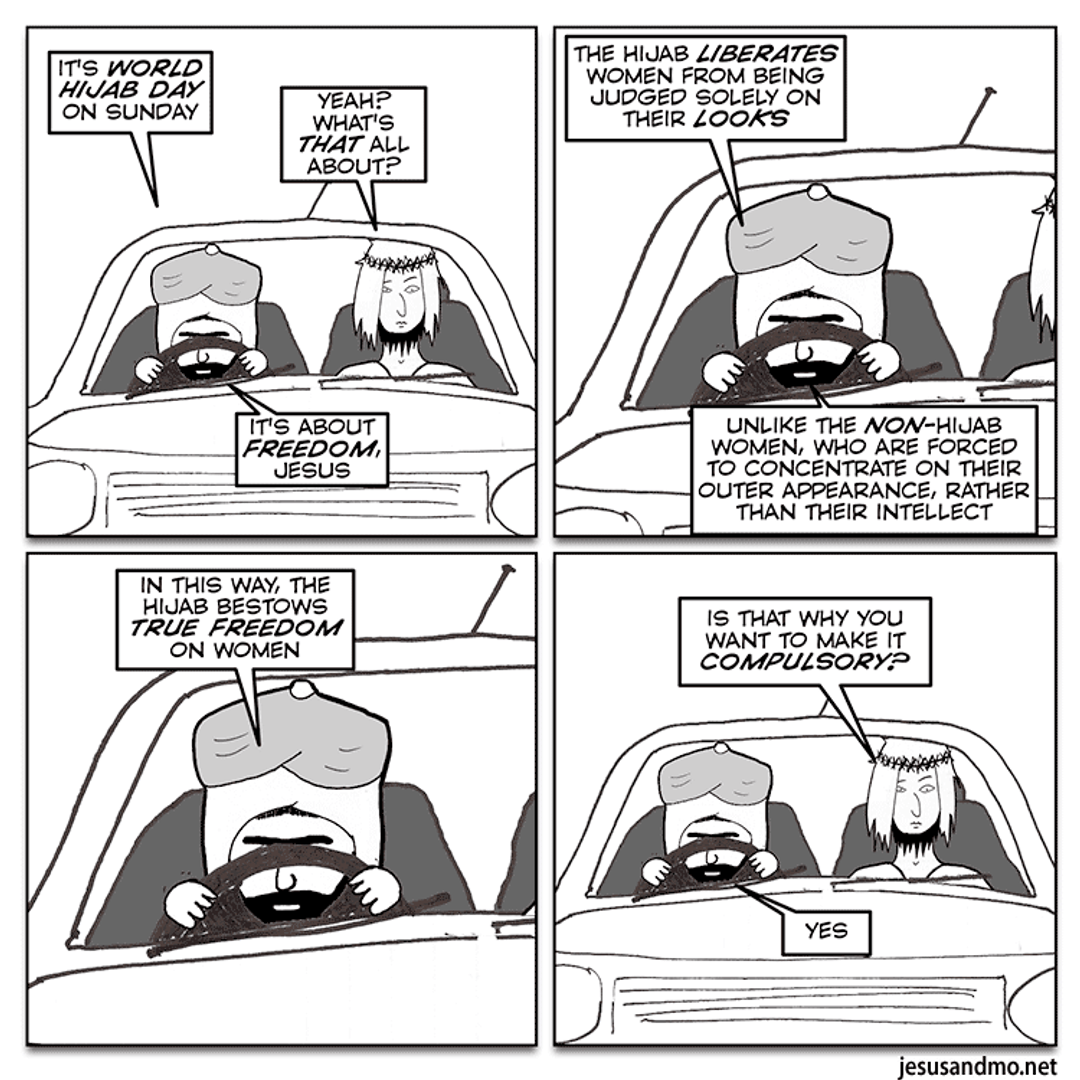
Jesus ‘n’ Mo ‘n’ hijabs
The latest Jesus and Mo strip, called “looks,” came with a message: “It’s World Hijab Day on Sunday! Fortunately, it’s also No Hijab Day, so it balances out.”
And (a recurring theme): Mo himself shows precisely the phenomenon he criticizes.
Here are the guidelines for World No Hijab Day from the Council of Ex-Muslims of Britain:
How to take part in No Hijab Day:
- We are calling on women of all beliefs and backgrounds to take off their hijab, and put it on a man on February 1.
- Use this opportunity to spark meaningful conversations about purity culture in Islam, challenge sex-apartheid, and show your solidarity with ex-Muslim, Iranian, Afghan, and other women around the world who refuse to wear the hijab.
- Share your thoughts, experiences, and support using #NoHijabDay and #HijabSilences
- Let your voice inspire real change for women’s rights.
But I don’t want to wear a hijab!
Note that you can support the strip for as little as $1 per month. Also, see the funny FAQ about the strip.
Readers’ wildlife photos
We have one submission, today from Paul Handford, and I’ll show part 1 of his hummingbird photos. Paul’s captions are indented, and you can enlarge his photos by clicking on them.
While living in south-central British Columbia, I was so fortunate as to have had close encounters with North America’s smallest breeding bird, the Calliope hummingbird, which weighs just short of 3 grams— about 0.1 oz— and is just over 3 inches long. Its scientific name, Selasphorus calliope, is well merited: the generic name derives from ‘selas‘ = Gk. ‘a bright flame’ plus ‘phoros‘ = ‘bearing’, ‘carrying’, while the specific epithet references Kalliope, chief of the muses, and goddess of poetry.
First, the female. Here are four views of her; in two you can see that the wing-tips reach beyond the short tail; in others you see the buffy flanks and faintly-spotted throat (the closely similar female Rufous hummer has a tail that extends beyond the wing-tips, and is strongly rufous on flanks and tail).


Then, males. The brilliant magenta feathers of the male’s gorget are very obvious when the bird faces you. These feathers can be erected so as to form a ‘sunburst’ ruff, which males will do when engaged in disputes, and in courtship displays (see below):


The magenta of the throat feathers is produced by the phenomenon of interference rather than by pigment and, as mentioned above, this optical effect is striking when directed at the viewer. But when seen from the side, these feathers lose their brilliance, often not appearing to be coloured at all:


Many hummingbirds are pretty pugnacious, and often engage in quite spectacular combat. In these next pics, two males try to impress one another, and the ‘sunburst’ erect ruff is visible:


The Health Effects of Air Pollution
Attitudes toward fossil fuels are sharply and ideologically divided in the US. When asked in 2025 if we should prioritize developing renewable or fossil fuel 6 in 10 respondents favored renewables, but this is down from 8 in 10 in 2020 (according to Pew research). This decline is mostly driven by a flip in the attitude of Republicans, which went from 2/3 […]
The post The Health Effects of Air Pollution first appeared on Science-Based Medicine.The Magnetic "Birdsong" of the Smallest Planet
BepiColombo is slowly uncovering more and more fun facts about Mercury as it continues its preliminary mission. One of the more interesting things found so far is a magnetic “chorus” that appears similar to a phenomenon found in Earth’s much larger magnetic field. A new paper in Nature Communications from the researchers responsible for the probe’s Mio instrument that is studying Mercury’s magnetic field describes what could be thought of as a form of magnetic birdsong.
We're getting closer to growing a brain in a lab dish
Pages
