
You are here
News Feeds
The one diet that’s good for everything: Best ideas of the century
The immense interconnectivity of the brain: Best ideas of the century
The hidden power of epigenetics: Best ideas of the century
End-to-end encryption: Best ideas of the century
Revealing the epic story of ancient humans: Best ideas of the century
The totemic 1.5°C climate target: Best ideas of the century
How fear drastically shapes ecosystems: Best ideas of the century
We can block the spread of HIV: Best ideas of the century
The electrification of everything: Best ideas of the century
Our solar system is extremely weird: Best ideas of the century
Crowdsourcing Wikipedia’s encyclopedia: Best ideas of the century
New Scientist’s guide to the 21 best ideas of the 21st century
Smartphones (yes, really): Best ideas of the century
The 5 worst ideas of the 21st century – and how they went wrong
Realising the importance of our microbiome: Best ideas of the century
We can rewrite our genetic code: Best ideas of the century
University of Austin: The anti-woke University circles the drain
The University of Austin (UATX), not to be confused with the University of Texas at Austin, was founded in October, 2021 as a sort of heterodox university, one where all viewpoints could be represented and debated. In this sense it was a counter to “elite” universities like Harvard and Princeton, whose faculty are almost entirely liberal and where free speech policies are sometimes abrogated. Wikipedia says this about the founders:
The University of Austin was conceived in May 2021 when venture capitalist Joe Lonsdale, St. John’s College president Pano Kanelos, British–American historian Niall Ferguson, and journalist Bari Weiss met in Austin. The proposal was publicized six months later in an article by Kanelos in Weiss’s newsletter Common Sense (which has since evolved into The Free Press).
Founding faculty fellows included Peter Boghossian, Ayaan Hirsi Ali, and Kathleen Stock. Other advisors included former Harvard President Lawrence Summers, former ACLU President Nadine Strossen, and former president of the American Enterprise Institute Arthur Brooks.
In November 2021, the university’s website listed Robert Zimmer, Larry Summers, John Nunes, Gordon Gee, Steven Pinker, Deirdre McCloskey, Leon Kass, Jonathan Haidt, Glenn Loury, Joshua Katz, Vickie Sullivan, Geoffrey Stone, Bill McClay, and Tyler Cowen as advisors to the university.
On November 11, 2021, Robert Zimmer announced his resignation from the university board, saying that UATX had made statements about higher education that “diverged very significantly from my own views”.[26] Shortly thereafter, Pinker followed suit. UATX apologized for creating “”unnecessary complications” for Pinker and Zimmer by not clarifying [sooner] what their advisory roles entailed.[28]
The founders and founding faculty are indeed a mixture of left- and right-wing people, and, with proper guidance and care, as well as a judicious selection of faculty, UATX had the possibility of turning into a decent alternative to other high-class but left-oriented schools. That was the original aim. Sadly, it did not happen.
I sensed trouble with Steve Pinker and our President, the late Bob Zimmer, resigned in November. There must have been something about the ideological leaning of the university—the feeling that it was founded to follow an antiwoke ideology rather than just allow all viewpoints to be erred—that turned off Steve and Bob. Here’s a FB post by Steve in response to a new article in Politico about UATX:

I don’t know why Bob Zimmer resigned, as he wasn’t explicit about it except to say, as the article notes, ““The new university made a number of statements about higher education in general, largely quite critical, that diverged very significantly from my own views.”
According to this new article in Politico by author and criminal justice professor at John Jay College of Criminal Justice Evan Mandery, UATX entered the drain in the spring of 2025 when the right-wing nature of the school became explicit. And now more advisors and faculty have resigned, and it looks as if the school (which is unaccredited, but might be in two years) is doomed. But the trouble started almost immediately when the school was founded. Read about this mess by clicking the screenshot below:
Here are some of the people involved in UATX (indented quotes are from the article):
Kanelos identified 32 people as trustees, faculty members and advisers to the new university including Jonathan Haidt, the NYU professor whose work Kanelos evoked in proclaiming that UATX would produce an “antifragile” cohort with the capacity to think “fearlessly, nimbly, and inventively”; Summers; Pinker; the playwright David Mamet; Glenn Loury, an economist at Brown University; computer scientist and podcaster Lex Fridman; authors Andrew Sullivan and Rob Henderson; the journalists Caitlin Flanagan, Sohrab Ahmari and Jonathan Rauch; Stacy Hock, an investor and philanthropist; and Ayaan Hirsi Ali, a conservative, Dutch politician-turned-writer known for criticizing Islam’s treatment of women, and who is married to Ferguson.
The list leaned right, to be sure. Loury, who is Black, zealously opposes affirmative action. Mamet had called Trump “the best president since Abraham Lincoln.” Hock served as chairwoman of an organization called Texas GOP 2020 Victory. Several of the academics had experienced backlash for taking conservative positions. These included Dorian Abbot, a geophysicist who’d had a planned lecture at MIT on extraterrestrial life canceled over his views on DEI; Peter Boghossian, who’d resigned from Portland State University in part because of the institution’s response to his sending hoax articles to academic journals; and University of Sussex professor Kathleen Stock, who’d faced protests over her allegedly transphobic views, which she disputed.
I’m not sure if Boghossian and Stock can be said to “lean right”, but never mind. But also on the list were Pinker, Strossen, and Haidt, all of whom see themselves as classical liberals.
Resignations began early, as the school’s ideological antiwoke agenda was manifest from the outset. Others who resigned were Geoffrey Stone, Vickie Sullivan, Andrew Sullivan, Heather Heying, Nadine Strossen (former head of the ACLU), Jon Haidt, and Jonathan Rauch. This gutted the advisory board of most of its well-known liberals. Heying said she resigned because she didn’t think the university’s vission was “sufficiently revolutionary,” and Pinker emailed Mandery with further explanation:
“Dissociation was the only choice,” Pinker told me in an email. “I bristled at their Trump-Musk-style of trolling, taunting, and demonizing, without the maturity and dignity that ought to accompany a major rethinking of higher education.” Furthermore, Pinker added, “UATX had no coherent vision of what higher education in the 21st century ought to be. Instead, they created UnWoke U led by a Faculty of the Canceled.”
That was pretty much my view as well. If you look at the curriculum page of UATX, you’ll see that science is pretty much limited to math and data analysis. As Mandery notes, the curriculum was in places bizarre. He reproduces the syllabus below, saying”
Indeed, the syllabus I reviewed for a class called “Intellectual Foundations of Science II” covered a range of topics unusual for a science class including “The Language of God: A Scientist Presents Evidence for Belief.” A student who’d taken the course shared a slide with me on “ensoulment” — the principally religious question of when a soul enters the human body — and said that the class had been told that IVF but not abortion could be consistent with the Catholic belief about ensoulment.
Enlarge this if you want to see part of the science curriculum, best described as a “dog’s breakfast”. Francis Collins on God? People from Colossal Biosciences on “de-extinction”? There is apparently no introduction to basic biology, but just a bunch of topics of current popular interest. This is no way to get a biology education.

Here is what’s represented as a slide from the class above. This does not belong in a biology class; it’s theology:
(from Politico): A slide on “ensoulment” — the principally religious question of when a soul enters the human body — was shown in the class. | Obtained by POLITICO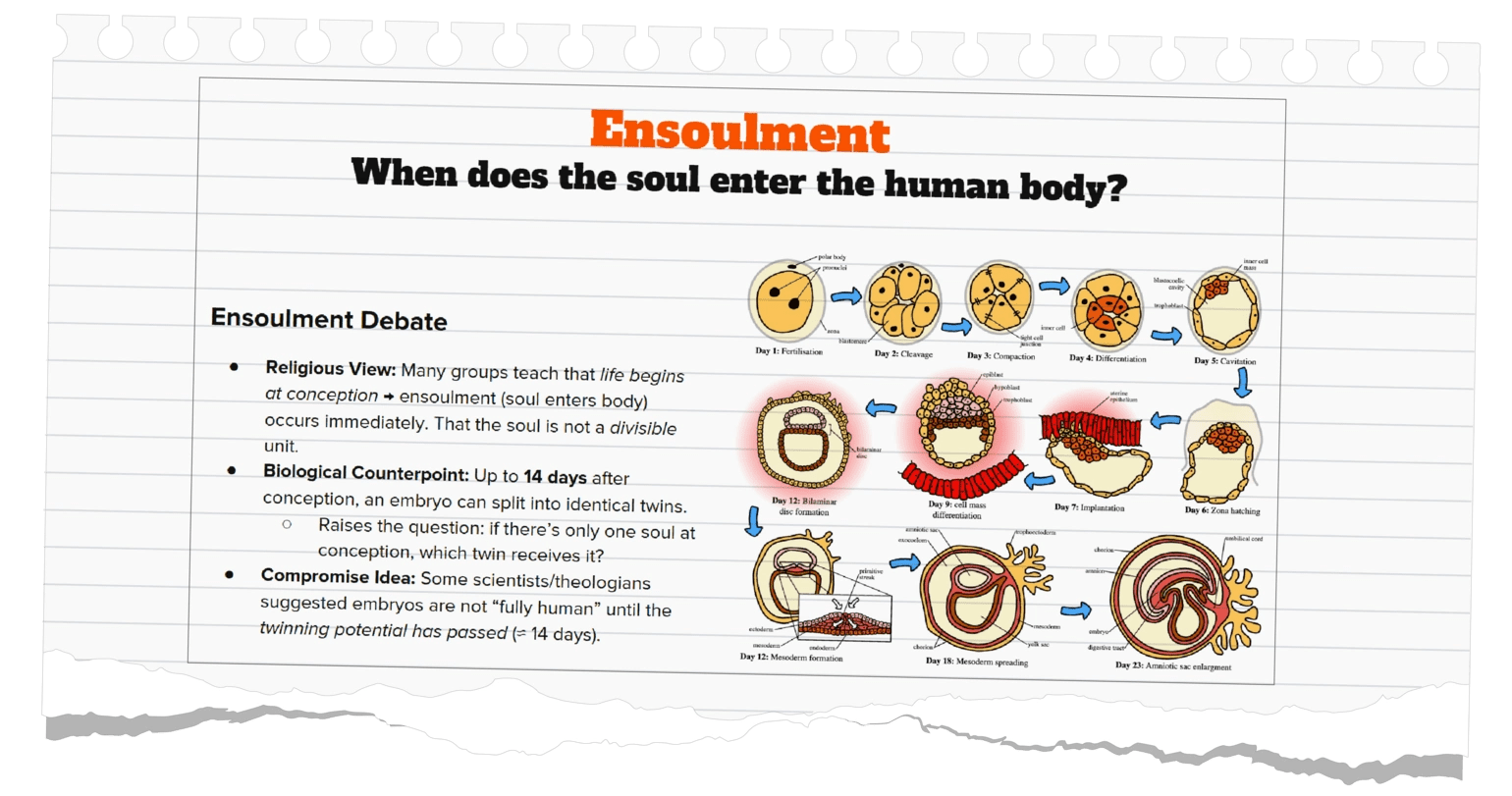
Another quote from the article:
The poor quality of the science offerings had bothered Heying and Pinker. “Others thought I was the token liberal,” Heying told me, “but I came to understand myself as the token scientist.” In an email, Pinker wrote, “They should have hired a widely esteemed scientist and proven program builder to set up their science division.”
As far as I can see from looking at the curriculum, they don’t have a decent one that could undergird a quality liberal-arts education. The goals of UATX at the outset were admirable, but the ideological motives of the founders eventually warped the school:
Over the past three months, I had more than 100 conversations with 25 current and former students, faculty and staffers at UATX. Each had their own perspective on the tumultuous events they shared with me, and some had personal grievances. But they were nearly unanimous in reporting that at its inception, UATX constituted a sincere effort to establish a transformative institution, uncompromisingly committed to the fundamental values of open inquiry and free expression.
They were nearly unanimous, too, in lamenting that it had failed to achieve this lofty goal and instead become something more conventional — an institution dominated by politics and ideology that was in many ways the conservative mirror image of the liberal academy it deplored. Almost everyone attributed significant weight to President Donald Trump’s return to power in emboldening right-leaning hardliners to aggressively assert their vision and reduce UATX from something potentially profound to something decidedly mundane.
There are a lot of other issues discussed in this long article, issues like how it dealt with a sexual harassment violation, abrogating the school’s own rules for how to adjudicate violations. This all culminated in a meeting on April 2 of last year when conservative founder Joe Lonsdale laid down a right-wing law for UATX:
. . . in the afternoon, all of the professors and staff were summoned, quite unusually and mysteriously, to a closed-door meeting. It had been called by Joe Lonsdale, a billionaire entrepreneur who’d co-founded the data analytics company Palantir Technologies with Thiel. Together with Ferguson and the journalist Bari Weiss, Lonsdale had been a driving force behind the creation of UATX and was a member of the board of trustees. But he wasn’t often present on campus, and it was almost unheard of for a member of the board to summon the staff, as Lonsdale had.
. . . . . “Let’s get right into it,” he said. Then, with heightened affect, Lonsdale explained his vision for UATX — a jingoistic vision with shades of America First rhetoric that contrasted rather sharply with the image UATX had cultivated as a bastion of free speech and open inquiry.
. . . “It was like a speech version of the ‘America love it or leave it’ bumper sticker,” one former staffer told me, and if you didn’t share the vision, the message was “there’s the door, you don’t belong here.” Like many of the people I spoke with for this story, the staffer was granted anonymity for fear of reprisal. “It was the most uncomfortable 35-to-40ish minutes I’ve ever experienced. People were shifting uncomfortably in their seats.”
. . .In an email I obtained that was sent to [President] Kanelos, the provost Jake Howland, the university dean Ben Crocker and a fellow professor, Morgan Marietta, Lind related what Ferguson had told him:
“According to Niall, under the constitution of UATX Joe Lonsdale, as chair of the board, had no authority to tell those of us at the meeting:
“That all staff and faculty of UATX must subscribe to the four principles of anti-communism, anti-socialism, identity politics, and anti-Islamism (this is the first time I heard of these four principles);
“That ‘communists’ have taken over many other universities and that he, Joe Lonsdale, would stay on the board for fifty years to make sure that no ‘communists’ took over UATX (the identity politics crowd and some Islamists are a threat, but the Marxist-Leninist menace in 2025?)”
Lind said when he asked for definitions of “communists” and “socialists,” he’d been told they included anybody who didn’t “believe in private property” and “hate the rich.” This, he wrote, struck him “as a libertarian political test excluding anyone to the left of Ayn Rand.” Lonsdale had said that the board would make a case-by-case determination on whether “New Deal liberals” would be allowed to work at UATX. Lind said that he considered himself “an heir to the New Deal liberal tradition of FDR, Truman, JFK and LBJ.” He was “in favor of dynamic capitalism in a mixed economy, moderately social democratic and pro-labor, and anti-progressive, anti-communist, and anti-identity politics.”
According to Lind, Londsdale repeatedly said that if the faculty weren’t comfortable with what he was saying they should quit.
“So I quit and I walked out,” Lind wrote.
A lot of the other resignations, including from notables like Strossen, Rauch, and Haidt, followed. There were emendations of the schools’ constitution, giving the President more power, and the Provost resigned, presumably after told he’d be fired.
Now things are in a mess. I sure as hell wouldn’t send a student to UATX to get a good education, for what they’ll get is a spotty but an anti-woke education. Yes, I am by and large anti-woke myself, but I am also pro-liberal-education, and by “liberal” I don’t mean “Left-wing’ but “liberating the mind”—through free inquiry.
At the end Mandery has two questions:
The first: Where was Bari Weiss? Many of the people I interviewed told me about internal conversations and shared internal emails. Weiss, who remains on the board of trustees, was almost never present in the conversations as they were related to me, and while I saw many emails on which Kanelos and Ferguson were copied, I never saw any including Weiss.
Weiss, one of the founders, was the person whose presence brought in many donations, but she seems to have absented herself from UATX. This may be because she’s burdened with running both The Free Press and CBS News, but she did not respond to a request for a comment. But wait! There’s more!:
The second question: Was UATX a hard-right project from the start? Based on my reporting, I don’t think it was. I was struck by the sincerity of the commitment to free speech and open inquiry from so many of the people with whom I spoke. A few were Trump supporters, but many more were best identified as anti-woke moderates or liberals. The university’s saga has a strong sense of historical contingency — that it could have gone quite differently had some high-leverage moments gone otherwise. A notable example is the episode surrounding Dan’s alleged violation [the sexual harassment charge] and expulsion, which several former staffers and faculty suggested was exploited by the Straussians as evidence of dysfunction in their successful second coup attempt.
So UATX, in its very first full year, was eroded by the very thing it tried to avoid: pervasive ideology in the curriculum:
When students returned for UATX’s second year, it was difficult not to notice the drift. The Tuesday night speaker series, at which attendance is mandatory, leaned unmistakably rightward — guests included Patrick Deneen, originalist judge Amul Thapar and Catherine Pakaluk, a Catholic University business school professor who’d written Hannah’s Children, about the 5 percent of American women who have five or more children.
As Mandery says, “The pluralists had lost.” Indeed. Nobody took care to forge a proper curriculum, and the right-wing bent of those who didn’t resign is forcing the school into a conservative version of Harvard—except it’s not nearly as good as any of the “elite” colleges that UATX aped.
My prediction is that the whole enterprise will fail. And if it doesn’t, it will never be a good place to send students, even though admission is based purely on meritocracy and tuition is free. Other schools may be full of left-wingers, but most of them don’t impose their views on the students in class, and it’s still possible to get a good education.
Mommas, don’t let your babies grow up to be UATX students.
Barnacle gloop could improve inflammatory bowel disease treatments
Moon Landing Hoax In School
Last week a child of one of my cohosts on the SGU, who is in fifth grade (the child, not the cohost), came home from school and declared, rather dramatically, “Mom, Dad – did you know that we never went to the Moon? It was all fake.” They found this to be a surprising revelation, but was convinced this was a proven scientific fact. Of course, we live in the age of the internet, and our children are going to be exposed to all sorts of information that may be misleading or age-inappropriate. This is one more thing parents have to deal with. What was disturbing about this incident was where they learned this “scientific fact” – from their science teacher.
Any parent should be concerned about this, but in a family of skeptical science communicators, this raised the alarm bells. But the first thing they did was send a polite e-mail to the teacher (cc’ing the principal) and simply ask what happened. This is good practice – always go to the primary source. It’s easy for anyone to get the wrong idea, and this wouldn’t be the first time a fifth grader misinterpreted a lesson in class. The teacher essentially said that while he did not explicitly tell the students we did not go to the Moon (the student reports he said “it’s possible we did not go to the Moon”), he personally believes we did not, and that it is a “proven scientific fact” that it would have been impossible, then and now, to send people to the Moon (somebody should tell the Artemis astronauts).
Apparently he raised at least two points in class – that there were (impossibly) no stars in the background of the photographs taken from the Moon, and the astronauts could not have survived passage through the radiation belts around the Earth. These are both old and long-debunked claims of the Moon-hoax conspiracy theorists. While it is easy to find sources online, let me briefly summarize why these claims are wrong.
The first claim, about no stars in the photographs from the Moon, is trivially solved with some basic photography knowledge. Cameras have to be set for different light levels. There are three basic setting – the ISO of the film or sensor (a measure of how sensitive it is to light), the aperture and the shutter speed. The sky on the Moon is black because there is no atmosphere to diffuse the light, but the surface during the day can still be very bright, and reflect off every surface. This means, to avoid over exposure, they would have used a small aperture and fast shutter speed, which would not have allowed for exposing the tiny amount of light coming from stars, which are only a point of light. Even from Earth, if you want to get a visible picture of stars at night you need to take a long exposure – long enough that you need to use a tripod. Regular cameras (including the ones used during Apollo) have a low dynamic range – the range of light levels they can capture simultaneously. So they would not have been able to capture the bright lunar surface and stars in the background at the same time. Modern digital cameras have techniques for capturing high dynamic range, but this does not apply to the Apollo-era cameras.
The second point refers to the Van Allen belts, which are belts of increased radiation intensity around the Earth. These are tori of ionic radiation trapped by the Earth’s magnetic field. They can vary in shape and intensity, and are not symmetrical. The inner belt is mainly protons and the outer belt is mainly electrons. They do pose an issue for satellites, which have to have proper shielding to protect any sensitive electronics. Crucially – we knew about the Van Allen belts since 1958, so NASA had this information when planning the Apollo missions.
This is a bit more complicated to debunk than the silly photography claim, but still, this information is widely publicly available. The effects of radiation exposure are determined by three variables – the intensity of the radiation, the type and energy of the particles, and the time of exposure. The Apollo capsules were specifically shielded with an aluminum alloy hull and insulation to reduce the intensity of the radiation. Also, NASA specifically calculated a launch trajectory to minimize the time they would spend traversing the Van Allen belts. They ended up spending just a few minutes in the higher energy lower belt, and about 90 minutes in the outer belt. The total radiation exposure was the equivalent of a typical CT scan – so not much. Because there are so few astronauts it is difficult to get statistically powerful data on their subsequent risk of death from cancer or cardiovascular disease, but what evidence we have shows no significant increase in risk.
So these two points, which this science teacher apparently believes “proves” it is impossible to send humans to the Moon, are easily debunked with some basic science knowledge. This gets me to the real point of this post – anyone who believes such a conspiracy is likely not qualified to teach science. I firmly believe that science teachers, even at the fifth grade level, need to have a working basic knowledge of science and critical thinking. Believing a conspiracy theory like this is evidence for lack of both. In addition to these points, we can ask – what would have to be true in order for the Moon hoax conspiracy to be true. The size of the conspiracy would have to be massive? Why didn’t the Soviet Union call us out on the hoax, which they could easily have detected and demonstrated? How has it been maintained for six decades? Why hasn’t the scientific community called NASA out on the hoax? If it were truly impossible to go to the Moon, there are generations of scientists, from all over the world, who could easily demonstrate this.
The lack of curiosity and critical thinking on display here is shocking and profound. What a horrible lesson to teach a class of fifth-graders. This also raises another point – expressing such beliefs to fifth graders (apparently without any proper context) shows an incredible lack of judgement. This was not part of any lesson plan or approved material, and he has to know it is (to say the least) controversial (bat-shit crazy is more like it). Even if it were presented in a “teach the controversy” format to encourage critical thinking, I would question whether this is age-appropriate.
Of course, we will turn this into a teaching moment, and use it as an opportunity to teach critical thinking, why grand conspiracy theories are suspect, and some of the relevant science. We will also do what we can to make sure the entire class gets this lesson. We also will try to drive home that teaching such nonsense as “proven scientific fact” to school children is, to say the least, not appropriate.
The post Moon Landing Hoax In School first appeared on NeuroLogica Blog.
Readers’ wildlife photos
Today we have a photo-and-text submission from Athayde Tonhasca Júnior on fly migration. It’s a subject dear to my heart as I used to work on it, publishing three papers on migration in Drosophila. Athayde’s subject, though, is hoverflies, not fruit flies. His captions are indented, and you can enlarge his photos by clicking on them. Note: I changed Athayde’s words “hover flies” to the more common usage “hoverflies,” but Athayde notes that most entomologists use the two-word rather than one-word description.
On the road again, goin’ places that I’ve never been
Sometime between 1400 and 1200 BC, Yahweh (aka God) decided it was time to nudge the Egyptians to let their captive Israelites go. Yahweh could have tried diplomacy, but in his infinite wisdom he concluded that “The Egyptians shall know that I am the LORD”. And there was no better way to let the Pharaoh and his people know who the bigwig was around there than by punishing them with a series of plagues. Of the ten celestial disasters inflicted upon the Egyptians, two involved mosquitoes (or midges) and flies, which probably were also the agents behind another two plagues manifested as infectious diseases of people and livestock. Yahweh understood very well the efficacy of some flies (order Diptera) and pathogens to wreck revenge – after all, he created them.
Fig 1. The Third Plague of Egypt, by William de Brailes, circa 1250. Aaron strikes his rod on the ground, transforming dust into gnats (kinnim in Hebrew). In the King James version of the Bible, lice are the culprits, but today most scholars accept that kinnim should be translated as ‘gnats’ or ‘mosquitoes’ © Jan Luyken, 1712, Wikimedia Commons:


The tales of pestilent flies depicted in the book of Exodus could have been inspired by real events, as pest infestations and epidemics were recurrent in the ancient world. Fly outbreaks are facilitated by these insects’ capability to disperse for long distances and arrive at new locations suddenly and in massive numbers. There are no better examples of these efficient colonisers than hoverflies or syrphid flies (family Syrphidae) such as the marmalade (Episyrphus balteatus) and the migrant (Eupeodes corollae) hoverflies. Each autumn, they leave Britain and head south to spend the winter in southern Europe and the Mediterranean. Their offspring move northwards in the spring, lay eggs, and the new generation sets out on the cycle again. Researchers have estimated that up to four billion marmalade and migrant hoverflies cross the English Channel to and from Great Britain every year. This represents 80 tons of biomass. If you are impressed by these figures, you should know that hoverflies account for a fraction of insects’ latitudinal migrations known as ‘bioflows’: about 3.5 trillion insects, or 3200 tons of biomass, migrate into southern Britain annually (Wotton et al., 2019). Insect bioflows pour vast amounts of nutrients (particularly nitrogen and phosphorus) and countless prey, predators, parasites and herbivores into ecosystems, but we have only a vague understanding of their impact on food webs and local species.
Fig 2. A female marmalade hoverfly, a long distance frequent flier © Guido Gerding, Wikimedia Commons:


These hardy wanderers have another particularity of significant ecological importance: they transport pollen grains.
Most flies have no pollen-collecting structures and have few ‘hairs’ (setae), which are important pollen gatherers. These are negative marks for candidates to the pollinators’ club, but some flies compensate their shortcomings by their massive numbers. Each marmalade and migrant hoverfly carries an average of 10 pollen grains from up to three plant species on their journey into Britain. That’s paltry compared to a bee, but altogether, those flies bring in 3 to 8 billion pollen grains on each inward journey.
Pollen importation via flies is a recurrent phenomenon. In Cyprus, warm temperatures and favourable winds bring millions of insect migrants from the Middle East region, more than 100 km to the east. Flies make up nearly 90% of these bioflows, and many of them are loaded with pollen (Hawkes et al., 2022).
Fig 3. A common drone fly (Eristalis tenax) (A) and a blowfly (Calliphora sp.) (B) with orchid pollinia attached to their heads after a > 100-km sea crossing to Cyprus © Hawkes et al., 2022:

Pollen-loaded flies can turn up anywhere the wind takes them, even to specks of dry ground in the middle of nowhere. Over a two-month period, 121 marmaladehover flies reached a North Sea oil rig approximately 200 km from Aberdeen, UK. Over 90% of these flies had pollen attached to them, sometimes from eight plant species. Based on pollen barcoding and wind trajectory modelling, it was estimated that these flies traversed from 265 to 500 km of open water in a single journey, probably from the Netherlands, Germany and Denmark (Doyle et al., 2025).
Fig 4. (a) Location of an oil rig visited by hoverflies (b), and its aerial view © Doyle et al., 2025:

Flies’ long-distance pollen transfers may help connect isolated plant populations, such as in fragmented habitats, but we don’t know much about the ecological implications. However we do know that their contribution can be important. In continental Europe, wild carrot (Daucus carota) depends on a range of insects for pollinators, especially bees. But bees are absent from La Foradada, a 1,6 ha Mediterranean islet about 50 km off the Spanish coast. In this solitary spot of land, D. carota subsp. commutatus relies on the accidental arrival of common drone flies for its pollination (Pérez-Bañón et al., 2007).
Fi 5. La Foradada, devoid of bees and humans, is visited by pollinating drone flies © JavierValencia2005 Wikimedia Commons:


Butterflies, bumble bees, moths and dragonflies are known travellers, but we know much less about migrant flies, which may have significant roles in pollination ecology. We just have to pay more attention to these unpretentious pilgrims.
References
Doyle, T.D. et al. 2025. Long-range pollen transport across the North Sea: Insights from migratory hoverflies landing on a remote oil rig. Journal of Animal Ecology 94: 2267–2281.
Hawkes, W.S.L. et al. 2022. Huge spring migrations of insects from the Middle East to Europe: quantifying the migratory assemblage and ecosystem services. Ecography e06288.
Pérez-Bañón, C. et al., 2007. Pollination in small islands by occasional visitors: The case of Daucus carota subsp. commutatus (Apiaceae) in the Columbretes archipelago, Spain. Plant Ecology 192: 133-151.
Wotton, K.R. et al. 2019. Mass seasonal migrations of hoverflies provide extensive pollination and crop protection services. Current Biology 29: 2167–2173.
Pages
