
You are here
News Feeds
How I learned to keep my brain in better repair this year
Best acronym? Best use of AI? We present our end-of-year awards
We may finally know what a healthy gut microbiome looks like
The JWST Just Identified A Supernova From Only 730 Million Years After The Big Bang
The NASA/ESA/CSA James Webb Space Telescope has confirmed the source of a super-bright flash of light known as a gamma-ray burst, generated by an exploding massive star when the Universe was only 730 million years old. For the first time for such a remote event, the telescope provided a detection of the supernova’s host galaxy. Webb’s quick-turnaround observations verified data taken by telescopes around the world that had been following the gamma-ray burst since its onset, which occurred in mid-March.
Inside the wild experiments physicists would do with zero limits
Genetic trick to make mosquitoes malaria resistant passes key test
Oldest evidence of fire-lighting comes from early humans in Britain
Uranus and Neptune are hiding something big beneath the blue
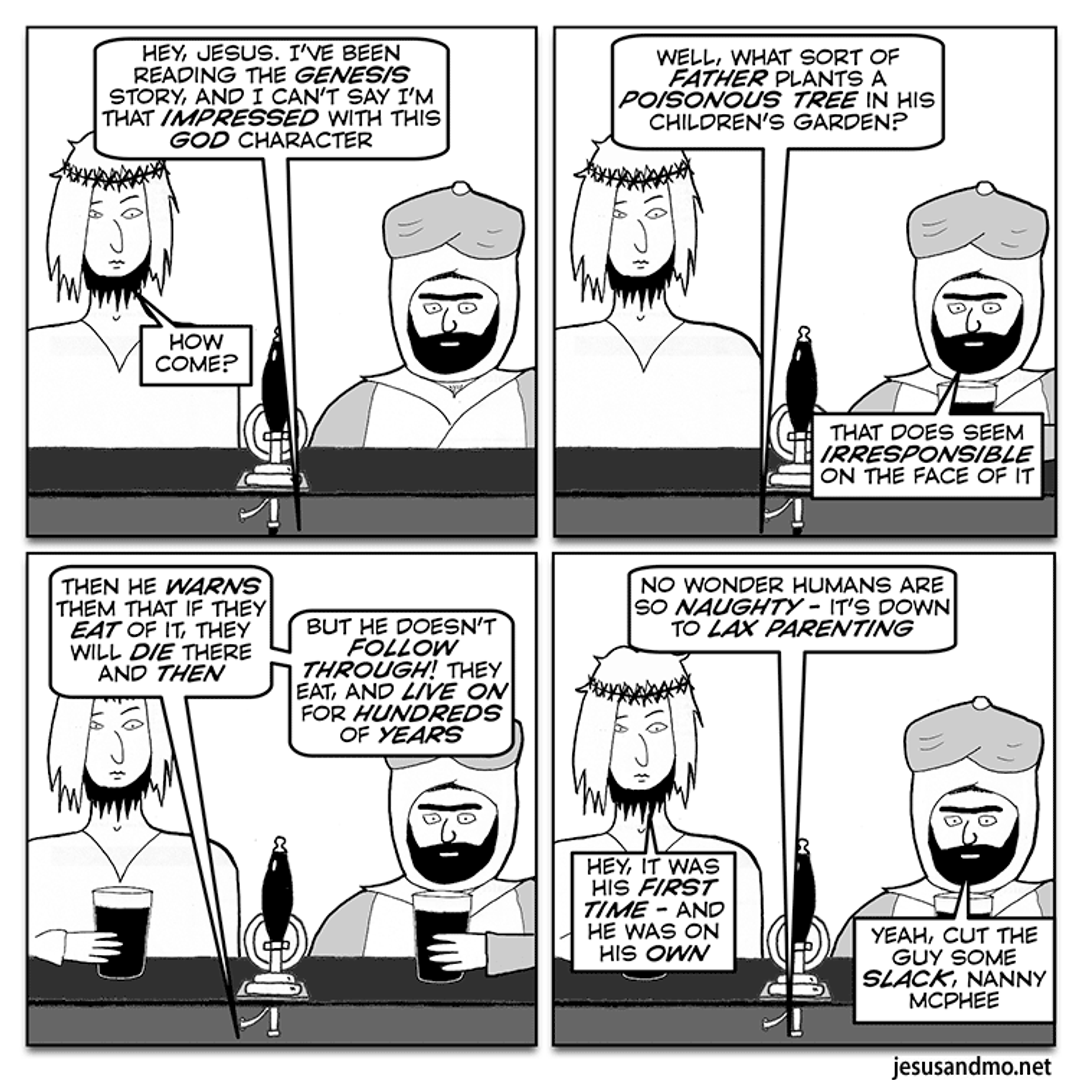
Jesus ‘n’ Mo ‘n’ the Poison Garden
Today’s Jesus and Mo strip, called “tree2,” is actually described as “A resurrection from 2006.” The barmaid, ever critical, points out that God is not a helicopter parent.
Extracorporeal Blood Oxygenation and Ozonation
There is an entire industry catering to people who, as Webb once famously said on the hilarious Homeopathic A&E skit, have “more money than sense.” This is the so-called “wellness” industry, now supercharged by an online army of “wellness influencers”. At first approximation, this entire industry is basically a scam. That may sound unfair, but it is built into its very essence. […]
The post Extracorporeal Blood Oxygenation and Ozonation first appeared on Science-Based Medicine.Scientists discover a new state of matter at Earth’s center
What the evolution of tickling tells us about being human
Australia's social media ban faces challenges and criticism on day one
The Primordial Black Hole Saga: Part 3 - Primordial Ooze
The early universe was a pretty intense place to be. And not just “early” as in a few billion years ago. I mean early early, just a few seconds after the Big Bang. The universe is small, less than a meter across. It’s hot, with temperatures so high it doesn’t even make sense to say them – they’re just stupidly high numbers with no connection to our everyday existence.
The British Robots Bringing Heavy Industry to Orbit
The UK is actively trying to support the infrastructure to make it a significant player in the coming age of the space economy. It recently received 560 proposals to it’s National Space Innovation Program, and handed out £17M in grants to 17 different organizations following five main themes. One of those is an effort by the University of Leicester and The Welding Institute (TWI) to develop a robotic welder for use in repairing and manufacturing in space, as described by a new press release from the university.
A 50 Million Light Year Structure Caught Spinning
Astronomers have discovered a filament 50 million light years long containing hundreds of galaxies, all spinning together. This immense structure, located 140 million light years away, challenges current models of galaxy formation by showing that large scale rotation can persist far longer and more coherently than theories predicted. The discovery offers a rare glimpse into how galaxies acquire their spin and reveals the Cosmic Web as a more dynamically active place than previously imagined.
Why we only recently discovered space is dark not bright
Did ancient humans start farming so they could drink more beer?
How Mars Controls Earth's Climate
A new study reveals that Mars plays a surprisingly crucial role in Earth's climate cycles, with new simulations showing that the mass of our planetary neighbours directly controls the timing and intensity of Milankovitch cycles that drive ice ages. By varying Mars's mass from zero to ten times its current value in computer models, researchers discovered that a more massive Mars strengthens the ~100,000 year climate cycles and creates the 2.4 million year "grand cycle" that influences Earth's long term climate. This finding demonstrates that Earth's climate rhythms are connected to the gravitational structure of the inner Solar System, not just the Sun and Moon.
Euclid Reveals What Wakes Sleeping Black Holes
The European Space Agency's Euclid telescope has delivered an unprecedented set of observations of one million galaxies that shows that galaxy collisions play a dominant role in awakening supermassive black holes from their sleep. Using revolutionary AI-powered analysis methods, astronomers discovered that merging galaxies contain up to six times more active black holes than isolated galaxies, with the most luminous black holes found almost exclusively in collision zones.
Pages
