
You are here
News Feeds
More criticism of Kristof’s allegations about Israel
By now the whole world–at least the world that reads the news–knows about Nicholas Kristof’s long NYT op-ed column accusing Israel of systemic, institutional sexual violence against Palestinian prisoners. For those who already hate Israel, his unsubstantiated allegations will serve only to reinforce their hatred and antisemitism. For those who are open-minded or sympathetic to Israel, well, they do have to admit that the allegations are unsubstantiated. But, as the saying goes, “A lie can travel halfway around the world while the truth is putting on its shoes.” Kristof is no dummy, and surely he knew that his claims would be snapped up by Israel haters and antisemites.
That is a good reason for Kristof to have verified all his sources and ensure that they had no history of bias (or at least the bias should have been made explicit)—something he did not do. This is in contrast to the Civil Commission on the October 7 Crimes Against Women and Children report, documenting Hamas’s sexual abuse during its invasion of Israel. The Commission has verification of all of its sources, including forensic evidence like photographs and bodies.
As most of Kristof’s critics have said, it is impossible to affirm that there was never any abuse of Palestinians by the IDF. But if you make an accusation that the abuse was both widespread and systemic, you’d better be able to back it up with evidence. Unfortunately, the NYT sees no need for that. relying on Kristof’s two Pulitzer Prizes and his claim that he interviewed witnesses brought forth by groups or people who can hardly be said to be unbiased. But yes, his claims should be investigated, but he would have to help the investigators by providing identities and documentation. I wouldn’t hold my breath until he does that.
In the meantime, it’s not hard to find criticisms online. I’ll just link to five new ones, showing an excerpt from each. I haven’t found people approving of Kristof’s claims, but then again I don’t read the kind of site that would do that. And those sites would have to independently try to verify Kristof’s claims, which nobody has done.
Amit Segal at It’s Noon in Israel: “Anatomy of a blood libel.“
In [Kristof’s] piece, published curiously as an op-ed rather than a news investigation, Kristof accuses the State of Israel, its prison system, the IDF, and the Shin Bet of systemic rape of Palestinian prisoners—primarily men, but also women. These are serious accusations, and it is certainly possible, if not inevitable, that abuse, even sexual, occurs within the prison system, as it does in almost every prison system worldwide. Whenever there is real evidence of such acts, it must be properly investigated and the guilty punished. However, for accusations to be taken seriously, they must be backed by actual evidence. In this regard, Kristof’s column is an absolute failure.
The column falls short of almost any journalistic standard, according to [Hebrew University professor Danny] Orbach. He points out that the reporter relies on only 14 unverified and uncorroborated testimonies, lacking details that would allow for investigation, verification, or refutation, to claim that systemic sexual abuse is widespread throughout the Israeli prison system. For comparison, in 2020, approximately 16,000 complaints of sexual assault and harassment by guards against prisoners were recorded in the United States, with only a tiny fraction proven to be based on real incidents. Of Kristof’s witnesses, only two identify themselves by name or provide details that could help locate the case. One of them, Sami al-Sai, is presented by Kristof as a “journalist.” In reality, he is a Hamas propagandist who cheered the mass murders of October 7—hardly a reliable source. At the very least, Kristof owed his readers a disclosure regarding who this man is. Prominent journalists have already pointed out that the two identified witnesses provided Kristof with “reheated noodles”—versions that changed and became “more sophisticated” over time, adding new gruesome details every time they spoke to a different reporter.
If it ended there, one could dismiss Kristof’s article as merely a negligent op-ed, but Orbach stresses that from here, things deteriorate. He explains that a large portion of the anonymous testimonies come from Euro-Med Monitor, which Kristof presents as a “human rights monitor.” In reality, this is a Hamas front organization whose chairman, Ramy Abdu, cheered October 7 and spread debunked lies and conspiracy theories—such as massacres at Shifa Hospital, organ harvesting, or the claim that humanitarian aid contained only burial shrouds—claims not taken seriously even by most anti-Israel journalists during the war. Unsurprisingly, Kristof mentions nothing to his readers about this organization’s reputation. Furthermore, another “source” Kristof cited in a video interview as a “man in the know” is actually an Israeli Hamas supporter and delusional conspiracist who was dismissed from the university where he worked due to sexual offenses. A “man in the know,” indeed.
The interviewees, of course, were not found or selected by chance. This raises the question: who was Kristof’s “fixer”? Reporters who do not know the language almost always rely on local fixers, and Kristof claims he found the interviewees through “human rights organizations,” which Orbach suggests points to a pre-planned direction by Euro-Med or its ilk. In the Palestinian arena, there is a documented pattern of witness coaching and bias, a phenomenon rarely caught but exposed during the “Jenin Massacre” libel that never was in 2002.
. . . . So, what do we have here? A “respected war correspondent,” winner of two Pulitzer Prizes, accusing a state of systematic rape based on 14 testimonies—12 of them anonymous, two public but highly problematic—with zero disclosure regarding the witnesses or the biases of the organizations providing the information. Unlike the Civil Commission’s report on October 7, Orbach emphasizes that Kristof made no real attempt to cross-reference the testimonies, used no forensic evidence, and did not attempt to interview Israelis who served in prisons or civilian doctors. The only senior Israeli he did interview, Ehud Olmert, apparently never said what was attributed to him.
This is not Kristof’s first time. In the early 2000s, Kristof championed a Cambodian anti-prostitution activist, calling her a “hero” in column after column. When it turned out she was a fraud who staged the scenes that brought her fame, Kristof admitted the mistake and the paper apologized. His current column shows that his tendency to believe anyone who seems “just” to him, without critical source analysis, remains intact. He has learned nothing, Orbach concludes.
Douglas Murray at The New York Post: “Why would the NY Times make such horrific claims about Israel. The reasons are several-fold.”
Nicholas Kristof raped my dog. At least that is what I have heard, from an anonymous source. A source who is intensely hostile to the New York Times columnist. And that’s good enough for me. Now I come to think of it, my pet pug has had a strange look on his face lately.
As it happens, the rumor that I have just attempted to spread is far less lurid and fanciful than the one that the New York Times chose to spread around the world this week.
In a piece which has already been widely debunked, Kristof claimed that Israeli prison guards routinely use rape as a method of torture on Palestinian prisoners. The piece portrayed Israeli prison guards and soldiers as rapists, sadists and akin to Nazi prison camp guards. Perhaps even worse.
. . . So here we get to the true question. Why would anyone make such a claim? And why would a purportedly serious newspaper publish it?
The reasons are several-fold. The first is that the New York Times story landed just a day before an anticipated report into Hamas’ use of sexual violence on October 7, 2023.
Many of us did not need further evidence of the crimes of that day. But the release of the commission of inquiry sets out in remorseless detail the “systematic, widespread” use of rape by Hamas on that day and the way in which sexual violence was “integral” to their attack.
It lays out the calculated way in which Hamas terrorists raped men and women on the day of the attack and raped Israeli hostages — men and women — while they were held in captivity in Gaza.
The findings include descriptions from footage, first-hand, eyewitness accounts and from mortuary photographs of the way in which Hamas members gang-raped women while killing them, and even raped their victims after killing them. It is impossible to think of crimes worse than those which Hamas committed on that day.
Unless you are Nicholas Kristof.
Because if you know that a report is coming out into Hamas’ use of sexual violence then it is clearly very important to invent a claim even more appalling than the real-life crimes of Hamas.
For the New York Times, it seems to have been crucial to throw a lie into the system in order to overwhelm or block any sympathy or understanding that might go in the direction of the Israelis.
The New York Times has leveled claims of antisemitism against a number of people in the past year. Sometimes accurately, sometimes not. But none of the worst things that Tucker Carlson or Nick Fuentes have ever said even comes close to the lie the New York Times has printed in its own pages. A paper that claims to be opposed to conspiracy theories has just mainstreamed the most disgusting conspiracy theory imaginable.
And just consider the effects of this.
The effect is to portray the soldiers and prison guards of the Jewish state as uniquely evil, uniquely disgusting and uniquely inhuman.
What wouldn´t someone do to express their disgust at such people? If Jews are the sort of people who can even turn dogs into rapists why shouldn’t a mob assemble outside the synagogues of New York? Why wouldn’t masked “activists” demonstrate their outrage by hounding Jewish children on the streets of this city? After all, the people they are going up against are uniquely evil. Right?
Matti Friedman and Dan Senor at the Free Press (a conversation): “How the ‘New York Times’ Laundered a Conspiracy.”
DS: You spent years inside the Associated Press bureau in Jerusalem. You know how sources are used, how the editorial decision-making works, and what the checks are on a reporter. Walk me through how a piece like this gets through.
MF: I was a correspondent for the AP from 2006 to 2011, and one thing that often isn’t clear to readers is the role NGOs play in creating the reporting readers actually see. The press corps is much weaker than it used to be—smaller staff, less experienced reporters, poor pay—and the demands of the 24-hour news cycle are much greater.
Into the vacuum created by that change come political NGOs, who have a lot of money and an interest in swaying coverage in their direction. When I was at the AP, I saw this happen. Big NGOs like Amnesty International and Human Rights Watch, as well as smaller ones operating around this conflict, were mostly funded by European governments and progressive foundations. They became, essentially, the source of information for reporters. Human Rights Watch, for example, would come out with a report, and the AP would write it up as news.
When I read Kristof’s article, I saw this machinery right away. Kristof was handed a package by NGOs. He mentions Euro-Med [Human Rights Monitor], which has proven ties to Hamas and has openly claimed that Israel is using weapons to “vaporize” Palestinians and that Israel is harvesting organs. Relying on Euro-Med is a bit of a stretch even for the world of the mainstream press. Kristof also mentions an anti-Israel activist named Sari Bashi, who is based in Ramallah. So local activists handed him the story, introduced him to his sources, and fed him the inflammatory, unverifiable material.
Senor also says this:
When you read the piece, you have to use your own compass to decide which charges could plausibly be true and which charges come from the world of conspiratorial, anti-Israel fantasy. I think there is a plausible reason for concern about sexual assaults of prisoners. I don’t think we can dismiss every account of sexual assaults against Palestinian detainees.
. . . we have to be able to look at our prison system and our military and say we want our institutions to observe the highest standard, and we’re clearly failing. Terrible things are happening, as they are in the carceral systems in New York, or in Iraq. I wish Israel could say that we’re better than everyone else. I’m not sure that we can say that. We need to be able to address our own moral issues without participating in this kind of deranged discourse.
Yuki Zeman at Quillette: “Nicholas Kristof and the pornography of accusation.”
. . . Allegations involving sexual violation by animals do not enter political discourse as neutral facts. They belong to an old repertoire of dehumanising horror. They turn the accused into something beyond cruel: a corrupter of species, a handler of filth, a director of bestial desecration, and a violator of the most basic taboos around moral and sexual hygiene. Is the claim true, false, exaggerated, mistranslated, or planted? Kristof does not know nearly enough to employ the claim in the way that he does. He treats it as a detail within a larger moral picture. A responsible and competent editor would have stopped reading right there and demanded to know what, exactly, has been established.
. . .None of this excuses abuse. The Sde Teiman case, involving alleged abuse of a Palestinian prisoner by Israeli reservists, deserved investigation so that truth could be separated from rumour and accusation. Where Israeli guards, soldiers, interrogators, or settlers have committed acts of sexual violence, they should be exposed, investigated, tried, and punished. Any attempt by Israeli politicians or mobs to shield abusers deserves condemnation. A society at war must still guard its own standards.
But it must also guard the truth. Taking rape and abuse seriously does not require us to accept propaganda dressed up as sexual horror. Nor does it require us to pretend that anonymous testimony, activist reports, and humanitarian vocabulary automatically produce truth. The harder task is to investigate abuse without surrendering judgment. A serious press should be able to do this. It should also be able to honour Israeli victims without handing their suffering to those who spent months demeaning it.
A columnist like Nicholas Kristof may even believe he is writing in defence of Palestinian victims. But when his essay relies on the same information ecology that sought to excuse, minimise, and invert the atrocities of 7 October, it risks becoming something else: a mouthpiece for those who defended the events of that day, or who needed its victims to disappear beneath a more useful accusation. This is what divides moral inquiry from propaganda.
Sherwin Pomerantz at the Times of Israel: “Nicholas Kristof’s illogical overreaching anti-Israel rant in the NYT.“
there does appear to be some level of sexual violence that goes on in Israeli prisons and, similar to the rest of the world, often the perpetrators are not held accountable. The fact that this goes on in prisons worldwide does not, of course, make it acceptable practice and Israel has taken a strong policy position against such activity.
But Kristof often relies on sources that themselves have been found to be unreliable. In a series of posts on X, the pro-Israel media watchdog HonestReporting challenged Kristof’s journalism, noting that the most explosive accounts in his op-ed came from unnamed sources, while the stories of those named had grown “steadily more lurid over time, with dramatic new details added years later.”
For example, one of Kristof’s sources, Sami al-Sai, had taken to social media on October 8, 2023, to praise the Hamas onslaught one day after it occurred, and eulogized the leader of a West Bank terror cell as “our martyred prince.”
HonestReporting also noted that, about a year ago, Sai spoke to Israeli human rights group B’Tselem about his alleged assault, and did not mention several specific, graphic details that he provided to Kristof, including being sodomized with a carrot, having his genitals grabbed by a female guard, and discovering “other people’s vomit, blood, and broken teeth” in his skin.
It also pointed out that Issa Amro, who told Kristof in 2024 that he had been assaulted on the day of the Hamas attack, had earlier told The Washington Post that he had been “threatened with sexual assault” on that day, not that he had been assaulted.
None of this, of course, excuses illegal activity of prison guards or, here in Israel, members of the IDF. Nor does it give a pass to a government that drops the charges against the accused, as it did in the Sde Teman case, simply because of community pressure.
This kind of activity is certainly not in keeping with the values of a county such as ours, which promises in its Declaration of Independence: The State of Israel “will be based on freedom, justice, and peace as envisaged by the prophets of Israel; it will ensure complete equality of social and political rights to all its inhabitants, irrespective of religion, race, or sex; it will guarantee freedom of religion, conscience, language, education, and culture; it will safeguard the holy places of all religions; and it will be faithful to the principles of the charter of the United Nations.”
. . . Finally, Kristof engages in illogical overreach when he states: “Yet our American tax dollars subsidize the Israeli security establishment, so this is sexual violence in which the United States is complicit.”
Truth be told, the $3.8 billion of annual US military aid to Israel is used to purchase armaments from US defense manufacturers and, of course, has nothing to do with the prison system or its faults. A weapon used by an IDF soldier in Gaza cannot be linked to prison abuses. Actually, it is the weapons used against us on October 7th and afterwards, paid for by the Iranians and Qataris, that are more logically linked to the alleged abuses in Kristof’s piece.
The commonality of these stories is that they admit the possibility of sexual abuse of prisoners, but argue that, given the fact that interrogations are recorded and photographed, and Israel’s history of prosecuting those who violate its law, the likelihood of widespread and systemic abuse known to the authorities is low. The articles argue that Kristof’s sources are biased and that some of their stories have changed over the years. And they say that the dog-rape story is not credible.
What should happen now? Well, Israel should conduct an investigation of the allegations. And so should the NYT, making Kristof reveal his sources and check them itself. The former will happen; the latter won’t.
If anybody else had done this rather than Kristof, they would be fired by the NYT. Remember that editorial-page editor James Bennet was forced to resign in 2020 after a social-media outcry following the publication of an op-ed by Republican senator Tom Cotton. Cotton’s argument, that U.S. troops might be used to quell riots following the death of George Floyd, was at least worthy of discussion, but the editor who approved it became the victim of “progressive” ire.
Kristof won’t be fired, though his careless accusations were far worse than the argument made by Cotton. But at least some of the shine is off Kristof’s Pulitzers, and the sentient world now knows him to be a crappy journalist, willing to tar an entire country on the basis of unverified claims.
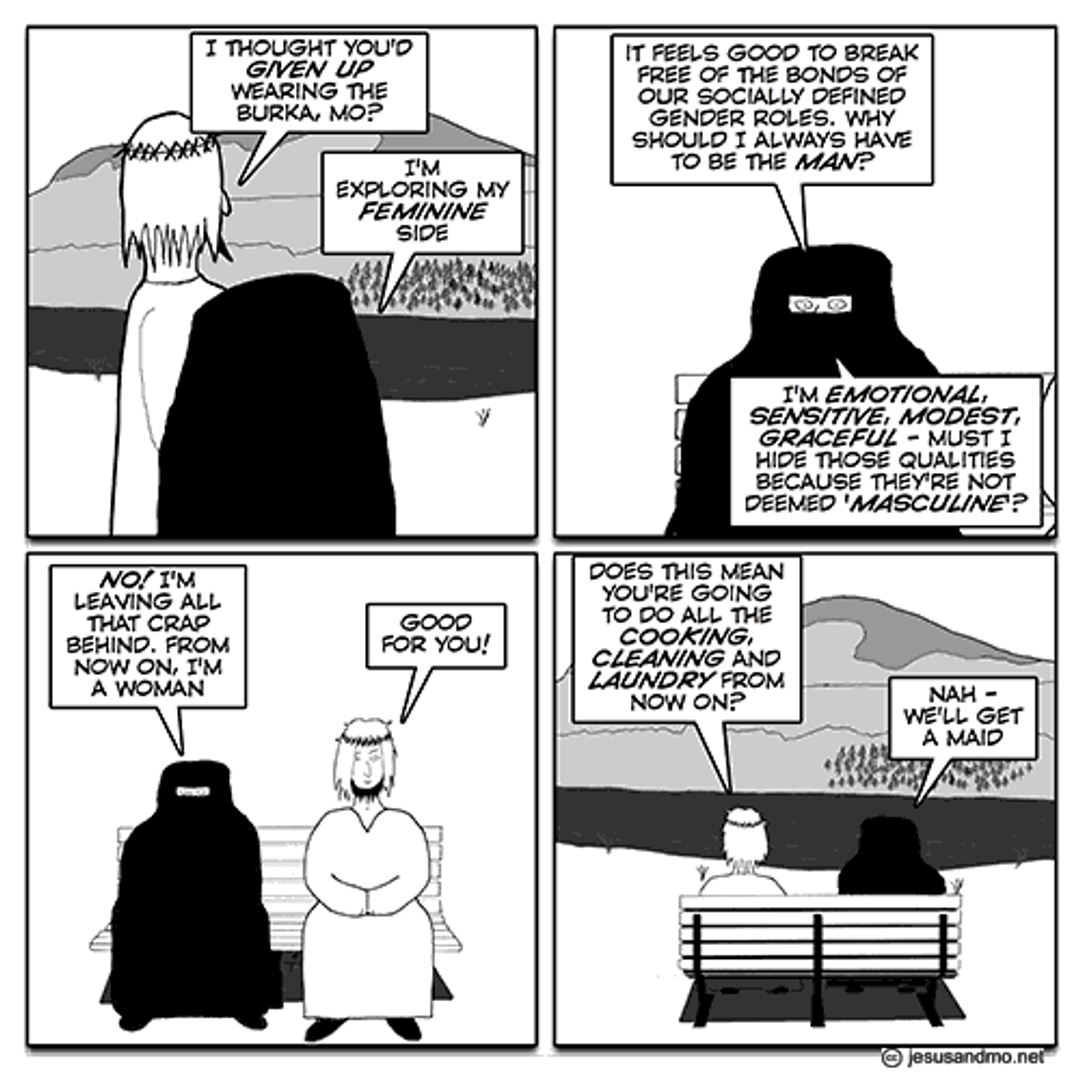
Jesus ‘n’ Mo ‘n’ transformation
The caption for this week’s Jesus and Mo, called “Hide,” is “In light of the Tickle v Giggle verdict in Australia, a Friday flashback to J&M’s first terfy strip from 2016.”
If you’re not familiar with Tickle v Giggle, click on the Wikipedia link above. Here’s the summary:
Tickle v Giggle is an Australian federal legal case regarding the legality of the membership policies used on Giggle, a social media app for women. Giggle excluded trans women in their membership policy, and withdrew membership from Roxanne Tickle, a transgender woman from New South Wales, on that basis. In 2022, Tickle brought the case against Giggle, and in August 2024, the court found that Tickle had been indirectly discriminated against under Australia’s Sex Discrimination Act, and ordered Giggle to pay costs of the case and damages. That finding was appealed both by Tickle and by Giggle’s CEO, Sall Grover, with hearings on those appeals held in the Federal Court of Australia (NSW Registry) from August 4 to August 6 2025. The appeal judgment was delivered on 15 May 2026 at 2 pm AEST. The court upheld the original judgment, dismissing Grover’s appeal and allowing Tickle’s cross-appeal, with the court finding two instances of direct discrimination against Tickle and awarding damages of $20,000, double the award at first instance. Grover has said she will appeal to the High Court of Australia.
x
Sky Show: Watch the Moon Dance With the Planets at Dusk Next Week
The Moon has a busy week ahead of it. If skies are clear, be sure to get outside on the evenings of May 18th/19th and surrounding nights to check out the evolving view to the west, in one of the best sky shows for 2026.
CAR T-cell therapy bolstered by stiffening up cancer cells first
Where do you think your ‘self’ is? Your answer is revealing
NASA’s new AI space chip could let spacecraft think for themselves
NASA’s new AI space chip could let spacecraft think for themselves
Mars may have once had an ocean and this chaotic valley is a big clue
NASA’s Roman Space Telescope could reveal millions of invisible neutron stars
Dark Matter May Have Left Its Fingerprint in a Gravitational Wave.
Dark matter makes up roughly 85 percent of all the matter in the universe. We have never directly detected a single particle of it. But a new method developed by physicists at MIT and across Europe may have just opened a door we didn't know existed. When two black holes collide and merge, they send ripples through the fabric of spacetime, these are known as gravitational waves and if those black holes happened to spiral through a dense cloud of dark matter on their way in, those waves carry an imprint of it. For the first time, scientists have a technique to read that imprint and one signal in the existing data is already raising eyebrows.
No One Should Care About or Trust Anything Dr. Marty Makary Says Ever Again
That, and 4 other thoughts on the resignation of Dr. Marty Makary.
The post No One Should Care About or Trust Anything Dr. Marty Makary Says Ever Again first appeared on Science-Based Medicine.Artemis III: The Mission That Has to Work Before Humans Can Return to the Moon.
Artemis II has barely left the headlines. On April 1st 2026, four astronauts climbed aboard NASA's Orion spacecraft, rode the most powerful rocket ever to carry humans beyond low Earth orbit, and swung around the far side of the Moon. The world watched. Now, before the dust has settled, NASA has outlined its plans for what comes next. Artemis III won't be landing on the Moon. But what it will do is arguably just as important and if history is any guide, it's exactly the kind of mission that makes the difference between a Moon landing and a disaster.
It's Raining Stardust. It Has Been for Thousands of Years.
Right now, as you read this, Earth is drifting through a cloud of debris from an ancient stellar explosion. Stardust, real stardust, is raining down on us so thinly scattered that we have only just found the proof. Locked inside Antarctic ice cores up to 80,000 years old, an international team led by the Helmholtz-Zentrum Dresden-Rossendorf has discovered traces of iron-60, a radioactive isotope that can only be created in the heart of an exploding star.
Scientists “bottle the sun” with a liquid battery that stores solar energy
We've Been Listening for Ten Years. Here's What We Heard
For ten years, astronomers at UCLA have been pointing one of the world's most powerful radio telescopes at the stars and listening. Not for pulsars or gas clouds, or the hiss of the cosmic microwave background, but for something far more extraordinary. A signal from another civilisation. The result of a decade's work, 70,000 stars, and 100 million candidate signals is now in and every single one of them was us! But far from being a disappointment, the findings are among the most rigorous and revealing in the history of the search for extraterrestrial intelligence.
A Cataclysmic Upswelling of Groundwater Carved This Channel on Mars
Shalbatana Vallis is a 1300 km water channel on Mars. It was carved out in one cataclysmic flooding event, possibly triggered by a massive impact. It's more evidence that liquid water once flowed on Mars.
UC Student Gets a Closer Look at Lonely Gas Giant
University of Cincinnati astrophysicist Paul Smith is part of an international team studying TOI-2031Ab, a gas giant orbiting a star 901 light years from Earth. Smith and his colleagues used the James Webb Space Telescope to study its atmosphere.
The Roman Space Telescope is Ahead of Schedule, and the Hubble is Giving it a Jump Start
One of the core community surveys of NASA’s Nancy Grace Roman Space Telescope, the Galactic Bulge Time-Domain Survey, is expected to locate over a thousand exoplanets that orbit far away from their stars, beyond the orbital distance of Earth from the Sun. Although Roman hasn’t launched yet, astronomers already are gathering useful supporting data by utilizing NASA's Hubble Space Telescope, which could assist astronomers in analyzing Roman data.
Vocal fry is more common in men, actually, find scientists
The Times ditched its public editor, but oy, does it need one now!
There have been a ton of articles criticizing Nicholas Kristof’s poorly sourced and dubious NYT column accusing Israel of widespread sexual torture of Palestinian prisoners (yes, with dogs, too)—most of the critiques noting that Kristof’s sources were unnamed, undocumented, and those that were named had histories of being pro-Hamas. You can easily find these critiques on social media, but Hen Mazzig, an Israeli writer and senior fellow at the Tel Aviv Institute, levels a different accusation: not so much at Kristof but at the New York Times itself.
He notes something I overlooked: the paper used to have a “public editor” whose job was to call attention to errors and misreporting in the paper, but the NYT ditched that position nine years ago. Now there is no public editor: their job has been sourced to—get this—social media and readers. The rationale is that social media itself, combined with reader reaction, will correct errors. But that’s completely bogus. Yes, readers and social media may point out errors, as they have in this case, but thety also can reinforce them. As you know, social media is a dumpster fire and there’s no guarantee that a clash of ideas and assertions will surely out the truth.
Beyond that, it is the responsibility of the paper itself to correct errors, apologizing for them and admitting guilt. The NYT won’t do that, for it’s pushed back on the criticism of Kristof’s delusions, defending them by asserting—get this again—that he won two Pulitzer Prizes. With two nods like that, how can he be wrong? Here’s all the NYT has said:
— NYTimes Communications (@NYTimesPR) May 13, 2026
In larger print; you can judge for yourself how extensive the “fact-checking” was, given that there was no public editor to describe it:

The deep-sixing of a public editor is almost an admission that a paper has no interest in correcting itself. You can see from the Times‘s doubling down in this latest case that the NYT is standing behind assertions of systemic sexual torture in the Israeli government, as well as in using trained dogs to rape prisoners. The fact that Kristof’s factual claims were made in an op-ed does not excuse the paper.
Click below to read:
Some quotes:
In 2014, the New York Times had a Public Editor. Her name was Margaret Sullivan. When it emerged that Nicholas Kristof had spent years platforming a fabricator named Somaly Mam, Sullivan wrote that Kristof “owes it to his readers to explain, to the best of his ability and at length, what happened and why.” Kristof did. He wrote a column titled “When Sources May Have Lied.” Editor’s notes were added to old work. The mechanism worked.
In 2017, the Times eliminated the Public Editor role. Publisher Arthur Sulzberger Jr. announced that “readers and social media followers collectively serve as a modern watchdog.” Liz Spayd was the last to hold the job.
This week, Kristof published a column accusing Israel’s security forces of systematic sexual violence, sourced from a man who celebrated October 7, an NGO whose chairman was designated by Israel as a Hamas operative in 2013, and a fourteen-person account that grows more lurid each time it migrates to a larger platform. The Times defended the column with a statement from a spokesperson named Charlie Stadtlander, citing Kristof’s two Pulitzers. There is no Margaret Sullivan inside the building anymore. There is only Charlie.
That is the story I want to tell. Not the column. The column has been dissected by a dozen outlets in 36 hours. The story is what the column reveals about the institution that printed it, and about the decision the institution made nine years ago that produced this moment.
Yesterday I wrote about the sources:
The piece is The New York Times Has a Source Problem. The short version: two of Kristof’s primary sources are a man who left UCLA after a 17-year-old said he sent her unsolicited photos, and an NGO whose chairman publicly mourned a senior Hamas commander as “our great commander” earlier this year. The same NGO has officially called Hamas’s sexual violence on October 7 a “propaganda tool.” Its board chair endorsed 9/11 inside-job conspiracies.
I asked yesterday how the Times missed any of this when two Google searches would have surfaced all of it.
Today I want to ask why nobody inside the paper is allowed to ask that question on the record.
This afternoon a Times spokesman released a statement defending Kristof. The operative line:
“There is no truth to this at all. Nicholas Kristof is a two-time Pulitzer Prize-winning journalist who has reported on sexual violence for decades.”
This was what happened when there was a public reporter and Kristof got his tuchas smacked:
Somaly Mam was a Cambodian woman who became globally famous on the strength of a story she told about her own childhood in sex slavery, and on the strength of the brothel rescues she said she conducted. Kristof made her career. He called her a “hero” in column after column. He live-tweeted her brothel raids to over a million followers. He featured her in his documentary Half the Sky.
In 2014, Newsweek published a piece by Simon Marks showing that Mam had auditioned girls to lie on camera. Her own backstory was fabricated. The “rescues” were sometimes police raids that generated headlines more than they helped victims. Mam resigned. The Washington Post’s Erik Wemple called for Kristof to audit his entire Cambodia archive. Kristof wrote that he wished he had never written about her, said he had been “hoodwinked,” and added editor’s notes to old columns.
His response when Margaret Sullivan and Erik Wemple pressed him was telling. He said it was hard to verify facts in Cambodia. He said he was “reluctant to be an arbiter” of Mam’s backstory. He said he didn’t know what to think.
This week, asked whether Palestinians might fabricate accusations to defame Israel, Kristof wrote that “to me that seems far-fetched.” That is the same credulity, twelve years older, applied to a higher-stakes accusation on a larger platform.
The Times has watched this reporter make this mistake before. In 2014 there was an internal voice with the authority to push him to answer for it. There is no such voice now.
There are other examples, but the point is that no such internal mechanism of correction exists. Instead, we get a defense, which Mazzig summarizes:
. . . The defense
This afternoon a Times spokesman released a statement defending Kristof. The operative line:
“There is no truth to this at all. Nicholas Kristof is a two-time Pulitzer Prize-winning journalist who has reported on sexual violence for decades.”
The fuller statement credits Kristof for traveling to the region and says his article collects accounts in the victims’ own words, backed by “independent studies.” It does not name the studies.
Read it twice if you need to. Notice what it does not say. It does not address Euro-Med’s Hamas affiliation. It does not address Sami al-Sai’s October 8 Facebook post celebrating the massacre. It does not address Amro’s shifting account between the Washington Post and the Times. It does not address the absence of corroborating evidence in the column’s most explosive cases. It does not say what the “independent studies” are.
It says Kristof has Pulitzers and the Times stands behind him.
In 2014, the same paper produced a Public Editor’s column titled “When Mr. Kristof’s Sources Are Questioned” and an internal reckoning. In 2026, the same paper produces a press release.
Deborah Lipstadt, until recently the United States Special Envoy to Monitor and Combat Antisemitism, asked the Times publicly whether it had any sense of decency. Lipstadt is the world’s leading historian of Holocaust denial. She knows what a blood libel looks like. When she names one out loud, the line has been crossed.
Mazzig hastens to add that he’s not saying Kristof is an antisemite or the NYT decided to hurt Jews. Nor is he claiming that Israel has never mistreated a prisoner, nor attacked one with dogs (I’d ask for evidence for both such claims, though). What he’s saying is this:
I am arguing something more dangerous because it is more boring. The editorial standards of the world’s most important paper have drifted, and the institution dismantled the internal voice that used to flag the drift. The defense statement issued today is what accountability looks like in a building where Margaret Sullivan no longer exists.
And he winds up going after the paper again:
The Times will probably not retract, but the conversation has started. Longtime contacts of media reporter David Shuster told him this afternoon there are discussions up the masthead. We will see.
What moves the needle is the accumulated record. The Somaly Mam parallel. The shifting Amro and al-Sai accounts. The verification asymmetry between American prisons and Israeli ones. The headline change on the Eurovision piece. The Silenced No More report. Lipstadt’s question. Yesterday’s piece and this one. Every citation builds the file.
That file is what real accountability requires. The Times made that file harder to build in 2017, and we are watching what that decision produced.
We know that the Times staff is full of young progressives—people who helped push out Bari Weiss, Donald McNeil, Jr., and James Bennet. They are sensitive to social media and public opinion, and the combination of progressive staff and social media is toxic.
The paper needs to correct Kristof’s column, for it’s clear he will not do so himself.
Pages
