
You are here
News Feeds
Bizarre Venus Surface Formations Puzzle Planetary Scientists
Enigmatic crownlike surface formations on Venus hold keys to understanding our twin planet’s deep interior. Or so says a new paper presented at the recent European Geosciences Union 2026 general assembly in Vienna.
NASA Captures Volatile Changes in Earth's Artificial Light
A study of NASA's Black Marble data reveals a pattern of regional volatility in nighttime illumination across the planet.
A Galaxy Cluster's Wild Youth
The galaxy cluster Abell 2029 is sometimes described as “the most relaxed cluster in the Universe.” This moniker does not arise from some sort of mellow vibe, but rather because of how calm and undisturbed the superheated gas that pervades the cluster appears to be. But new Chandra X-ray observations of the massive cluster highlight a major merger 4 billion years ago that still shape it today.
Is Earth’s Constant Companion a Stray Asteroid or a Chunk of the Moon?
Earth has a group of cosmic stalkers. Known as “co-orbitals”, these small bits of rock have a 1:1 mean motion resonance with Earth. Basically, they take the exact same amount of time to orbit the Sun as we do. Astronomers have long believed these objects wandered in from the main asteroid belt between Mars and Jupiter, but recent spectral analysis suggests they better match the space-weathered lunar silicates that make up the Moon’s surface. As such, there has been an ongoing debate about whether these cosmic stalkers are actually visitors from the belt or blasted pieces of the Moon. A new study, published in Icarus, from researchers Elisa Alessi and Robert Jedicke provides strong hints that the belt is the more likely source - but pretty soon we’ll get a definitive answer from a spacecraft.
“Raising Hare”: an engrossing natural-history memoir
Raising Hare was published by Pantheon books in 2024; it’s a relatively new and short book (2024; 284 pages) by Chloe Dalton, who worked for the UK government as a foreign-policy advisor. But her regular work receded in importance when she came across a baby female European hare—a leveret—huddled in the bush in her country residence. Her decision to take in the orphaned baby changed her life and character in many ways, all recounted in this wonderful memoir which has won many prizes. I recommend it very highly.
The book is not mawkish at all, but observant and thoughtful. Most of it is devoted to her perceptions of the hare (which she never names), an animal that she lets run free indoors and out, though it usually spends most of its time in her house. The narrative lasts three years, during which the hare has six leverets of her own. Dalton becomes engrossed with its behavior and studies the literature on hares extensively in addition to her own constant observations. All this results in the reader becoming deeply educated about an animal that few see—except running away at a distance.
It turns out that hares are not only playful, but extraordinarily patient, sitting in one spot for hours. (The leverets are largely left alone after birth, huddled inconspicuously in the vegetation save for a brief daily period when the mother suckles them.) The adults, too, spend a lot of their time flattened in places where predators are less likely to attack them. After all, hares have been called “nature’s buffet,” for they are herbivores but are attacked by all manner of carnivores.
Dalton spends a fair amount of time in introspection, wondering what it’s like to be a hare (a question never answered) and seeing how she herself has been changed by the constant presence of a wild animal. (I have to say that I’ve gone through something similar with ducks.) At any rate, the writing is first-rate, the natural history is thorough, and this is one of the best human-and-biology books I’ve ever read.
Two friends who have good taste in books recommended Raising Hare, and I didn’t look up any reviews before I read it. Now I will, so I’ve just read the NYT review here. An excerpt:
Despite less-than-encouraging words from a local conservationist about the leveret’s chances of survival, Dalton committed. For anyone who has hand-fed an unweaned animal in the hopes of saving its life, her anecdote about desperately eye-droppering lamb formula into the leveret’s mouth on their first night together will spark an instant flashback.
As she found out, the internet is full of information about rabbits (the hare’s smaller domesticated cousin), but there’s not much on hares themselves. She dug deep into the research, even consulting the 18th-century poetry of William Cowper for clues on which solids to feed the leveret, and reports, “Porridge oats were the final revelation. When I sprinkled a few oats in a bowl, it swallowed them with every appearance of satisfaction.”
Dalton did not name, tame or cage the animal, turning her house into a free-range hare bed-and-breakfast. Its behavior began to change her own: “I was moved by the leveret’s dignity, the sense of well-being and calm it spread, and the simplicity of its life.”
Adapting her own work-driven existence to the daily rhythms and environmental awareness introduced by her furry new housemate, she had an epiphany: “I’d been waiting for life to go back to normal, but if I could derive this much pleasure from something so simple, what else might be waiting to be discovered?” The irony of learning to slow down from an animal known for its speed is not lost here.
. . . To divulge much more of the book’s arc would rob the reader of its most revealing moments, especially as the hare matures and her priorities shift. But Dalton’s clear, measured prose and Denise Nestor’s delicate drawings provide a gentle cottagecore vibe and a bit of solace in a world that has now returned to an even more frenetic state. In “Raising Hare,” nature, indeed, takes its course.
The review is, in my view, far less enthusiastic than the book deserves, so here’s a bit from the Guardian review:
The cover and endpapers of Chloe Dalton’s debut, Raising Hare (beautifully illustrated by Denise Nestor) at first seem to resemble these children’s books: there are no rabbits, but hares, doing what hares do: inspecting berries, leaping, boxing, feeding young and gazing outward, apparently, towards the reader. The story of this excellent book is in one sense familiar: a narrator, experiencing a rupture or crisis, is transformed through a magical encounter with a “wild” creature, a hare. But there is much more going on here. As hare and narrator enter into conversation, their strange dialogue begins to shed light on our relationship with our non-human neighbours, bringing into question assumptions about control, consent, boundaries and autonomy. Unlike my daughter’s books, this is a sustained and patient attempt to cross the species abyss, and to see the world through the hare’s eyes.
That’s more like it. Here’s the cover, and you can click on it to access the Amazon review.
The NYT gives a photo of Dalton’s hare attributed to Dalton, so I don’t think I’m violating any journalistic rules to show those photos. Isn’t she beautiful?
(From the NYT): The hare at the heart of Chloe Dalton’s memoir.Credit…Chloe Dalton
Here’s an 18½-minute video of Dalton reading from the book and discussing its contents, including the changes the hare wrought in Dalton herself.
First test of CO2 removal with green sand finds no harm to marine life
SpaceX is about to launch tallest and most powerful rocket in history
Cleaning up air pollution could weaken vital AMOC ocean current
More criticism of Kristof’s allegations about Israel
By now the whole world–at least the world that reads the news–knows about Nicholas Kristof’s long NYT op-ed column accusing Israel of systemic, institutional sexual violence against Palestinian prisoners. For those who already hate Israel, his unsubstantiated allegations will serve only to reinforce their hatred and antisemitism. For those who are open-minded or sympathetic to Israel, well, they do have to admit that the allegations are unsubstantiated. But, as the saying goes, “A lie can travel halfway around the world while the truth is putting on its shoes.” Kristof is no dummy, and surely he knew that his claims would be snapped up by Israel haters and antisemites.
That is a good reason for Kristof to have verified all his sources and ensure that they had no history of bias (or at least the bias should have been made explicit)—something he did not do. This is in contrast to the Civil Commission on the October 7 Crimes Against Women and Children report, documenting Hamas’s sexual abuse during its invasion of Israel. The Commission has verification of all of its sources, including forensic evidence like photographs and bodies.
As most of Kristof’s critics have said, it is impossible to affirm that there was never any abuse of Palestinians by the IDF. But if you make an accusation that the abuse was both widespread and systemic, you’d better be able to back it up with evidence. Unfortunately, the NYT sees no need for that. relying on Kristof’s two Pulitzer Prizes and his claim that he interviewed witnesses brought forth by groups or people who can hardly be said to be unbiased. But yes, his claims should be investigated, but he would have to help the investigators by providing identities and documentation. I wouldn’t hold my breath until he does that.
In the meantime, it’s not hard to find criticisms online. I’ll just link to five new ones, showing an excerpt from each. I haven’t found people approving of Kristof’s claims, but then again I don’t read the kind of site that would do that. And those sites would have to independently try to verify Kristof’s claims, which nobody has done.
Amit Segal at It’s Noon in Israel: “Anatomy of a blood libel.“
In [Kristof’s] piece, published curiously as an op-ed rather than a news investigation, Kristof accuses the State of Israel, its prison system, the IDF, and the Shin Bet of systemic rape of Palestinian prisoners—primarily men, but also women. These are serious accusations, and it is certainly possible, if not inevitable, that abuse, even sexual, occurs within the prison system, as it does in almost every prison system worldwide. Whenever there is real evidence of such acts, it must be properly investigated and the guilty punished. However, for accusations to be taken seriously, they must be backed by actual evidence. In this regard, Kristof’s column is an absolute failure.
The column falls short of almost any journalistic standard, according to [Hebrew University professor Danny] Orbach. He points out that the reporter relies on only 14 unverified and uncorroborated testimonies, lacking details that would allow for investigation, verification, or refutation, to claim that systemic sexual abuse is widespread throughout the Israeli prison system. For comparison, in 2020, approximately 16,000 complaints of sexual assault and harassment by guards against prisoners were recorded in the United States, with only a tiny fraction proven to be based on real incidents. Of Kristof’s witnesses, only two identify themselves by name or provide details that could help locate the case. One of them, Sami al-Sai, is presented by Kristof as a “journalist.” In reality, he is a Hamas propagandist who cheered the mass murders of October 7—hardly a reliable source. At the very least, Kristof owed his readers a disclosure regarding who this man is. Prominent journalists have already pointed out that the two identified witnesses provided Kristof with “reheated noodles”—versions that changed and became “more sophisticated” over time, adding new gruesome details every time they spoke to a different reporter.
If it ended there, one could dismiss Kristof’s article as merely a negligent op-ed, but Orbach stresses that from here, things deteriorate. He explains that a large portion of the anonymous testimonies come from Euro-Med Monitor, which Kristof presents as a “human rights monitor.” In reality, this is a Hamas front organization whose chairman, Ramy Abdu, cheered October 7 and spread debunked lies and conspiracy theories—such as massacres at Shifa Hospital, organ harvesting, or the claim that humanitarian aid contained only burial shrouds—claims not taken seriously even by most anti-Israel journalists during the war. Unsurprisingly, Kristof mentions nothing to his readers about this organization’s reputation. Furthermore, another “source” Kristof cited in a video interview as a “man in the know” is actually an Israeli Hamas supporter and delusional conspiracist who was dismissed from the university where he worked due to sexual offenses. A “man in the know,” indeed.
The interviewees, of course, were not found or selected by chance. This raises the question: who was Kristof’s “fixer”? Reporters who do not know the language almost always rely on local fixers, and Kristof claims he found the interviewees through “human rights organizations,” which Orbach suggests points to a pre-planned direction by Euro-Med or its ilk. In the Palestinian arena, there is a documented pattern of witness coaching and bias, a phenomenon rarely caught but exposed during the “Jenin Massacre” libel that never was in 2002.
. . . . So, what do we have here? A “respected war correspondent,” winner of two Pulitzer Prizes, accusing a state of systematic rape based on 14 testimonies—12 of them anonymous, two public but highly problematic—with zero disclosure regarding the witnesses or the biases of the organizations providing the information. Unlike the Civil Commission’s report on October 7, Orbach emphasizes that Kristof made no real attempt to cross-reference the testimonies, used no forensic evidence, and did not attempt to interview Israelis who served in prisons or civilian doctors. The only senior Israeli he did interview, Ehud Olmert, apparently never said what was attributed to him.
This is not Kristof’s first time. In the early 2000s, Kristof championed a Cambodian anti-prostitution activist, calling her a “hero” in column after column. When it turned out she was a fraud who staged the scenes that brought her fame, Kristof admitted the mistake and the paper apologized. His current column shows that his tendency to believe anyone who seems “just” to him, without critical source analysis, remains intact. He has learned nothing, Orbach concludes.
Douglas Murray at The New York Post: “Why would the NY Times make such horrific claims about Israel. The reasons are several-fold.”
Nicholas Kristof raped my dog. At least that is what I have heard, from an anonymous source. A source who is intensely hostile to the New York Times columnist. And that’s good enough for me. Now I come to think of it, my pet pug has had a strange look on his face lately.
As it happens, the rumor that I have just attempted to spread is far less lurid and fanciful than the one that the New York Times chose to spread around the world this week.
In a piece which has already been widely debunked, Kristof claimed that Israeli prison guards routinely use rape as a method of torture on Palestinian prisoners. The piece portrayed Israeli prison guards and soldiers as rapists, sadists and akin to Nazi prison camp guards. Perhaps even worse.
. . . So here we get to the true question. Why would anyone make such a claim? And why would a purportedly serious newspaper publish it?
The reasons are several-fold. The first is that the New York Times story landed just a day before an anticipated report into Hamas’ use of sexual violence on October 7, 2023.
Many of us did not need further evidence of the crimes of that day. But the release of the commission of inquiry sets out in remorseless detail the “systematic, widespread” use of rape by Hamas on that day and the way in which sexual violence was “integral” to their attack.
It lays out the calculated way in which Hamas terrorists raped men and women on the day of the attack and raped Israeli hostages — men and women — while they were held in captivity in Gaza.
The findings include descriptions from footage, first-hand, eyewitness accounts and from mortuary photographs of the way in which Hamas members gang-raped women while killing them, and even raped their victims after killing them. It is impossible to think of crimes worse than those which Hamas committed on that day.
Unless you are Nicholas Kristof.
Because if you know that a report is coming out into Hamas’ use of sexual violence then it is clearly very important to invent a claim even more appalling than the real-life crimes of Hamas.
For the New York Times, it seems to have been crucial to throw a lie into the system in order to overwhelm or block any sympathy or understanding that might go in the direction of the Israelis.
The New York Times has leveled claims of antisemitism against a number of people in the past year. Sometimes accurately, sometimes not. But none of the worst things that Tucker Carlson or Nick Fuentes have ever said even comes close to the lie the New York Times has printed in its own pages. A paper that claims to be opposed to conspiracy theories has just mainstreamed the most disgusting conspiracy theory imaginable.
And just consider the effects of this.
The effect is to portray the soldiers and prison guards of the Jewish state as uniquely evil, uniquely disgusting and uniquely inhuman.
What wouldn´t someone do to express their disgust at such people? If Jews are the sort of people who can even turn dogs into rapists why shouldn’t a mob assemble outside the synagogues of New York? Why wouldn’t masked “activists” demonstrate their outrage by hounding Jewish children on the streets of this city? After all, the people they are going up against are uniquely evil. Right?
Matti Friedman and Dan Senor at the Free Press (a conversation): “How the ‘New York Times’ Laundered a Conspiracy.”
DS: You spent years inside the Associated Press bureau in Jerusalem. You know how sources are used, how the editorial decision-making works, and what the checks are on a reporter. Walk me through how a piece like this gets through.
MF: I was a correspondent for the AP from 2006 to 2011, and one thing that often isn’t clear to readers is the role NGOs play in creating the reporting readers actually see. The press corps is much weaker than it used to be—smaller staff, less experienced reporters, poor pay—and the demands of the 24-hour news cycle are much greater.
Into the vacuum created by that change come political NGOs, who have a lot of money and an interest in swaying coverage in their direction. When I was at the AP, I saw this happen. Big NGOs like Amnesty International and Human Rights Watch, as well as smaller ones operating around this conflict, were mostly funded by European governments and progressive foundations. They became, essentially, the source of information for reporters. Human Rights Watch, for example, would come out with a report, and the AP would write it up as news.
When I read Kristof’s article, I saw this machinery right away. Kristof was handed a package by NGOs. He mentions Euro-Med [Human Rights Monitor], which has proven ties to Hamas and has openly claimed that Israel is using weapons to “vaporize” Palestinians and that Israel is harvesting organs. Relying on Euro-Med is a bit of a stretch even for the world of the mainstream press. Kristof also mentions an anti-Israel activist named Sari Bashi, who is based in Ramallah. So local activists handed him the story, introduced him to his sources, and fed him the inflammatory, unverifiable material.
Senor also says this:
When you read the piece, you have to use your own compass to decide which charges could plausibly be true and which charges come from the world of conspiratorial, anti-Israel fantasy. I think there is a plausible reason for concern about sexual assaults of prisoners. I don’t think we can dismiss every account of sexual assaults against Palestinian detainees.
. . . we have to be able to look at our prison system and our military and say we want our institutions to observe the highest standard, and we’re clearly failing. Terrible things are happening, as they are in the carceral systems in New York, or in Iraq. I wish Israel could say that we’re better than everyone else. I’m not sure that we can say that. We need to be able to address our own moral issues without participating in this kind of deranged discourse.
Yuki Zeman at Quillette: “Nicholas Kristof and the pornography of accusation.”
. . . Allegations involving sexual violation by animals do not enter political discourse as neutral facts. They belong to an old repertoire of dehumanising horror. They turn the accused into something beyond cruel: a corrupter of species, a handler of filth, a director of bestial desecration, and a violator of the most basic taboos around moral and sexual hygiene. Is the claim true, false, exaggerated, mistranslated, or planted? Kristof does not know nearly enough to employ the claim in the way that he does. He treats it as a detail within a larger moral picture. A responsible and competent editor would have stopped reading right there and demanded to know what, exactly, has been established.
. . .None of this excuses abuse. The Sde Teiman case, involving alleged abuse of a Palestinian prisoner by Israeli reservists, deserved investigation so that truth could be separated from rumour and accusation. Where Israeli guards, soldiers, interrogators, or settlers have committed acts of sexual violence, they should be exposed, investigated, tried, and punished. Any attempt by Israeli politicians or mobs to shield abusers deserves condemnation. A society at war must still guard its own standards.
But it must also guard the truth. Taking rape and abuse seriously does not require us to accept propaganda dressed up as sexual horror. Nor does it require us to pretend that anonymous testimony, activist reports, and humanitarian vocabulary automatically produce truth. The harder task is to investigate abuse without surrendering judgment. A serious press should be able to do this. It should also be able to honour Israeli victims without handing their suffering to those who spent months demeaning it.
A columnist like Nicholas Kristof may even believe he is writing in defence of Palestinian victims. But when his essay relies on the same information ecology that sought to excuse, minimise, and invert the atrocities of 7 October, it risks becoming something else: a mouthpiece for those who defended the events of that day, or who needed its victims to disappear beneath a more useful accusation. This is what divides moral inquiry from propaganda.
Sherwin Pomerantz at the Times of Israel: “Nicholas Kristof’s illogical overreaching anti-Israel rant in the NYT.“
there does appear to be some level of sexual violence that goes on in Israeli prisons and, similar to the rest of the world, often the perpetrators are not held accountable. The fact that this goes on in prisons worldwide does not, of course, make it acceptable practice and Israel has taken a strong policy position against such activity.
But Kristof often relies on sources that themselves have been found to be unreliable. In a series of posts on X, the pro-Israel media watchdog HonestReporting challenged Kristof’s journalism, noting that the most explosive accounts in his op-ed came from unnamed sources, while the stories of those named had grown “steadily more lurid over time, with dramatic new details added years later.”
For example, one of Kristof’s sources, Sami al-Sai, had taken to social media on October 8, 2023, to praise the Hamas onslaught one day after it occurred, and eulogized the leader of a West Bank terror cell as “our martyred prince.”
HonestReporting also noted that, about a year ago, Sai spoke to Israeli human rights group B’Tselem about his alleged assault, and did not mention several specific, graphic details that he provided to Kristof, including being sodomized with a carrot, having his genitals grabbed by a female guard, and discovering “other people’s vomit, blood, and broken teeth” in his skin.
It also pointed out that Issa Amro, who told Kristof in 2024 that he had been assaulted on the day of the Hamas attack, had earlier told The Washington Post that he had been “threatened with sexual assault” on that day, not that he had been assaulted.
None of this, of course, excuses illegal activity of prison guards or, here in Israel, members of the IDF. Nor does it give a pass to a government that drops the charges against the accused, as it did in the Sde Teman case, simply because of community pressure.
This kind of activity is certainly not in keeping with the values of a county such as ours, which promises in its Declaration of Independence: The State of Israel “will be based on freedom, justice, and peace as envisaged by the prophets of Israel; it will ensure complete equality of social and political rights to all its inhabitants, irrespective of religion, race, or sex; it will guarantee freedom of religion, conscience, language, education, and culture; it will safeguard the holy places of all religions; and it will be faithful to the principles of the charter of the United Nations.”
. . . Finally, Kristof engages in illogical overreach when he states: “Yet our American tax dollars subsidize the Israeli security establishment, so this is sexual violence in which the United States is complicit.”
Truth be told, the $3.8 billion of annual US military aid to Israel is used to purchase armaments from US defense manufacturers and, of course, has nothing to do with the prison system or its faults. A weapon used by an IDF soldier in Gaza cannot be linked to prison abuses. Actually, it is the weapons used against us on October 7th and afterwards, paid for by the Iranians and Qataris, that are more logically linked to the alleged abuses in Kristof’s piece.
The commonality of these stories is that they admit the possibility of sexual abuse of prisoners, but argue that, given the fact that interrogations are recorded and photographed, and Israel’s history of prosecuting those who violate its law, the likelihood of widespread and systemic abuse known to the authorities is low. The articles argue that Kristof’s sources are biased and that some of their stories have changed over the years. And they say that the dog-rape story is not credible.
What should happen now? Well, Israel should conduct an investigation of the allegations. And so should the NYT, making Kristof reveal his sources and check them itself. The former will happen; the latter won’t.
If anybody else had done this rather than Kristof, they would be fired by the NYT. Remember that editorial-page editor James Bennet was forced to resign in 2020 after a social-media outcry following the publication of an op-ed by Republican senator Tom Cotton. Cotton’s argument, that U.S. troops might be used to quell riots following the death of George Floyd, was at least worthy of discussion, but the editor who approved it became the victim of “progressive” ire.
Kristof won’t be fired, though his careless accusations were far worse than the argument made by Cotton. But at least some of the shine is off Kristof’s Pulitzers, and the sentient world now knows him to be a crappy journalist, willing to tar an entire country on the basis of unverified claims.
Jesus ‘n’ Mo ‘n’ transformation
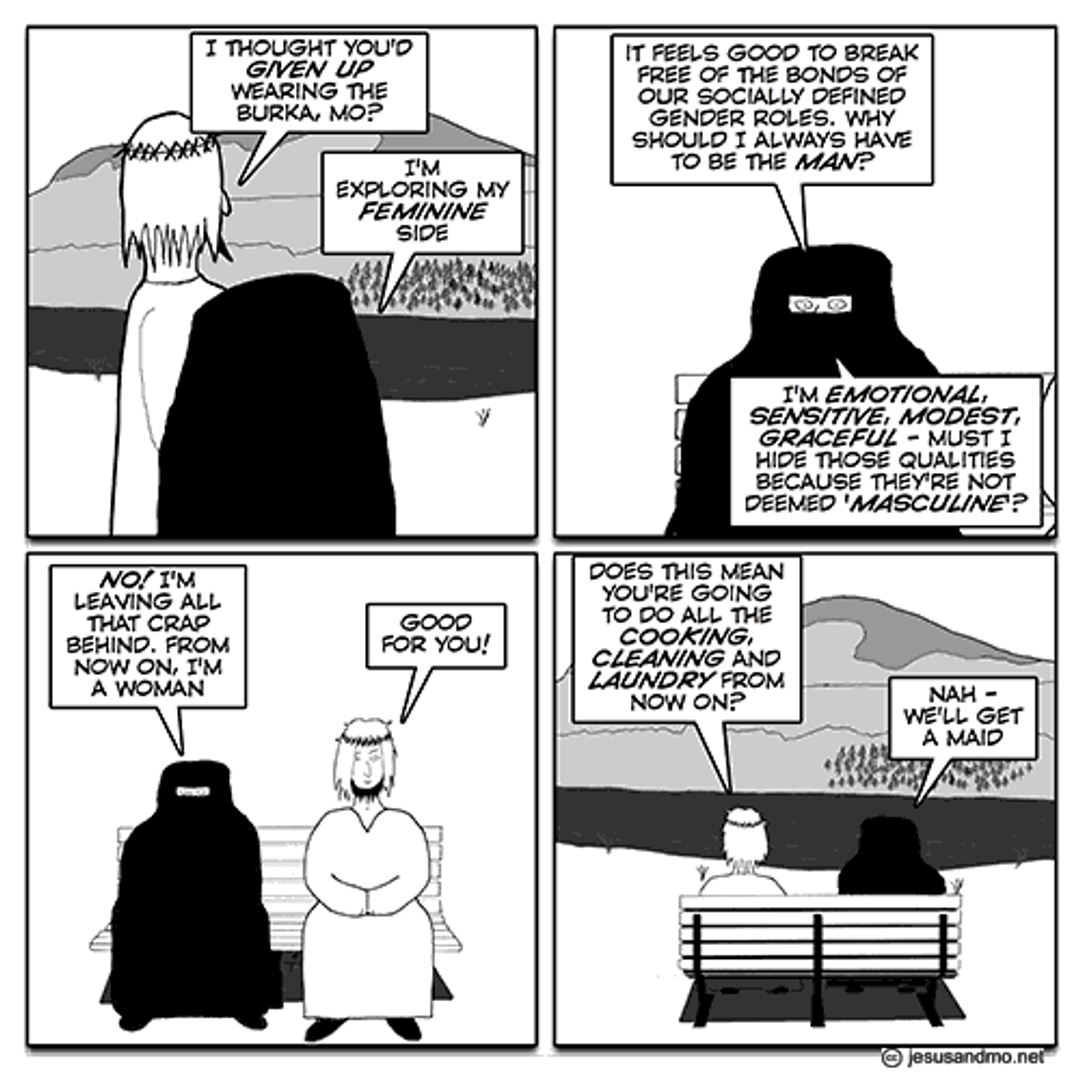
The caption for this week’s Jesus and Mo, called “Hide,” is “In light of the Tickle v Giggle verdict in Australia, a Friday flashback to J&M’s first terfy strip from 2016.”
If you’re not familiar with Tickle v Giggle, click on the Wikipedia link above. Here’s the summary:
Tickle v Giggle is an Australian federal legal case regarding the legality of the membership policies used on Giggle, a social media app for women. Giggle excluded trans women in their membership policy, and withdrew membership from Roxanne Tickle, a transgender woman from New South Wales, on that basis. In 2022, Tickle brought the case against Giggle, and in August 2024, the court found that Tickle had been indirectly discriminated against under Australia’s Sex Discrimination Act, and ordered Giggle to pay costs of the case and damages. That finding was appealed both by Tickle and by Giggle’s CEO, Sall Grover, with hearings on those appeals held in the Federal Court of Australia (NSW Registry) from August 4 to August 6 2025. The appeal judgment was delivered on 15 May 2026 at 2 pm AEST. The court upheld the original judgment, dismissing Grover’s appeal and allowing Tickle’s cross-appeal, with the court finding two instances of direct discrimination against Tickle and awarding damages of $20,000, double the award at first instance. Grover has said she will appeal to the High Court of Australia.
x
Sky Show: Watch the Moon Dance With the Planets at Dusk Next Week
The Moon has a busy week ahead of it. If skies are clear, be sure to get outside on the evenings of May 18th/19th and surrounding nights to check out the evolving view to the west, in one of the best sky shows for 2026.
CAR T-cell therapy bolstered by stiffening up cancer cells first
Where do you think your ‘self’ is? Your answer is revealing
NASA’s new AI space chip could let spacecraft think for themselves
NASA’s new AI space chip could let spacecraft think for themselves
Mars may have once had an ocean and this chaotic valley is a big clue
NASA’s Roman Space Telescope could reveal millions of invisible neutron stars
Dark Matter May Have Left Its Fingerprint in a Gravitational Wave.
Dark matter makes up roughly 85 percent of all the matter in the universe. We have never directly detected a single particle of it. But a new method developed by physicists at MIT and across Europe may have just opened a door we didn't know existed. When two black holes collide and merge, they send ripples through the fabric of spacetime, these are known as gravitational waves and if those black holes happened to spiral through a dense cloud of dark matter on their way in, those waves carry an imprint of it. For the first time, scientists have a technique to read that imprint and one signal in the existing data is already raising eyebrows.
No One Should Care About or Trust Anything Dr. Marty Makary Says Ever Again
That, and 4 other thoughts on the resignation of Dr. Marty Makary.
The post No One Should Care About or Trust Anything Dr. Marty Makary Says Ever Again first appeared on Science-Based Medicine.Artemis III: The Mission That Has to Work Before Humans Can Return to the Moon.
Artemis II has barely left the headlines. On April 1st 2026, four astronauts climbed aboard NASA's Orion spacecraft, rode the most powerful rocket ever to carry humans beyond low Earth orbit, and swung around the far side of the Moon. The world watched. Now, before the dust has settled, NASA has outlined its plans for what comes next. Artemis III won't be landing on the Moon. But what it will do is arguably just as important and if history is any guide, it's exactly the kind of mission that makes the difference between a Moon landing and a disaster.
Pages
