
You are here
News Feeds
Caturday felid trifecta: Larry the Cat finally catches a mouse; the counties that have the most cats; cat meme helps catch a cyberhacking group; and lagniappe
We’re back with three Caturday items and a bit of lagniappe.
First, Larry the Cat, the Chief Mouser of the Cabinet Office, has shirked his job, catching almost no nice after 15 years at 10 Downing Street. But at least, at the ripe old age of 19, Larry has not only caught a mouse, but gobbled it up in front of the Prime Minister’s door. Click the headline to read the Times story:
Excerpt:
Once accused of shirking responsibility, Downing Street’s chief mouser has finally lived up to his title.
While Sir Keir Starmer reassured the British public that he would seek to mitigate the rising cost of living during a prime ministerial speech on Wednesday, Larry the cat was making a precision kill.
Larry killed the ill-fated rodent in the courtyard of the Foreign Office, dragged it across the street and ate it by No 10’s door.
The moment was captured by GB News’s political editor, Christopher Hope, who insisted: “This is not an April fool.” Video showed Larry toying with the mouse, pawing it, tossing it in the air and clasping it in his jaws.
. . .[Larry] was recruited in 2011 to deal with a rodent problem after a BBC camera tracked a rat outside No 10.
Battersea Dogs & Cats Home recommended Larry as “a cat who enjoys attention” but was also “a bit of a bruiser” with excellent mousing skills — skills that have finally seen the light of day.
According to the Independent, this grisly affair happened during a Keir Starmer press conference about the Iran war.
Here’s a video (WARNING: RODENT DEATH)
More from the Times:
Early in his tenure, he was given the nickname “Lazy Larry” for his penchant for napping. The Cabinet Office was forced to defend his mousing as being in the “tactical planning stage”.
Yet by June 2011, David Cameron, then prime minister, boasted that Larry had “got three mice — verifiable”.
Since the untimely death of his nemesis, Palmerston, the Foreign Office cat who resigned from his post in 2020, Larry has now outlasted one chief mouser, five prime ministers and is staring down his sixth.
You go, Larry! Show ’em that we old geezers have still got it!
********************
From VGraphs. Yes, populous countries have more cats, but it’s not in strict proportion to their human populations. for example, China’s population of 1.4 billion is about four times that of the U.S., but the U.S. has 27% more cats. You can do the math for the rest.

**************************
From the WSJ: a computer whiz managed to infiltrate himself into a serious hacking group to plug the leaks—using a cat meme!
Click to read (if you have a subscription):
An excerpt 9my bolding):
Sitting in his dorm room at the Rochester Institute of Technology, Benjamin Brundage was closing in on a mystery that had even seasoned internet investigators baffled. A cat meme helped him crack the case.
A growing network of hacked devices was launching the biggest cyberattacks ever seen on the internet. It had become the most powerful cyberweapon ever assembled, large enough to knock a state or even a small country offline. Investigators didn’t know exactly who had built it—or how.
Brundage had been following the attacks, too—and, in between classes, was conducting his own investigation. In September, the college senior started messaging online with an anonymous user who seemed to have insider knowledge.
As they chatted on Discord, a platform favored by videogamers, Brundage was eager to get more information, but he didn’t want to come off as too serious and shut down the conversation. So every now and then he’d send a funny GIF to lighten the mood. Brundage was fluent in the memes, jokes and technical jargon popular with young gamers and hackers who are extremely online.
“It was a bit of just asking over and over again and then like being a bit unserious,” said Brundage.
At one point, he asked for some technical details. He followed up with the cat meme: a six-second clip that showed a hand adjusting a necktie on a fluffy gray cat.
Brundage didn’t expect it to work, but he got the information. “It took me by surprise,” he said.
Eventually the leaker hinted there was a new vulnerability on the internet. Brundage, who is 22, would learn it threatened tens of millions of consumers and as much as a quarter of the world’s corporations. As he unraveled the mystery, he impressed veteran researchers with his findings—including federal law enforcement, which took action against the network two weeks ago.
Here’s the cat meme that Brundage used. It’s a Trojan Kitty!

And the nefarious proxy network he took down:
Three times a year, several hundred of the techies who keep North America’s internet running gather to talk shop. Last June they met at a conference in Denver hosted by the North American Network Operators’ Group.
One major topic was a fast-growing and often legally dubious business known as residential proxy networks. Dozens of companies around the world run such networks, which are made up of consumer devices like phones, computers and video players.
These “res proxy” companies rent out access to internet connections on the devices to customers who want to look like they’re surfing the internet from a genuine home address.
That kind of access is useful for people who want privacy or for companies that want to masquerade as regular people to test out internet features for particular regions or scrape the web for data (say, a shopping price-comparison site). AI companies use the networks to get around blocks on automated traffic so they can gather large amounts of data to train their models.
Then there are the customers who want to hide their identity while engaging in ticket scalping, bank fraud, bomb threats, stalking, child exploitation, hacking or espionage.
Some device owners willingly sign up to be on these networks so they can make a few dollars a month, but most have no idea they’re connected to one.
. . .Brundage had identified 11 of the largest residential proxy companies, including Ipidea, that were vulnerable to the bug, and began drafting emails to them explaining how to fix the problem.
But first, he had to complete his finals.
The day after his last test, on Dec. 17, Brundage sent out the emails. Five days later, he got on a plane to fly to Mexico for Christmas vacation, where he was sick with the flu almost the entire time. Christmas came and went without a DDoS disaster.
On the 26th, Brundage got an email from Ipidea apologizing. His email had gone into a spam folder, but they were fixing the problem.
The Ipidea spokeswoman previously told the Journal the company “once adopted relatively aggressive market expansion strategies,” but later tightened up its business practices.
A week later, security blogger Brian Krebs published a story highlighting Brundage’s research on Kimwolf’s origin. Within hours, Renée Burton, the head of threat intelligence at networking company Infoblox, was texting Brundage. She was astonished to discover that a quarter of her corporate clients had been infected with the Kimwolf software.
The hackers hadn’t only unlocked a back door into millions of home networks—they had also created a way to break into thousands of corporations. A more sophisticated hacker could have stolen corporate secrets, installed ransomware or created a back door to return to the network, Brundage said.
All solved because of a tie-wearing kitty!
*********************
Lagniappe: This is me on vacation (from Cats Doing Cat Stuff):

h/t: Pyers, Gregory
Astronomers finally solve the gamma-Cas X-ray mystery after 50 years
This laser turns metal into a star-like plasma in trillionths of a second
Radio Telescope Array Reveals the Masses of Hidden Young Stars
The Orion Nebula provides a master class in the study of newly born stars as the closest starbirth region to us. Yet, many of its youngest ones are still swaddled in their birth creches, hidden by clouds of gas and dust. The Very Large Baseline Array (VLBA) radio telescopes have managed to punch through the dusty obscuring veil to study a pair of young binary systems called Brun 656 and HD 294300 born in the Nebula.
2026 will be the hottest year on record, leading scientist predicts
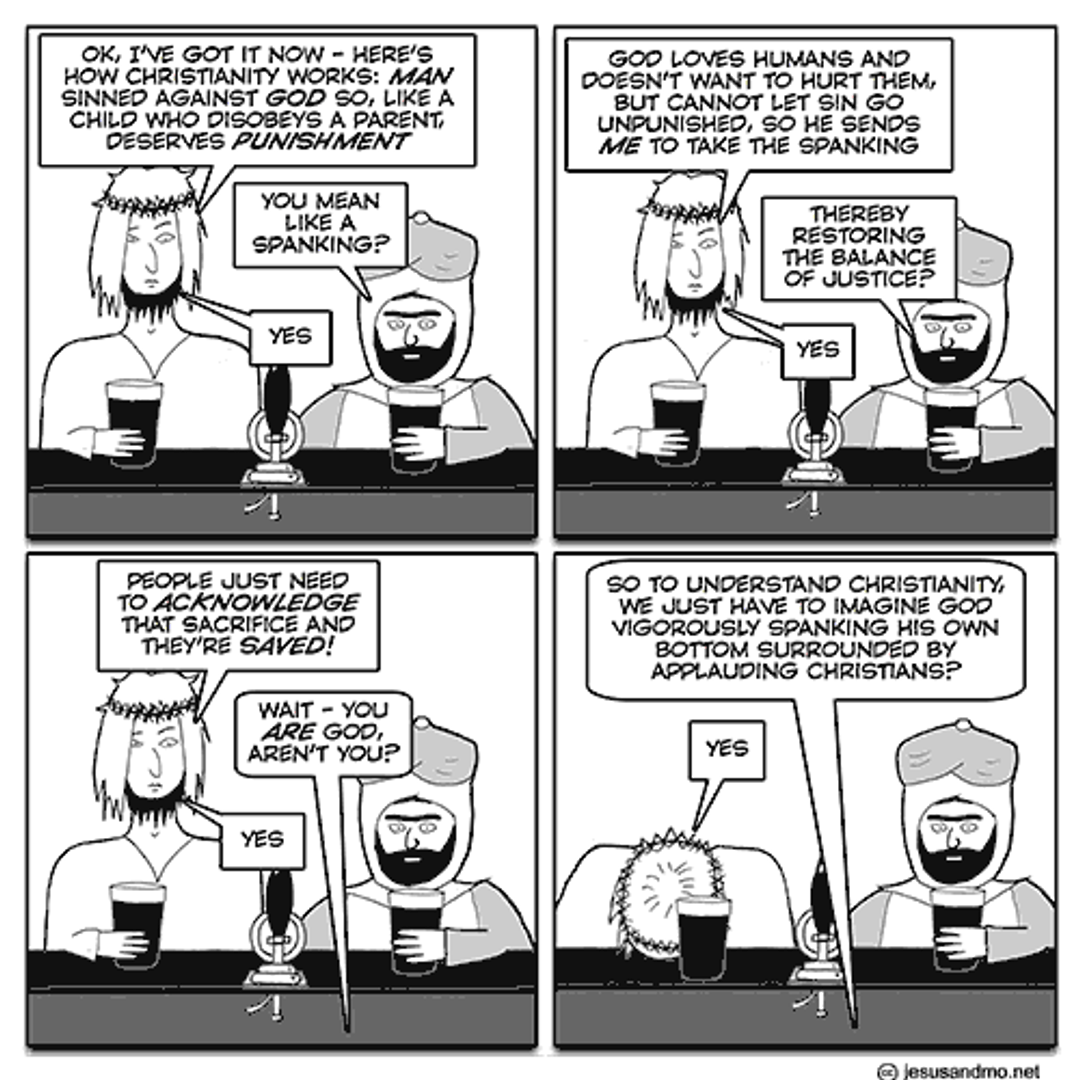
Jesus ‘n’ Mo ‘n’ substitutionary atonement
We have another “Friday Flashback from 9 years ago.” The concept of substitutionary atonement—something that Hitchens used to beef about—has always confused me, as it simply makes no sense. By killing his own son, who is really part of himself, God gave us all the possibility of going to Heaven. Whaaaat?
Mo takes it apart here:
Is the Large Magellanic Cloud a First-Time Visitor?
Our most massive satellite galaxy, the Large Magellanic Cloud (LMC), has been the center of a heated debate in the astrophysics community over the last few years. That debate centers on whether this is the LMC’s first or second “pass” by the Milky Way itself - and it has huge implications for the evolution of our galaxy given the disruption such a large grouping of stars has. A new paper from Scott Lucchini, Jiwon Jesse Han, Sapna Mishra, and Andrew J. Fox and his co-authors, currently available in pre-print on arXiv, provides what they claim to be definitive evidence that this is, in fact, the first time LMC has encountered the Milky Way.
The newly-arrived hen is Vashti
The other day I showed photos of a mallard hen who came to the pond on Wednesday and whose bill markings were strikingly similar to that of Vashti, the hen who departed with her brood of seven a week before last Tuesday. Her behavior, her immediate bonding with Armon, and bill markings all combine to identify her as Vashti, whose brood likely perished after her exit. So it’s bittersweet that she returned again: sadness for the ducklings loss combined with joy and confidence that she’ll breed again. If she does, can we keep her here this time?
Anyway, I attach a few more photos showing a match between Vashti’s bill markings (taken before she fled) and the markings of the “new duck”. Some people were dubious about the hen’s identity, but I’m going with Vashti.
Vashti’s bill is distinguished, on its top side, by a black patch, then a break before the tip, which is again marked with black. Here it is:

Vashti again:

Top of the bill and left side new duck. Notice the two black patches extending ventrally from the left side of the top marking—same as above.

Top of the bill and right side, new duck

The top is a match, and, as I showed last time, so is the right side. Here’s the right side of the new duck again. Notice the match with the photo above: a black patch on the side with a line of speckles to its rear:

New duck, right side:

Given the huge variance in pigmentation of bills among hens, which you’d have to see for yourself to appreciate, the above is enough for me. Our new hen is Vashti. But I’ll also show the left side, for which the photos are not quite as good.
Vashti, left side of bill. There are not many markings but a few black dots below the nostril:

New duck, left side of bill. Notice the line of about five dots below the nostril—same as above.

It’s Vashti, who clearlymade her way back to the familiar pond after losing her brood. There is ample time for her to nest and incubate her eggs again, so I am feeding her a lot to prompt that. She’s bonded with Armon, who never left the pond, and they are showing bonding and courtship behaviors. I am pretty sure she will nest and breed again.
This would not be the first time we’ve had double-brooding here. When Honey stole Dorothy’s brood, getting a batch of 16 to take care of, Dorothy eventually re-nested and produced her own brood, which she did rear to fledging.
Here’s a classic photo of Honey with her mixed brood of 16, half of them ducknapped. She was a great mome, and all of these ducklings fledged. “But isn’t that evolutionarily maladaptive?”, you ask. Perhaps, unless Dorothy and Honey were related. I have no idea if they were, but I think it’s simply a case of a maternal instinct that was coopted, like humans adopting unrelated babies.

Readers’ wildlife photos
Well, brothers and sisters, friends and comrades, this is the last batch of photos I have. If you’re feeling generous and have some good wildlife photos, well, you know what to do.
Today’s lot comes from Ephraim Heller: they are manakins and tanagers from Trinidad and Tobago. Ephraim’s captions are indented, and you can enlarge the photos by clicking on them.
Today we have photos of manakins and tanagers that I photographed on my February visit to Trinidad and Tobago.
The three manakin species in these photographs all engage in lekking. Females choose a partner at the lek, mate, and then depart to build a nest and raise chicks entirely on their own. Males contribute only sperm. This behavior places intense sexual selection pressure on males, driving the evolution of exotic plumage, acrobatic movements, and multi-male performances. I make no comment on potential parallels in human behavior.
Blue-backed manakin (Chiroxiphia pareola) males engage in cooperative lekking. Two males — typically an older dominant individual and a younger subordinate — perform a dance in which they jump over each other on a branch. The female observes, and when she is sufficiently engaged, the subordinate male withdraws and the dominant male completes the mating. In these photos you see one of the males perched on the lekking branch and then performing the jump.


JAC: Here’s a video showing a related lekking species, the Blue manakin (Chiroxiphia caudata) and their remarkable courtship dance. Look at those males lined up, each trying to show he’s a better jumper than the others!
Each white-bearded manakin (Manacus manacus) male clears a small patch of forest floor down to bare earth and maintains one or more bare sticks above it as perches. The display involves rapid leaps between these sticks and the ground accompanied by a shockingly loud cracking sound – it sounds like someone snapping their fingers right next to your ear. It’s produced by the wings connecting above the back, which is enabled by a limb muscle, the scapulohumeralis caudalis, that is the fastest skeletal muscle in any vertebrate. Here you see two white-bearded manakins perched on their lekking branches and preparing to jump to the ground.


JAC: I also added a video of the white-bearded manakin courtship:
The golden-headed manakin (Ceratopipra erythrocephala) male’s lek display includes a “moonwalk” in which it slides backward along a perch. Sadly, I didn’t observe the moonwalk. In these photos the male has the bright yellow head, and you can see a female behind the male in the second photo.


JAC: Here’s a golden-headed manakin male courting, though I can’t really say it’s a “moonwalk.” They also pop their wings.
This gorgeous bay-headed tanager (Tangara gyrola) stopped me dead in my tracks. It has microstructures in its feathers that scatter light to intensify its hues. In addition, a hidden layer of white or black feathers beneath the outer plumage acts as a reflective backing, boosting the brightness and saturation of the visible colors:

The palm tanager (Thraupis palmarum) is one of the most common birds in Trinidad. The second photo is of the nest, which was conveniently located in a planter on our hotel’s balcony:


White-lined tanager (Tachyphonus rufus) males are glossy black, while females are rufous.


The silver-beaked tanager (Ramphocelus carbo):
Close-In Planets Act as "Bouncers" to Create Rogue Worlds
Rogue planets sound like rare travelers amongst the stars, freed from the gravitational constraints of a host system, left to forever wander the interstellar void. But modern models suggest these Free Floating Planets (FFPs) as they are technically known, are actually very common - nineteen times more common than planets beyond the “snow line”, which is the distance from the central star where it becomes cold enough that hydrogen compounds like water, ammonia, and methane can condense into ice. But why are FFPs so common? What forces them out of the stellar systems where they form? A new paper from Xiaochen Zheng of the Beijing Planetarium and his co-authors, available in pre-print in arXiv, offers a plausible explanation - planetary “bouncers”.
NHS England rushes to hide software over AI hacking fears
Prematurely published Hili dialogue
I accidentally hit “publish” instead of “save” when I was preparing today’s Hili dialogue (most of it got done yesterday afternoon), so subscribers might have gotten an incomplete email yesterday and none today.
If you want to read the completed one, click on the screenshot below.
The 4 biggest myths about hydration, according to an expert
Oxford physicists achieve first-ever “quadsqueezing” breakthrough in quantum physics
Oxford physicists achieve first-ever “quadsqueezing” breakthrough in quantum physics
This new aluminum could replace rare metals and cut costs dramatically
Oak trees use delaying tactics to thwart hungry caterpillars
Will Colombia summit kick-start the end of the fossil fuel era?
Why I explore our inevitable love for robots in my novel Luminous
Read an extract from Luminous by Silvia Park
Pages
