
You are here
News Feeds
A planet just vanished. NASA’s Hubble reveals a violent cosmic secret
When Stars Blow Bubbles
For the first time, astronomers have caught a stellar nursery in the act of blowing giant celestial bubbles, revealing a massive outflow of gas stretching over 650 light-years from one of the Milky Way’s most extraordinary star clusters. Using nearly two decades of data from NASA’s Fermi Gamma-ray Space Telescope, researchers traced this budding stream of supercharged particles as it expands beneath our Galaxy’s disk, offering crucial insights into how young, massive stars shape galactic evolution.
The Sticky Problem of Lunar Dust Gets a Mathematical Solution
Lunar dust poses one of the most persistent challenges for spacecraft operations on the Moon, clinging stubbornly to surfaces and infiltrating equipment with potentially devastating consequences. Now, researchers have developed a comprehensive mathematical model that reveals exactly how electrically charged dust particles behave when they collide with spacecraft at low speeds, uncovering surprising insights about what makes them stick and what allows them to bounce away.
The Interstellar Comet That’s Spilling Its Secrets
Astronomers have measured water streaming from interstellar comet 3I/ATLAS for the first time since it passed closest to the Sun. Using a spacecraft that’s been watching the Sun for nearly three decades, scientists detected hydrogen glowing around the comet and calculated that it was producing water at extraordinary rates. These measurements not only confirm that interstellar comets behave remarkably like our own Solar System’s icy wanderers, but also provide crucial clues about what comets looked like in the early universe.
Rare Saturn-sized rogue planet is first to have its mass measured
Chess can be made fairer by rearranging the pieces
NASA’s Webb telescope just discovered one of the weirdest planets ever
Readers’ wildlife photos
We start the new year with clouds, which, though some say they’re loaded with bacteria (and created by the bacteria as a means of dispersal), we’ll consider nonliving atmospheric phenomena. This montage could be called, “I’ve looked at clouds that way,” and comes from reader David Jorling in Oregon. David’s captions are indented, and the photos can be enlarged by clicking on them.
First of all here is an overly simple chart that I used to identify the clouds: UCAR/L.S. Gardiner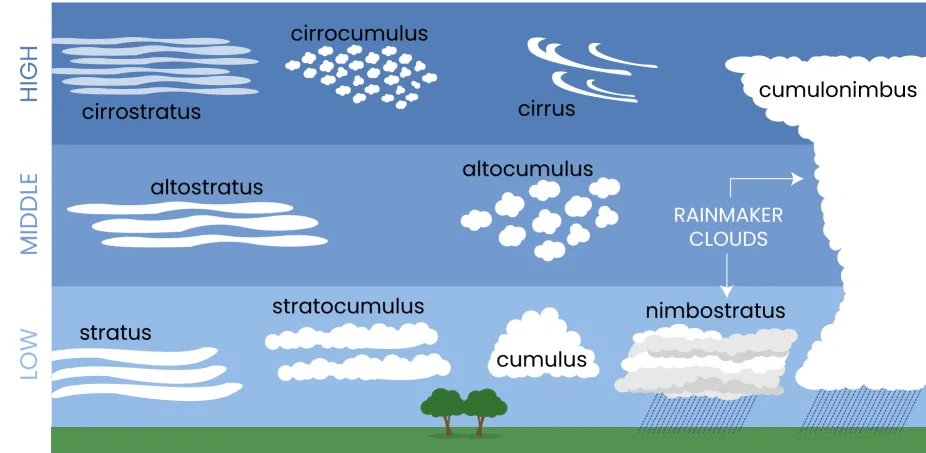
As to these three photos, the first was taken at Mary S Young State Park while I was walking my dog. These are “cirrus” clouds which, as I understand it, means there are strong winds in the upper atmosphere:

As to the following two pictures, which were taken from my yard amongs the Douglas Fir Trees. My best guess (and perhaps one of your readers has more expertise is that these are a mixture of cirrostratus and cirrocumulus clouds. perhaps in a state of transition:

More pictures taken from my yard. Again my best guess as is cirrrostratus clouds:
Perhaps these are in transition from cirrostratus to cirrus: My suspicious is that these are Cirrostratus transitioning to cirrus:


This one was taken at sunset near Timberline Lodge on Mt Hood. They may have appeared lower perhaps because I was at about 6000 feet elevation instead of about 300 feet where I live. So my suspicion is that these are either cirrocumulus or altocumulus clouds:
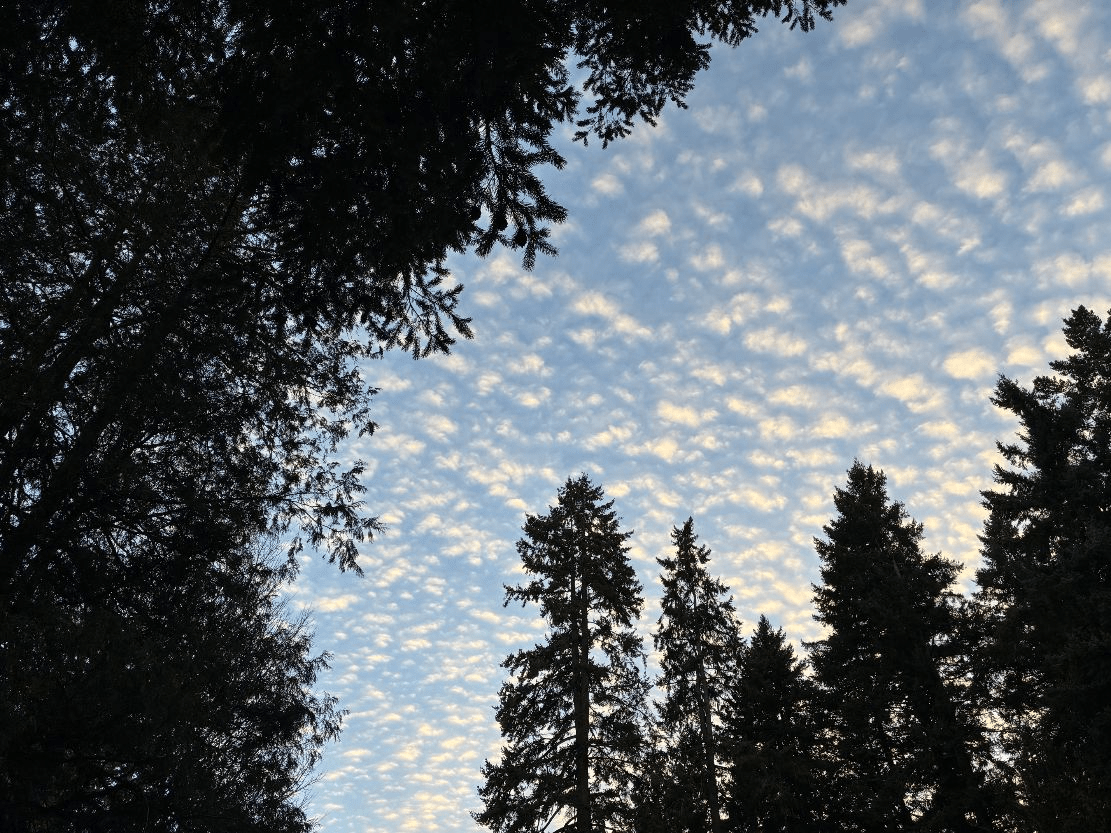
This is a picture from my yard toward some neighboring Douglas Firs and assorted evergreens. I suspect these are cirrocumulus clouds:
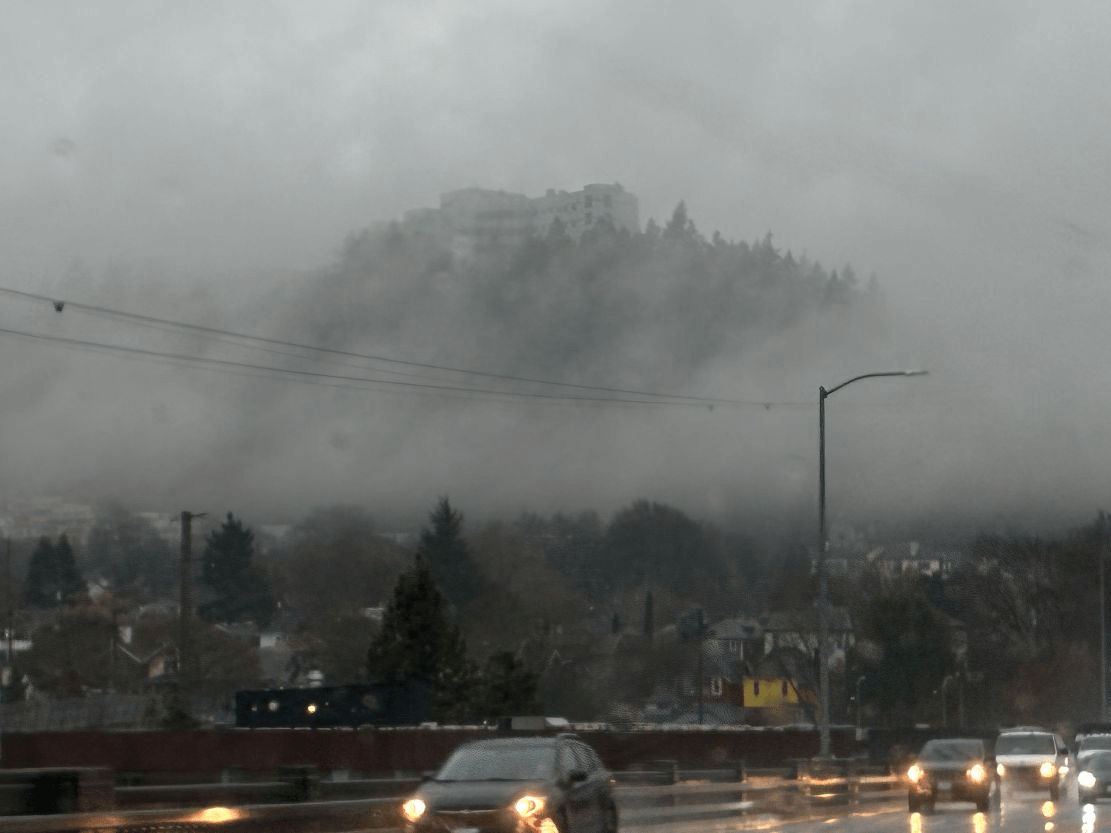
This is a picture I took from my car during a nationally forecast “Atmospheric River”. (In Oregon we call it “Rain”.) The picture was taken westbound on the Ross Island Bridge. The building above the Stratocumulus cloud (in Oregon we call it a “Fog Bank”) is one of the buildings of the Oregon Health Sciences University, which is the main medical school in Oregon:
The 3 things you should do this New Year to foster a positive mindset
The Murray Hill Declaration
It's the responsibility of our medical establishment to protect the vulnerable and keep schools open.
The post The Murray Hill Declaration first appeared on Science-Based Medicine.What if AI becomes conscious and we never know
Gaia Spots Worlds Being Born
ESA’s Gaia space telescope has achieved something astronomers thought nearly impossible, detecting planets while they’re still forming inside the dusty discs surrounding newborn stars. By measuring the subtle gravitational wobbles that unseen companions induce on their host stars, Gaia has found hints of planets, brown dwarfs, and companion stars in 31 young stellar systems out of 98 surveyed.
Astronomers ring in the new year with a stunning galaxy collision
Scientists Race to Film Black Holes in 3D
The iconic 2019 and 2022 photographs of black holes M87* and Sagittarius A* captivated astronomers worldwide with their fuzzy orange doughnut shapes. Now, scientists are preparing to take the next giant leap by creating the first ever 3D movies of black holes that could fundamentally reshape our understanding of gravity and the universe’s most violent phenomena.
When Galaxies Collide
Two spiral galaxies locked in a slow motion collision have been captured in stunning detail by NASA’s James Webb Space Telescope and Chandra X-ray Observatory. The pair grazed past each other millions of years ago, triggering spectacular waves of star formation and distorting their elegant spiral arms into sweeping silver blue streamers. This celestial dance, playing out over hundreds of millions of years, offers astronomers a rare glimpse into the violent yet creative process that shapes galaxies across the universe.
New images reveal what really happens when stars explode
A missing protein may be aging your immune system
Could 2026 be the year we start using quantum computers for chemistry?
An MCAT prep question
One of my colleagues’ students is going to take the MCAT, the test required to get into med school. (As far as I know, it’s still required.) The student found this question in a practice exam they were taking on a laptop.

I’ll print out what’s above:
Which of the following statements is NOT an accurate description of gender?
A. Gender is a biological distinction.
B. Gender ideals and expectations vary by culture.
C. Some societies recognize more than two genders.
D. Gender is a performative aspect of individual identity.
I know the right answer, but perhaps you can vote to see which one was deemed correct by those who made the test. It’s unclear to me why this is on a test designed to assess students’ ability to succeed in medical school. Well, you get a chance to answer it below, as here’s a poll. Pick one,and remember, you’re looking for an INACCURATE description of gender.
Note: There is a poll embedded within this post, please visit the site to participate in this post's poll.
Scientists just found the best places to look for ancient life on Mars
Pages
