
You are here
News Feeds
These tiny holes could change how the world cleans water
Quantum computer quickly mines cryptocurrency while using less energy
Giant underground neutrino detector brings scientists closer to cracking the neutrino puzzle
Brain-inspired chip runs near absolute zero and could transform quantum computing
How to sparkle in conversation with strangers
First working nuclear clock heralds a new era in timekeeping
MAHA Doctors Promised Kennedy Would be the Savior of Vaccines. What Happened Next?
It was a mistake to treat bad faith political actors as wise medical sages. Cildren are paying the price today.
The post MAHA Doctors Promised Kennedy Would be the Savior of Vaccines. What Happened Next? first appeared on Science-Based Medicine.One-way quantum synchronization could make quantum computers more reliable
One-way quantum synchronization could make quantum computers more reliable
The Shape of a Black Hole
Black holes are already strange enough, regions of space where gravity is so extreme that not even light can escape. But physicists have long known there's another layer of weirdness, that black holes also behave like thermodynamic objects, with temperature, entropy, and phase transitions just like a gas or a liquid. Now, a new approach borrowed from pure mathematics is revealing hidden patterns in that behaviour and hinting at something fundamental about the nature of black holes themselves.
Written in Rock
A small rock found in the African desert has just handed scientists an extraordinary window into one of the most violent and consequential periods in the history of the Solar System. Inside this lunar meteorite, a chunk of the Moon knocked to Earth by an ancient collision, researchers have found evidence of a massive impact event 3.5 billion years ago, one that matches the timing of known impacts on Earth and in the asteroid belt. Three worlds but one shared bombardment and a story that may have everything to do with the origins of life.
Titan's Hidden Blanket
Saturn's moon Titan has long fascinated scientists, it’s a world with rivers, lakes, and a thick atmosphere, all made not of water but of methane. Now, a new study suggests Titan is stranger than first imagined since beneath its surface lies a 9 km thick crust of methane laced ice that acts like a giant thermal blanket, warming the interior in ways nobody expected.
Did Life Start When Impacts Created Vast Hydrothermal Systems in Earth's Crust?
Earth was bombarded by impactors in its first couple billion years. These impacts created a vast network of hydrothermal systems in the crust that could've spawned life. New research examines their extent.
Global map reveals the vast scale of underground fungal networks
Have we finally worked out how Venus flytraps snap shut?
El Niño has started and the weather could get weird
Meet REMORA: The Autonomous Space Fleet Built to Tag and Track Asteroids
To truly understand what an asteroid is made up of, we need to send a probe to it. Remote sensing from ground-based telescopes, or even orbiting observatories, and only do so much. A new white paper submitted to the UK Space Agency’s 2035 Space Frontiers programme, pitches just such a mission architecture. Called the REndezvous Mission for Orbital Reconstruction of Asteroids (REMORA), the plan calls for a swarm of autonomous CubeSats to tag, track, and characterize multiple near-Earth asteroids.
Watch the Moon Occult Venus in the Daytime for North America on June 17th
If you’re like us, you’ve been following the close conjunction of Jupiter and Venus in the June dusk sky. Next week, the Moon enters the evening scene, and actually occults (passes in front of) the planet Venus in what promises to be one of the top skywatching events for 2026.
Duck doings #1: Brood of unnamed duck vanishes the day it came down; miscellaneous stuff
I believe I’ve mentioned before that we’ve lost two broods of ducklings in Botany Pond this year: Vashti’s brood of 7 and then an unnamed duck’s brood of 12. I was in Savannah, Georgia when Vashti’s brood came down on Sunday, April 19, and several people fed her and her brood, though of course the brood doesn’t each much at first because they’re still going on residual egg yolk. There was a storm, and then, on Tuesday, April 21, the brood vanished some time in the afternoon. We don’t know what happened, but I have a good idea based on watching the brood of the second duck (see below).
Here’s the only picture I have on hand of Vashti’s first brood, taken by a member of Team Duck with an iPhone. There were seven; I think one is out of range or behind her.
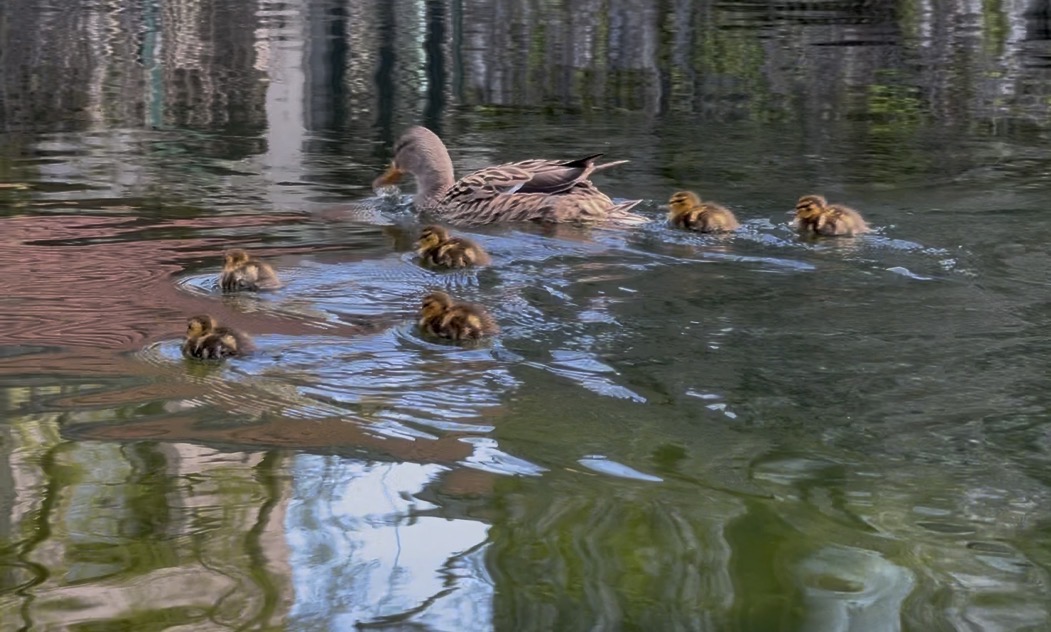
Nobody saw what happened but she was gone. On May 1, a hen returned to the pond, and she clearly knew me, coming for food on my whistle and consorting with Armon, her spouse, who had patiently abided in the pond the whole time. Bill photos (not shown) matched her with 100% accuracy to the Vashti who left. She’s shown below. As for what happened to the ducklings, well, it’s best not to think of it.
Below: Vashti returned! After about two weeks she re-nested, using exactly the same first-floor nest she had last time. But more on that in a later post.

That was it for a while, and then, on the afternoon of May 22, someone reported a lone duckling on the other side of the building from the pond side where Vashti had nested. I rescued it at great effort with the help of another Team Duck member; the rescue was hard as it ran into a tangle of vines and leaves at the bottom of an adjacent building, but we got it and I took it to the Chicago Bird Collision monitors for rescue, where it would be taken to rehab. It was clearly a newly-hatched duckling, as it still had its “egg tooth.”
Suspecting that it might have fallen out of a nest somewhere on that side of the building, I went back early next morning, and, sure enouogh, I found yet another newly-hatched duckling on the ground near the same spot. I took it upstairs and put it in a box with soft teeshirts near a space heater (they need to be kept warm). I was fairly sure by then that there was a nest up above on the non-pond side of the building, and, sure enough, when I went back, there was a mother duck with about five babies in tow, trying to get to the pond. The problem was that she was trying to go on the north side, which required going up stairs, across a breezeway, and then going down. The ducklings couldn’t jump that high, so I had to shoo the brood around the south side of the building, through the vegetation and a fence, and into the pond.
But wait! There’s more! After the unnamed hen (I’ll call her “UH”) was in the pond, I went back to the spot where I saw her, and, sure enough, there were six more babies milling about, peeping piteously, and looking for mom. Several got stuck in a window well. I got them all, put them in a fly net, and walked them back to the pond. Picking up two at a time, I put them on a rock in the pond. The mother heard their peeping and swam to them immediately. I did this three times until there were eleven ducklings with UH. Then I went back upstairs, got the early-morning straggler, and put it on the rock. Sure enough, UH came back and retrieved that one, too. Now, with mom and all twelve babies together in the pond, I was happy—and quite proud of myself of retrieving them in the morning all by myself (this was at about 6:30-7:30 a.m.).
Here they are (or rather, were). The mother started, as always, giving them the obligatory tour of the pond.

After the circumnavigation I was glad that Mom took them out of the water to dry off, sitting on a rock and then squatting on the ducklings to dry them off and oil them:


I sat on the benches nearby, for several drakes in the pond (I don’t think Armon was one of them) began harassing the brood; they wanted to mate with the mother. She would fly away and then return to the brood—over and over again. Sadly, the harassment continued, and I was there until about 11 a.m. when the mother, followed by her entire brood, walked south through the fence into dense vegetation.
That was the last time I saw them; I didn’t want to go tramping through the bushes and weeds lest I squash somebody or scare them. I was sure they’d return, but they didn’t. (Mom later came back, like Vashti did, and she’s still here, but so far didn’t renest.) Every day for four or five days I would scour the area around the pond, including adjacent buildings near the quad, looking for the brood, but they were gone. Like Vashti’s first brood, it is certain that all the ducklings perished. I was—and still am—heartbroken.
In the next post, which I’ll write in a day or two, I’ll relate how Vashti produced seven eggs, and how with the help of Facilities we devised a scheme to capture the whole family before they could get to the pond and be harassed out of existence. But more on that later. How about some brighter topics now?
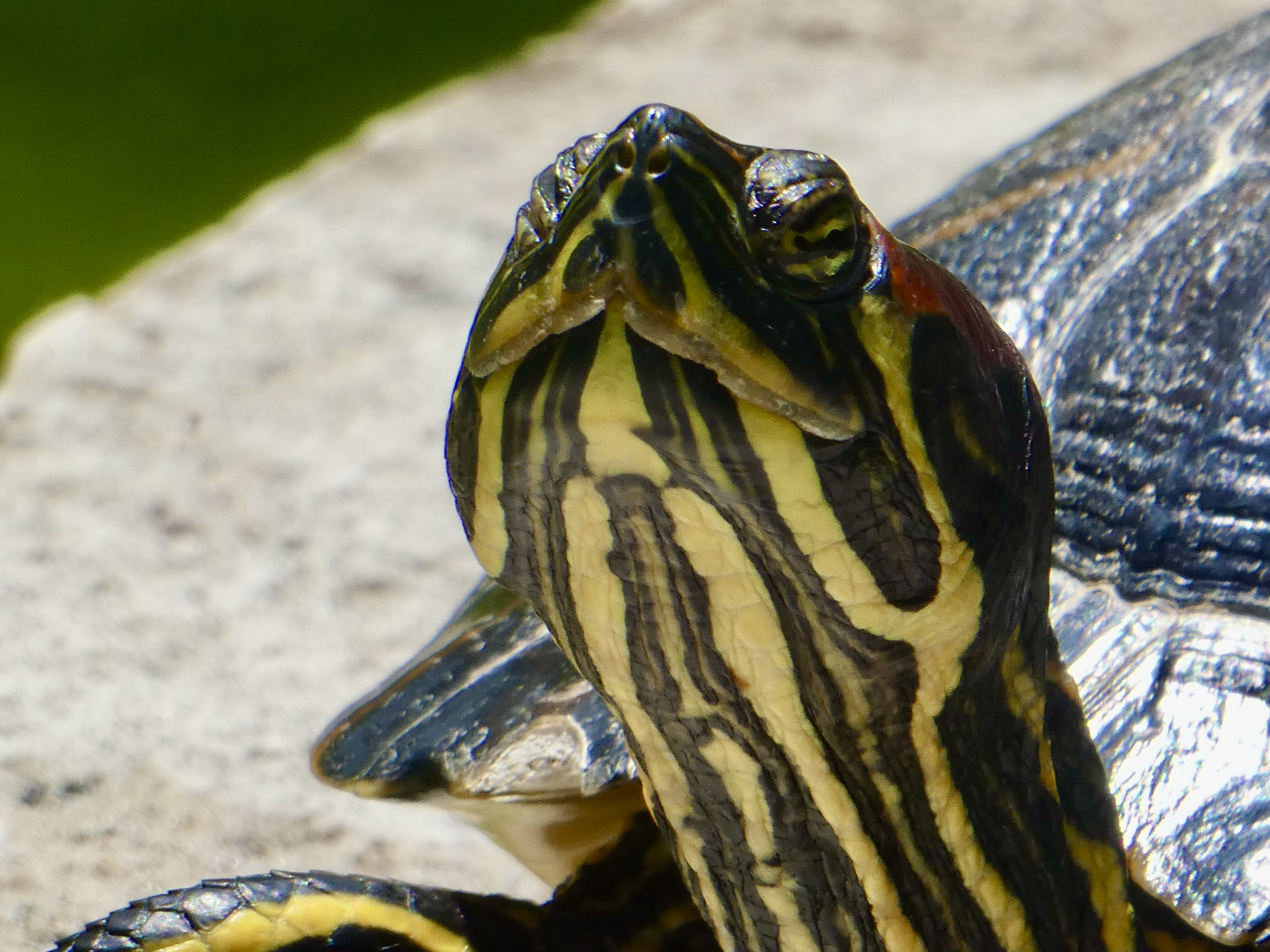
Turtles are also a perennial favorite, and we have five red-eared sliders (or rather, four red-eared sliders and one yellow-bellied slider; all are members of two subspecies of the same species, the pond slider Trachemys scripta.) Here are some photos:
Here are all five sunning on a rock; only rarely do we see them all together like this. You can see that one has more melanin than the others; Greg Mayer, who has visited, calls it “Mel”:

More usually we see two, three, or four. Everybody who walks by them stops to look, and many people whip out their phones to take photos:

They are cold-blooded (“poikilothermic”), and so to warm up enough to swim and metabolize, they love to lie in the sun, stretching out their limbs and necks to expose as much of the blood-containing tissue as possible. We call this “turtle yoga”, and I always explain to people by the pond what is going on, as they don’t understand the stretching:

More turtle yoga. Look at those stretches!

Head shots:

But I don’t tend the turtles, save for tossing them an occasional pellet of duck food. I just make sure that nobody bothers them (and believe me, people try). With no ducks to play with, I engage with the three resident squirrels by the Pond, two of which are fairly tame and the other one skittish. The tame one will crawl up my pants to get a nut; I give them entire walnuts in the shell, and roasted unsalted peanuts in the shell (I have to worry about their blood pressure!). Here’s one who climbed on me while I was watching the ducks with binoculars (it’s early in the morning and I’m dishevelled):

The tamest one (I have not given them names):

Look at that adorable face:

That one has, besides being tame enough to know me and crawl up my body, finally allowed me to pet her, which is not something you want to do to a squirrel you don’t know. DO NOT TRY THIS AT HOME! I had to get her (it’s a lactating female) to get used to being touched and now I can gently place my hand on her back while she positions a nut in her mouth:

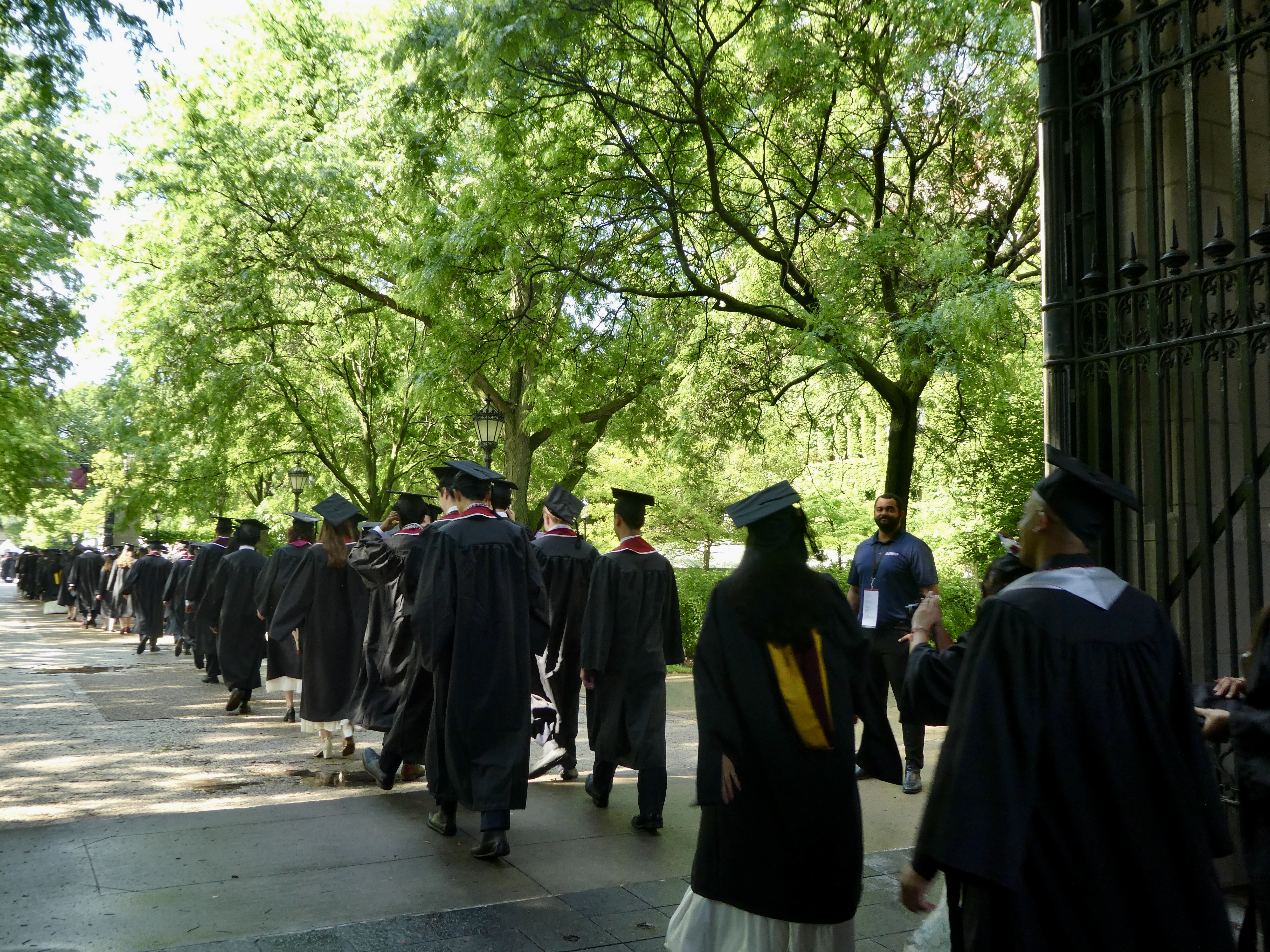
Saturday, June 6 was graduation day at the University of Chicago. By that time Vashti had been back nesting for about three weeks (I calculated that she began sitting on a new batch of eggs on May 15, but I was off a bit, as you’ll see in the subsequent post.
Entering the Quad from the street:

Marching to the Quad. I didn’t go to graduation, but I didn’t hear of any disruptions this year. Congrats to the grads; it’s a hard slog here!
More on Vashti’s second brood in the next post.
Astrochemical Model Digs Into the Universe's Missing Sulfur
Sulfur is one of the most abundant elements in the universe. If you peer into a diffuse interstellar cloud, you find loads of it - about the amount expected based on fusion patterns of the stars it was born in. However, if you look at a dense, cold, molecular cloud - the kind where those stars actually form - it seems like 99% of the sulfur that is expected to be there is missing. Scientists have puzzled over this “missing sulfur problem” for decades, though a leading theory is that the element hides on icy dust grains making it hard to detect. A new paper published in Astronomy & Astrophysics from the Max Planck Institute for Extraterrestrial Physics and the Centro de Astrobiologia describes a new computer simulation model that they aimed to support the interpretation of laboratory results and test our current understanding of sulfur evolution in interstellar ices.
Pages
