
You are here
News Feeds
Woolly rhino genome recovered from meat in frozen wolf pup’s stomach
What about Minnesota? Another discussion.
I’m still afflicted with Weltschmerz, but also heartened that readers had a lot to say in yesterday’s discussion, so I’m glad that when I’m low, my presence isn’t needed on every post (I did read all the comments).
Today I want to kick-start another discussion if I can, this time about what’s going on in Minnesota. I’m referring not to the welfare-fraud scandal that brought down governor Tim Walz, but the big fight between ICE agents and local residents, spurred not just by Trump sending more lawmen into the state, but by the killing of Renée Good by an ICE agent. This has led to big and ongoing protests in which Minnesotans gather in big crowds whenever ICE shows up, trying to prevent them from apprehending suspects. These are not peaceful on either side: ICE agents fire pepper spray and tear gas, while some demonstrators physically assault lawmen and block the cars of ICE agents. (To see how well the citizens are organized, read Olivia Reingold’s piece “I joined ICE watch” at the Free Press.)
Since I am not and haven’t been there, I’m not sure whether the protestors are trying to incite violence as part of their protests, hoping, as did Martin Luther King, Jr. did in the Sixties, that brutality on the party of the law will promote one’s cause. The difference is that King’s cause was to get rights for black people, while the cause of the protestors seems to be to keep Trump from using heavyhanded tactics to deport undocumented immigrants. This difference is why, I think, we don’t see many black people speaking out about the demonstrations.
I have still not decided whether Good’s killing was illegal: a deliberate act of manslaughter or even murder. Because someone was killed, though, and there is some question that bullets were fired gratuitously, I think there needs to be an investigation of the officer and, if things look illegal, a trial. We need to preserve our system of law and accountability. But I am not willing to pronounce the officer guilty, as so many are doing (my Facebook page is full of those pronouncements). That would take a trial. All I can say is that, since we haven’t yet had a trial or an investigation the incident looks like an unfortunate concatenation of a woman who should not have been doing what she did (blocking ICE access with her car, and refuse refusing orders to exit her car), and an ICE officer who may have been overly retributive because he had been through a similar experience (dragged by a car for many yards) in recent weeks.
So, please discuss this issue. What do you think should be done about the officer who killed Good? Does Good herself bear any responsibility for what happened? Are the protestors completely peaceful, or are they hoping to provoke violence? Are they trying to keep officers from enforcing the law? (My view is that all undocumented immigrants deserve a hearing before an immigration judge before they are deported, but also that that ICE is being heavy-handed in law enforcement. Further, in the end there should be a procedure to expel people who entered the country illegally, giving priority to those with a criminal record.) Sometimes it seems to me that the protestors all want open borders and no deportations, which is not in line with what most Americans want.
I have written too much already, and am still rethinking the events in Minnesota, but I thank Ceiling Cat that I don’t have to adjudicate them.
By the way, the Minnesota state legislature has just brought up Tim Walz on four articles of impeachment, all involving the corruption scandal in his state. He’s already said he won’t be running again.
A Supernova That Shouldn't Exist
For decades, astronomers believed that the most massive stars in the universe lived fast and died quietly, collapsing directly into black holes without the spectacular fireworks of a supernova explosion. That understanding has been dramatically overturned by observations of SN 2022esa, a peculiar supernova that erupted from an incomprehensibly massive star and is now destined to become a black hole binary system.
Sinking river deltas put millions at risk of flooding
Psychiatry has finally found an objective way to spot mental illness
To Study the Moon's Ancient Ice, We First Have to Pollute It
There is a fundamental tension in space exploration that has created ongoing debates for decades. By creating the infrastructure we need to explore other worlds, we damage them in some way, making them either less scientifically interesting or less “pristine,” which some would argue, in itself, is a bad thing. A new paper available in JGR Planets, from Francisca Paiva, a physicist at Instituto Superior Técnico, and Silvio Sinibaldi, the European Space Agency’s (ESA’s) planetary protection officer, argues that, in the Moon’s case at least, the problem is even worse than we originally thought.
RFK Turns Food Pyramid On Its Head
Last week I wrote about the new vaccine schedule under RFK, which reveals his process. He doesn’t appear to have one. Our HHS secretary is shooting from the hip, ignoring expert advice, and trusting only his own conspiracy-addled instinct. He quickly followed with his take on the food pyramid, echoing unscientific nonsense he has been spouting for years. This also reflects another […]
The post RFK Turns Food Pyramid On Its Head first appeared on Science-Based Medicine.Jesus ‘n’ Mo ‘n’ equivocation
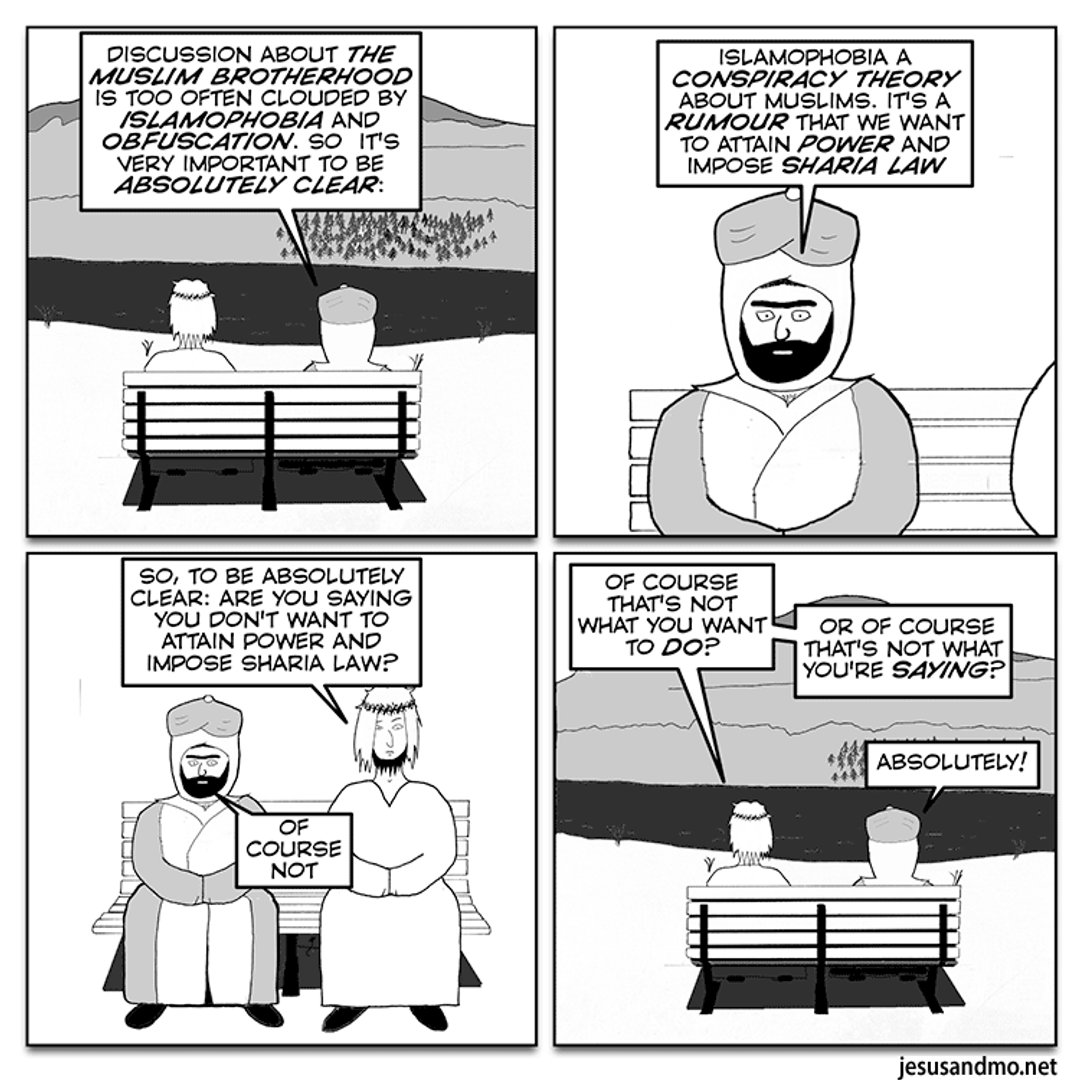
Today’s Jesus and Mo strip, called “absolutely,” came with a terse comment from the artist: “Thanks for clearing that up, Mo.”
Peering Below Callisto’s Icy Crust with ALMA
What exists beneath the surface of Jupiter’s icy moon, Callisto? This is what a recent study accepted by The Planetary Science Journal hopes to address as a team of researchers investigated the subsurface composition of Callisto, which is Jupiter’s outermost Galilean satellite. This study has the potential to help scientists better understand the interior composition of Callisto, which is hypothesized to possess a subsurface liquid water ocean, and develop new techniques for exploring planetary subsurface environments.
Readers’ wildlife photos
In the last readers’ wildlife photo feature I have, James Blilie has appeared with some black and white photos. His captions are indented, and you can enlarge his photos by clicking on them.
Here are another set of landscape photos that I have converted to black and white for posting to a black and white Facebook group. I am having a lot of fun having another “go” at older images in B&W. Over the last 15 years or so, my software skills for editing photos have improved dramatically. Since I “came from” the perspective of shooting Kodachrome slides (everything was fully captured when I pressed the shutter button), I at first resisted the idea of using photo-editing software after I switched to digital. That was a mistake. Editing images is critical (like editing most other works).
These are from all over and many are scanned 35mm slides or negatives.
Three images for Jasper National Park and Mount Robson Provincial Park in Canada, September 1981. All scanned B&W negatives.
Beaver Lake on the Jacques Lake trail in Jasper National Park:
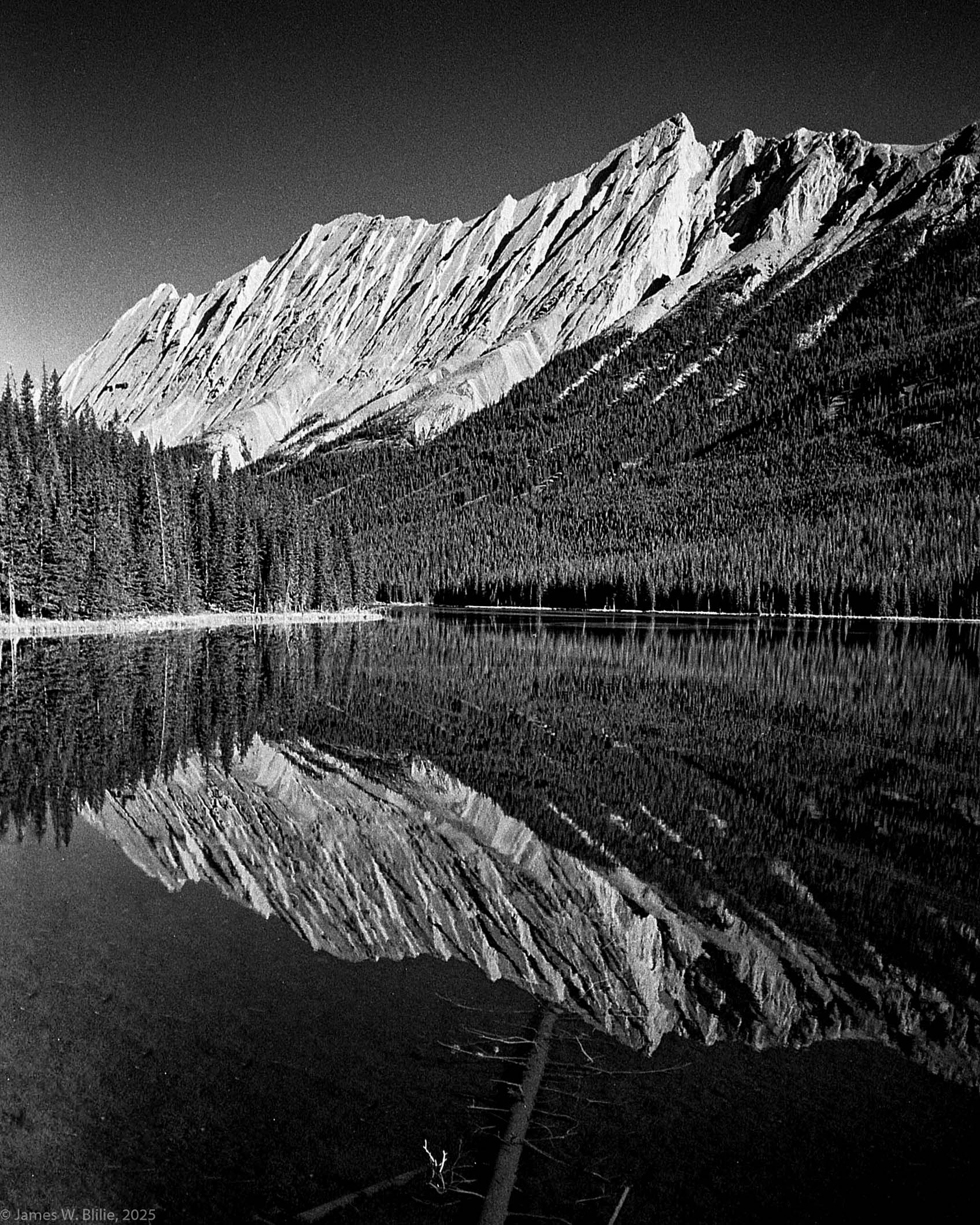
Summit Lake with figure, on the Jacques Lake trail in Jasper National Park:
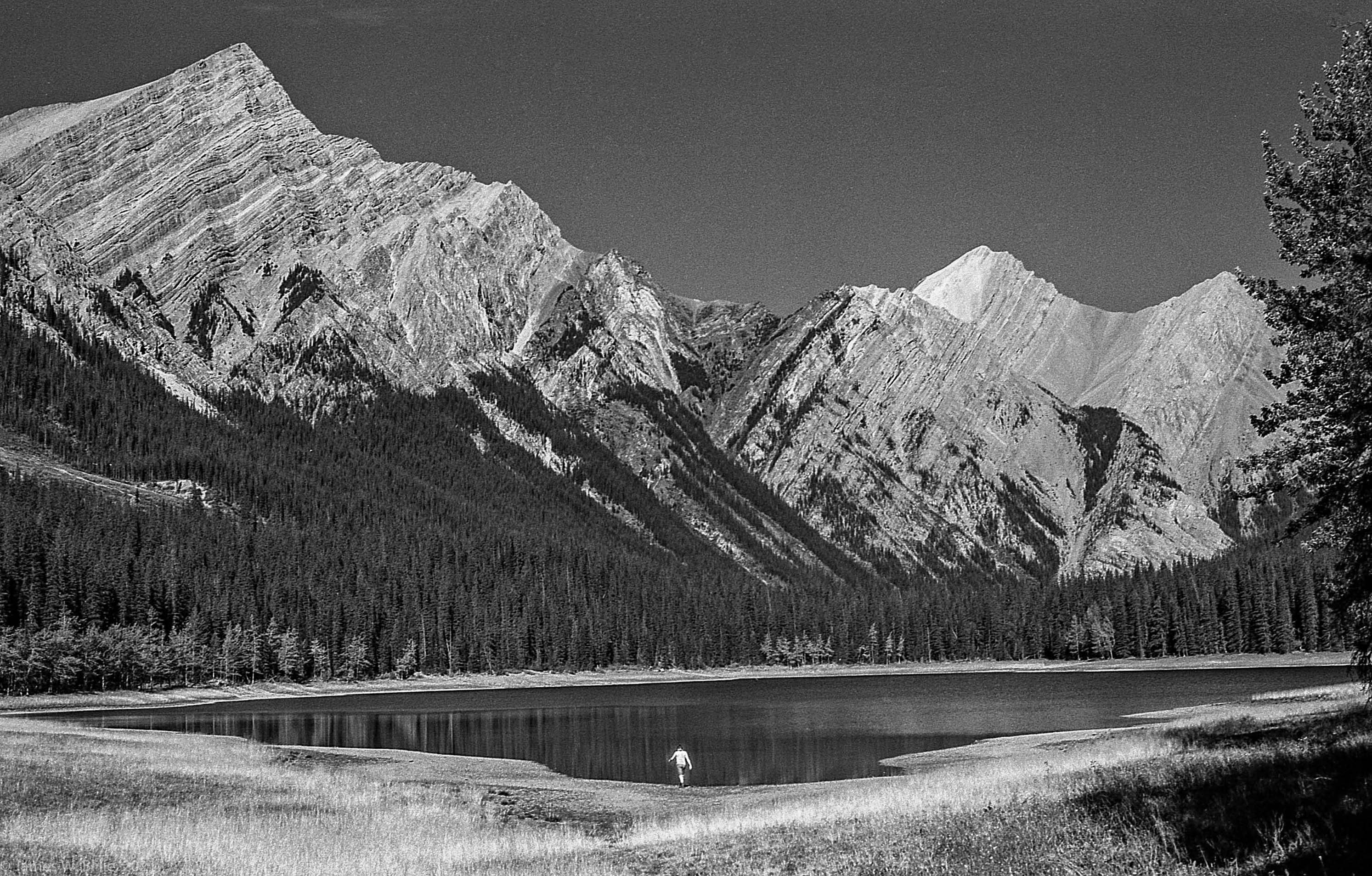
Mount Robson from Berg Lake at dawn. One of the great mountain views of the world. I lugged the Rolleiflex and a tripod up to Berg Lake. To be young and strong again!:

Next a photo from September 1982, also scanned B&W negative: Taking a break from long canoeing days in the Boundary Waters Canoe Area Wilderness in far northern Minnesota:

Next, a few from my days of mountaineering in my youth, all scans from film originals:
An image I call The Thinker, taken at a camp at around 8200 feet elevation (2500m) on the south side of Mount Stuart in Washington state en route to the summit. 1984,
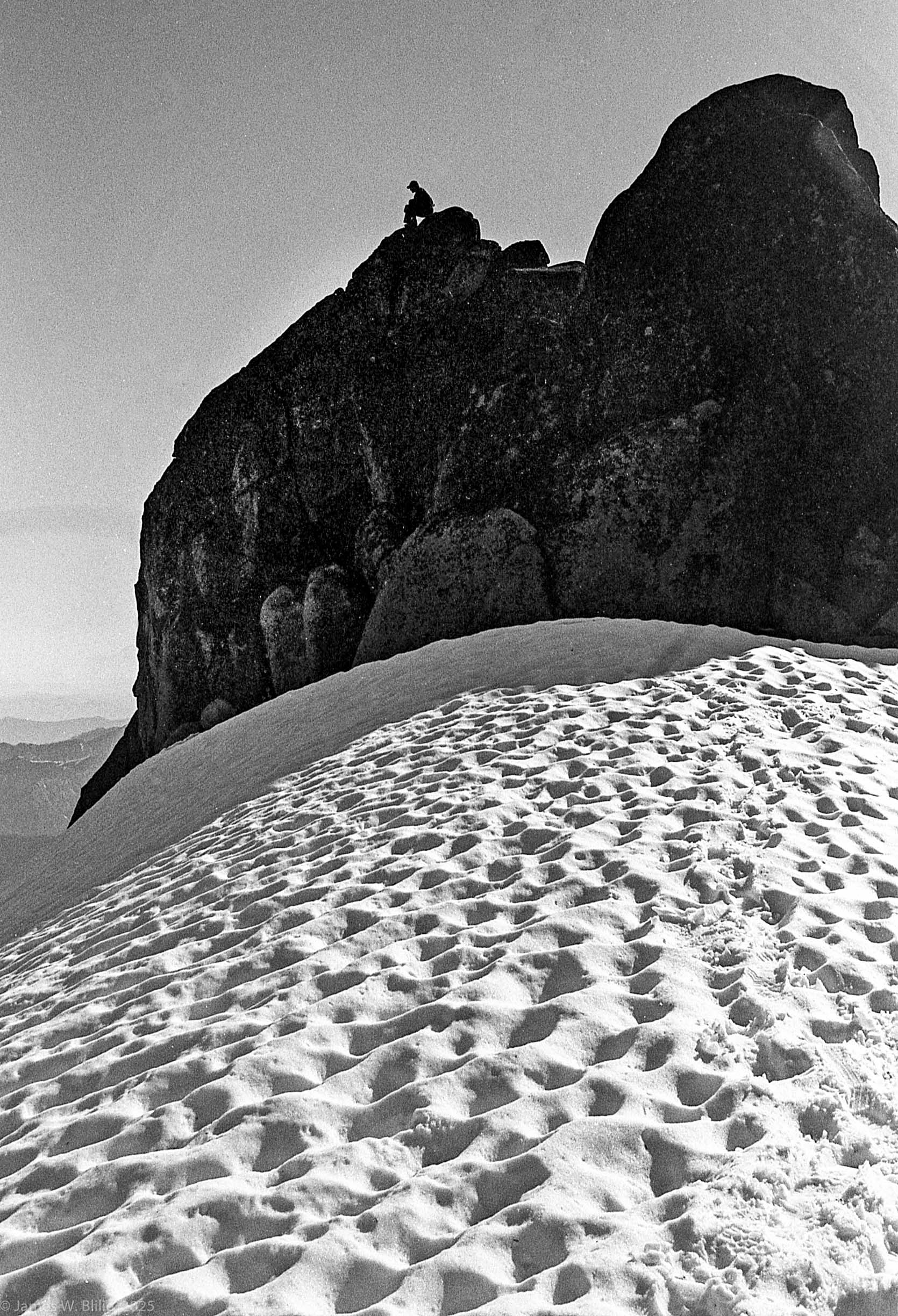
Climbers on the north ridge of Mount Adams, Washington state, with Mount Rainier in the background. 1987. I have climbed Mount Adams, now visible outside my office window, three times, always by the more remote, less-frequented North Ridge:

Climbers on the Easton Glacier on Mount Baker, Washington state, 1989:

Next, a photo taken in Kathmandu, Nepal, 1991, scanned Kodachrome 64:

A photo taken while backcountry skiing in Gairbaldi Provincial Park, north of Vancouver, BC, 1988:

A photo of skating tracks on the frozen pond behind our former home in Minnesota, 2013:

A photo from the Mission San Juan Capistrano, California, February 2023:

Finally, a photo taken in Seattle, in the vicinity of the Ballard Locks, March 2023:

Equipment:
Pentax K-1000, ME Super, and LX cameras and various Pentax M-series and A-series lenses
Rolleiflex 6cm roll film camera with Schneider 75mm f/3.5 lens that my Dad bought in Germany in 1950 and passed on to me in the 1980s
Olympus OM-D E-M5 micro-4/3 camera and various Olympus Zuiko and Leica lenses for that system
Software: Lightroom 5
Scanner: Epson V500 Perfection (current model is V600, I think. An excellent scanner.
China has applied to launch 200,000 satellites, but what are they for?
Follow SpaceX's Returning Crew-11 Mission Wednesday Night
In a historic first, an unspecified medical issue is prompting an early return from the International Space Station on Wednesday night, January 14th. And while the return will be featured live online from undocking to splashdown, if skies are clear, you might just be able to see the pair crossing the night sky tonight, shortly after undocking.
T. rex took 40 years to become fully grown
Three ways to become calmer this New Year that you haven't tried (yet)
We must completely change the way we build homes to stay below 2°C
Sooner-than-expected climate impacts could cost the world trillions
The Surprising Heat of Early Clusters
Astronomers using ALMA have detected the earliest hot galaxy cluster atmosphere ever observed, revealing a massive reservoir of superheated gas in the infant cluster SPT2349-56 just 1.4 billion years after the Big Bang. The gas is far hotter and more pressurised than current theories predicted for such a young system, forcing scientists to completely rethink how galaxy clusters evolved in the early universe. This discovery suggests that violent processes like supermassive black hole outbursts and intense starbursts heated these cluster atmospheres much earlier and more efficiently than anyone expected, fundamentally challenging our understanding of how the universe’s largest structures formed.
How Black Holes Slowly Starve Galaxies
Astronomers using the James Webb Space Telescope and ALMA have discovered one of the oldest ‘dead’ galaxies in the universe, revealing that supermassive black holes can kill galaxies through slow starvation rather than violent destruction. The galaxy, nicknamed ‘Pablo’s Galaxy’, formed most of its 200 billion solar masses of stars between 12.5 and 11.5 billion years ago before abruptly stopping, not because its black hole blew away all the gas in one catastrophic event, but because it repeatedly heated incoming material over multiple cycles, preventing fresh fuel from ever replenishing the galaxy’s star forming reserves.
When Baby Stars Throw Tantrums
NASA’s Hubble Space Telescope has captured stunning new image of HH 80/81, a pair of objects created when supersonic jets from a newborn star slam into previously expelled gas clouds, heating them to extreme levels. These jets, powered by a protostar 20 times more massive than our Sun, stretch over 32 light years through space and travel at speeds exceeding 1,000 kilometres per second, making them the fastest outflows ever recorded from a young star.
These small lifestyle tweaks can add a year to your life
Pages
